I’m currently in the middle of exam season at my Faculty of Enology in Florence, and I can’t attend all the events that keep appearing in my mailbox. Still, I notice that attention to the topic of “wine and young people” is growing more and more.
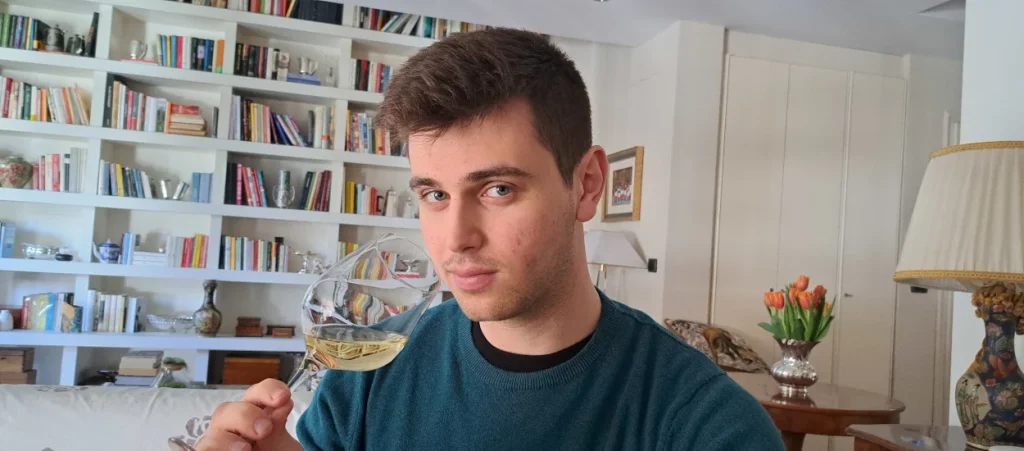
Over the past year I have been working on the project Wining-giovani.it,it, an initiative funded by the Vitamina G grant from LazioCrea, dedicated to spreading wine culture among people under 25. I therefore don’t claim to speak by hearsay, nor do I have the arrogance of speaking “from below” because of my young age. I simply want to share my point of view based on my personal experience.
I would be very happy to receive feedback on what I’m about to say. I believe that discussion with those who I hope will one day be my colleagues can only contribute to my professional growth.
Who could (and should) talk about young people
This is the point I most want to emphasize.
Often, those who speak about young people are no longer young themselves. We affectionately call them boomers, and although in this age group I constantly find—and hope to continue finding—education, information, inspiration, and advice, I think that when the subject is young people, young people themselves should be involved first and foremost.
I believe that the point of view of a 20-year-old cannot coincide with that of a 50-year-old and that, as a consequence, the observation of the current landscape—as well as the initiatives proposed to address it—often suffers from a kind of structural bias.
At many wine events I feel like a fish out of water. Despite my work and dedication to tasting (I’ve tried around 2,000 wines between the ages of 18 and 21, if not more), my participation in the guides of the friends at vinodabere.it,t, my presence at numerous wine events, and my studies in enology, aside from those who already know me, when I introduce myself I often receive a kind of “rookie’s welcome.” It’s almost as if a 21-year-old could not possibly belong in “grown-up” situations. And speaking with other young enthusiasts, I’ve realized that this is not a problem that concerns only me.
For this reason, in my view, the first necessity is to ensure a greater presence of young people—young in age, not just young at heart (we appreciate you, but in this case you don’t count)—at wine events, especially those where ideas can be shared as well as wine.
Wine and young people
With a few exceptions, wine does not have the same appeal for young people as beer or spirits. In bars and clubs it is quite rare to see someone under 25 asking for a glass of wine: beer or cocktails are considered more appropriate and more fashionable.
This is a matter of habits, communication, and, as we will see later, language. Young people want to have fun and, at the moment, wine is not perceived as fun, nor is it associated with other forms of entertainment.
Tasting
Let’s imagine we have managed to place a group of twenty-year-olds in front of a glass of wine and asked them to smell it. “What do you smell?”
But what could they possibly smell if they were (like many of us) born and raised in cities, where our noses are used to everything except the aromas we might find in wine?
In my project we started with an olfactory contest. We thought that the chances of getting a meaningful answer to the question “What do you smell?” could only increase by first “awakening” the sense of smell—helping people understand the difference between rosemary and sage, between vanilla and a flower.
Only then, by moving our senses away from the monotony of the city, can we begin to trigger a process of exploration, curiosity, and appreciation for what is in the glass.
Language
What I often hear is that we simply need to change the language we use. Yes, that is important—but it is not enough.
The technical language of wine is essential in professional contexts, but it tends to create distance when the target audience is young people—or more simply anyone who is not deeply involved in the wine world.
I’d like to conclude this section by recalling an old video by Antonio Albanese, in which a sommelier is parodied and pushed to the extreme. It’s a short and very funny scene—highly recommended. But if even satire plays on that overly solemn way of speaking, there must be a reason.
Or perhaps the real question is this: shouldn’t we speak in technical and refined terms when we are in a professional setting, and in a simple, accessible way when addressing people who are not professionals?
Perhaps these are the questions that those working in the wine world should start asking themselves. Because in a world where the only constant is change, the first thing that must change is the way we approach the new.