In Rome, the Istituto Grandi Marchi honours an Italian journalist for the first time. But the evening dedicated to Daniele Cernilli becomes, above all, an opportunity to reflect on how to communicate wine to younger generations, through education, new approaches to communication and generational renewal.
Perhaps the challenge facing wine today is not simply finding new consumers. It is finding the right words to speak to them.
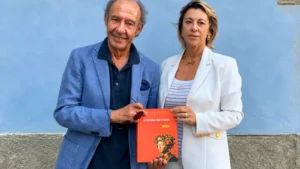
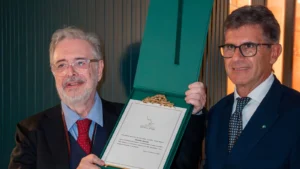
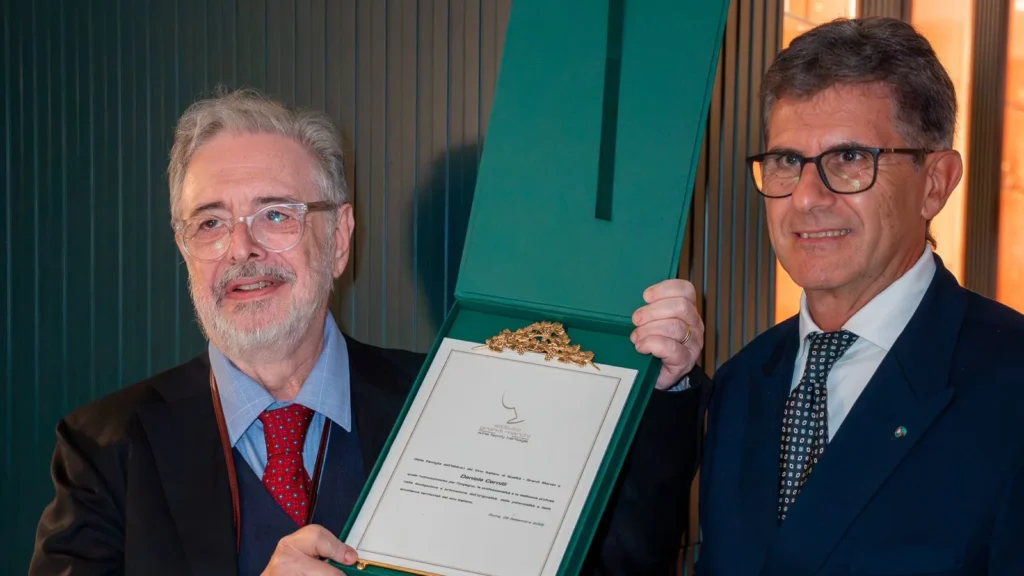
This was one of the clearest themes to emerge in Rome during the annual gathering of the Istituto Italiano Grandi Marchi, which this year presented its award to Daniele Cernilli. For the first time, following international figures such as Burton Anderson, Jens Priewe, Monica Larner, James Suckling and Isao Miyajima, the award recognising outstanding contributions to wine communication went to an Italian.
It was a decision that inevitably shifted the conversation beyond the celebration of an individual career. Cernilli, co-founder of Gambero Rosso and the driving force behind DoctorWine since 2011, has witnessed more than forty years of transformation in Italian wine, observing not only its rise in quality and international recognition but also the gradual evolution of the way it is communicated.
And it was precisely on this subject that, during the evening at Rome’s Vizio Rooftop Restaurant, the award took on a significance that felt less ceremonial and far more relevant to the present.
“I’m very happy, and proud too,” Cernilli says, emphasising the particular significance of being the first Italian to receive the award. But he quickly shifts the focus from the recognition itself to the profession. And, above all, to how that profession needs to change.
“We need to move from the world of storytelling to the world of asking,” he says.
It is a phrase that captures a very specific vision: moving away from using expertise to create distance between those who communicate and those who listen, and returning instead to the idea of wine journalism as, first and foremost, a service to its audience.
“We shouldn’t intimidate readers and wine enthusiasts by overwhelming them with displays of supposed expertise. We should try to put ourselves at their service. After all, our profession is about reporting and sharing knowledge.”
His remarks touch on one of the industry’s most sensitive issues: its relationship with younger generations. As drinking habits change, alternatives multiply and wine sometimes appears to communicate through codes understood mainly by those already familiar with it, the challenge is not necessarily to persuade young people to drink wine, but to make the world of wine less intimidating for those who may wish to explore it.
“Young people are less interested in wine today because we’ve made it too complicated,” Cernilli observes. “We need to become understandable again and put ourselves at the service of everyone’s knowledge and curiosity. We need to answer the questions of those who want to discover wine. We don’t need to prove how clever we are.”
This was probably one of the evening’s most thought-provoking reflections. For years, the wine industry has invested heavily in storytelling, building narratives around bottles that evoke places, families, vintages and grape varieties. It has been an essential part of the cultural development of Italian wine. Yet when any form of communication becomes too rigid or self-referential, it risks turning into a barrier.
The same need to rethink communication emerges, from a different perspective, in the words of Piero Mastroberardino, president of the Istituto Grandi Marchi. The award presented to Cernilli, he explains, is part of an annual gathering intended not only as a celebration but also as an opportunity for discussion and future planning.
“It’s an opportunity to come together, refocus on some of the major issues facing our association and recognise individuals who have made an extraordinary contribution to the world of wine.”
But, above all, it is an opportunity to look ahead. And the project in which the Institute is currently investing most strongly concerns the younger generations of the families behind its member wineries.
“Our first project, which began a few years ago but is still taking shape, is our young members’ group,” Mastroberardino explains. “These are our sons and daughters who are joining the family businesses, completing their studies or already working within them. They bring different ideas, creativity and perspectives, helping us redefine the formats of our events and the way we communicate about wine.”
This is therefore about more than a generational transition within family businesses. It is a dialogue between different ways of perceiving and presenting the same product. “Their ideas are a godsend,” Mastroberardino adds. “They’re bringing us fresh inspiration and new energy.”
Generational change in the wine industry is, after all, almost always a delicate balancing act. On one side lies a heritage built over time, encompassing territories, reputations, international relationships and established winery identities. On the other is a consumer whose habits are changing rapidly, who uses different tools and who often no longer identifies with some of the conventions through which wine has communicated over recent decades.
“The challenge is not to discard the values we have established while, at the same time, remaining open to the opportunities that arise,” Mastroberardino explains.
The objective, therefore, is to find common ground between “our view of the world, which could be described as belonging to yesterday or today, and the perspective of today and tomorrow represented by the younger generations.”
This dialogue also extends to international markets. The Institute, which brings together eighteen historic Italian wine producers, continues to maintain the international outlook that has characterised its activities since its foundation.
“Every year, we schedule visits to emerging markets, sometimes even relatively small ones, where we go to explore, understand consumer behaviour and discover what people expect from us,” Mastroberardino explains.
He sums up this approach with a particularly vivid image: “The Istituto Grandi Marchi has always been a trailblazer. Where no road existed, we’ve carved out paths with a machete through the jungle. And that’s something we want to continue doing.” Perhaps this is precisely where the perspectives of Cernilli and Mastroberardino meet.
Exploring new markets inevitably means exploring new ways of communicating. And reaching people who do not belong to wine’s traditional audience requires something more than simply producing more stories.
It requires listening.
The award presented to Cernilli was created to celebrate those who have contributed to spreading Italian wine culture around the world. In the Institute’s own explanation of the award, the quality of wine communication is recognised as an integral part of promoting and enhancing Italy’s winemaking heritage.
Yet, paradoxically, the message emerging from Rome seems to suggest that the next chapter may require less determination to tell stories and a greater willingness to understand the questions being asked by those listening.
Because wine remains as complex and fascinating as ever. There is no need to diminish that complexity.
What matters is ensuring that complexity does not become a language understood by only a select few.