The Abruzzo cooperative is supporting the Abruzzo, Lazio and Molise National Park by contributing to the purchase of radio collars used to monitor the Marsican brown bear. The initiative accompanies the redesign of the organic Animaletti range and aims to turn the label into something more than a graphic element.
A bear on a wine label can be just an image. Or it can become the starting point for a broader story, one in which wine reconnects with the territory it comes from not only in productive terms, but also through its environmental and social dimension. This is the path Cantina Tollo has chosen with the project linked to its Animaletti range, using the recent bottle redesign as an opportunity to provide tangible support for the protection of the Marsican brown bear carried out by the Abruzzo, Lazio and Molise National Park.
The cooperative will contribute to the purchase and refurbishment of satellite radio collars used to monitor the animals’ movements. These devices allow researchers to collect information on the areas frequented by the bears, track their movements and gather essential data for the conservation of one of the most symbolic species of the central Apennines.
It is no coincidence that the project comes from a cooperative winery. Francesca Palmitesta, Head of Marketing and Branding at Cantina Tollo, places particular emphasis on this aspect when explaining the meaning of the initiative.
“A cooperative winery has in its DNA the principle of giving back to the territory what the territory gives to us,” she explains. “From this year, we have decided to support the National Park through a donation dedicated to the purchase of radio collars for monitoring the Marsican brown bear.”
A simple idea, but one that shifts the perspective. Territory is not only soil, climate, vineyards and denominations. It is a far more complex system made up of ecosystems, communities, landscapes and biodiversity. And if wine increasingly uses words such as sustainability and identity, the decisive step is the one that turns statements into concrete action.
The partnership with the Park fits precisely within this approach. Cantina Tollo, founded in 1960 and built around the shared work of its winegrower members, sees the initiative as part of a broader responsibility towards Abruzzo and its natural resources. An approach the cooperative also links to its sustainability journey, certified according to the Equalitas standard.
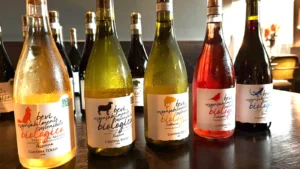
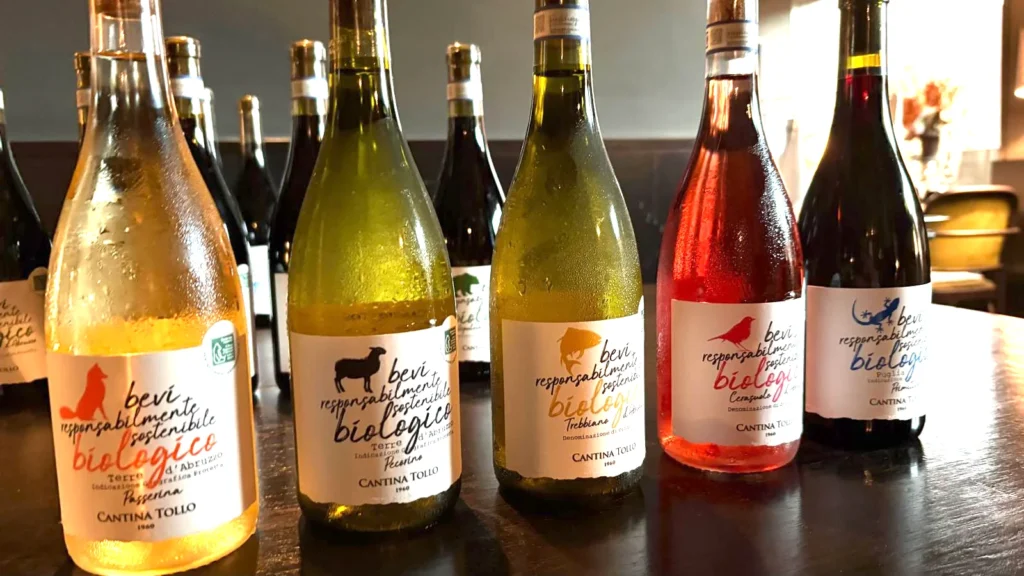
At the same time, the project reaches the shelves through the redesign of the organic Animaletti range, which includes Montepulciano d’Abruzzo PDO, Cerasuolo d’Abruzzo PDO, Trebbiano d’Abruzzo PDO, Pecorino and Passerina Terre d’Abruzzo PGI, and Primitivo Puglia PGI. The new labels feature a seal highlighting the collaboration with the Abruzzo, Lazio and Molise National Park.
This is probably one of the most interesting aspects of the initiative: using packaging not only to distinguish a product, but also to introduce the person buying it to a story about the territory.
“We wanted to link the project to the Animaletti range, which has recently undergone a redesign,” Francesca says. “The bottles will carry a seal showing the collaboration between Cantina Tollo and the Park.”
It is a choice that gives the name of the range itself a less decorative meaning than it might initially suggest. The “Animaletti” thus become a reference to real biodiversity, embodied in Abruzzo by one of its most fragile and recognisable symbols: the Marsican brown bear.
The collaboration, however, does not end with the radio collars. Cantina Tollo will also be a technical partner of the International Bear Association Conference, scheduled to take place in Pescasseroli from 20 to 25 September 2026. The event will bring scientists, researchers, institutions, NGOs and communities involved in bear conservation from different parts of the world into the heart of the Park.
Gianluca Orsini, President of Cantina Tollo Group, places the project within a broader vision in which the cooperative’s role goes beyond production alone: an organisation capable of generating economic value while also maintaining a close relationship with local communities and the environmental heritage of the area.
It is a perspective shared by the Park as well. According to Giovanni Cannata, Commissioner of the Abruzzo, Lazio and Molise National Park, conserving a species such as the Marsican brown bear cannot be the responsibility of protected areas alone, but requires alliances with businesses, institutions and other organisations operating across the territory.
Perhaps this is where the Animaletti project finds its most interesting meaning. Not so much in the seal placed on a bottle, but in the attempt to connect two forms of heritage that belong to the same landscape: the agricultural and the natural.
Because talking about territory in wine inevitably also means talking about what lives around the vineyards, the communities that cultivate them, the forests that border agricultural land and the natural balances that make those places recognisable.
In this sense, the Marsican brown bear does not become the ambassador for a wine range. It remains what it is: a rare and fragile presence in the Apennines. But precisely for that reason, it can remind us that behind a bottle lies a territory far greater than the vineyard from which it comes.