From the almost rosé-like Sorbara to the darker, more tannic Grasparossa, Lambrusco is far more than a sparkling red wine from Emilia. Behind one of Italy’s best-known wine names lies an entire world of grape varieties, territories, styles and interpretations. Today, what Lambrusco needs most is to be recognised and appreciated for what it truly is.
For years, Lambrusco has perhaps paid the price of its own success. An instantly recognisable name, an enormous international presence and an easy-drinking appeal that has made it popular far beyond the borders of Emilia. Yet this very popularity has often led to its identity being oversimplified, reducing a complex and diverse wine category to the generic image of a pleasant, uncomplicated, lightly sparkling red.
In reality, a journey through the Modena countryside is enough to reveal just how incomplete that picture is.
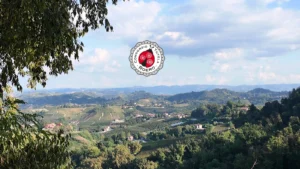
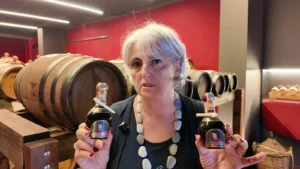
“Lambrusco is an incredibly diverse world,” Daniela Vaschieri explains as we stand among the vineyards of Castelvetro di Modena. “In the province of Modena alone, we have four DOC appellations: Modena, Sorbara, Salamino di Santa Croce and Grasparossa di Castelvetro.”
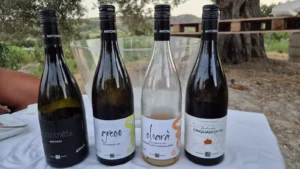
Even within these appellations, colour, structure and character can vary dramatically. Sorbara can display such a pale hue that it almost resembles a rosé, accompanied by a striking sense of freshness. Grasparossa di Castelvetro, by contrast, moves towards deeper colours, greater body and a much more pronounced tannic structure.
Looking beyond Modena, the protected appellation system encompasses six denominations across the provinces of Modena and Reggio Emilia: Modena DOC, Lambrusco di Sorbara DOC, Lambrusco Grasparossa di Castelvetro DOC, Lambrusco Salamino di Santa Croce DOC, Reggiano DOC and Colli di Scandiano e di Canossa DOC. Together, the two provinces have approximately 16,600 hectares under vine, around 10,000 of which are dedicated to Lambrusco. In 2025, production reached approximately 32 million bottles of Lambrusco DOC, alongside a further 86 million bottles of Lambrusco Emilia IGT.
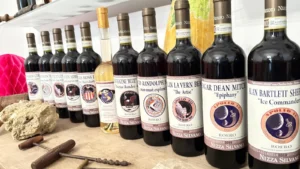
Even referring to “the Lambrusco grape” in the singular is, in itself, an oversimplification. The name actually identifies a family of twelve red grape varieties: Sorbara, Grasparossa, Salamino, Foglia Frastagliata, Barghi, Maestri, Marani, Montericco, Oliva, Viadanese, Benetti and Pellegrino. This biodiversity inevitably translates into diversity in the glass.
“We go from Sorbara, which is extremely fresh and pale in colour, all the way to Grasparossa, where the tannins are much more pronounced and the must is considerably darker,” Daniela explains. “Yet it remains a lightly sparkling wine, with relatively low alcohol content.”
It is precisely this combination of freshness, gentle bubbles and moderate alcohol that offers one of the most interesting opportunities to reinterpret Lambrusco today.
At a time when the wine world is debating dealcoholisation, mindful consumption and the growing demand for lighter wines, Lambrusco has always possessed many of the qualities that contemporary consumers increasingly seek: approachability, freshness, conviviality and versatility at the table.
“We believe we already have the perfect product,” Daniela observes. “Lambrusco is low in alcohol, it has bubbles, and it is immediately enjoyable. There is hardly an occasion when you couldn’t open a bottle. For us in Emilia, above all, it is a wine that brings people together.”
Yet conviviality does not necessarily imply simplicity in production or standardisation. And this is probably where one of the most important challenges for Lambrusco’s future lies.
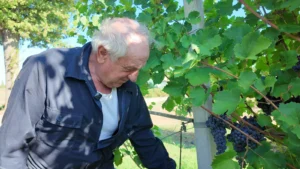
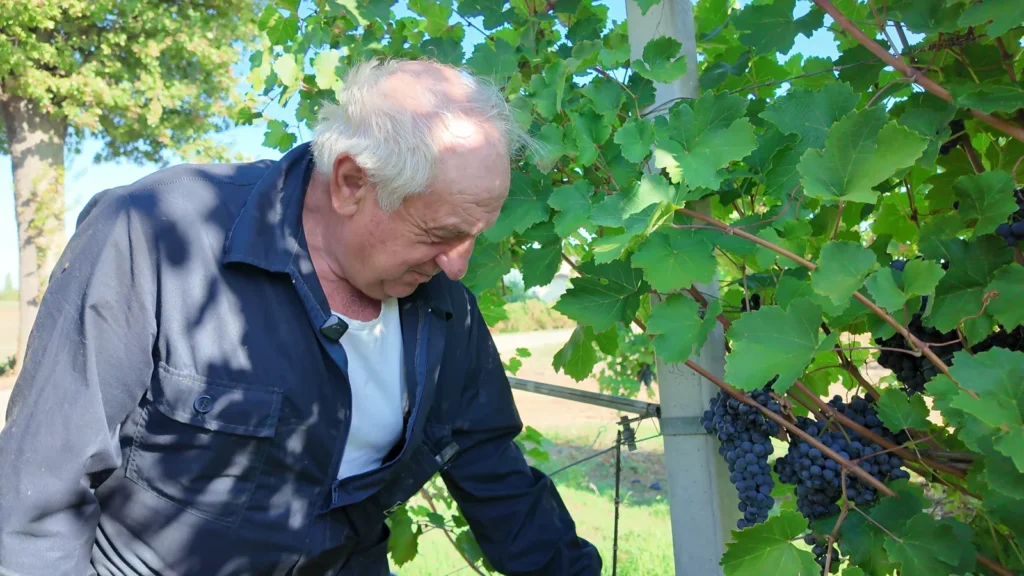
“Outside Emilia, there is still sometimes a perception of Lambrusco as an industrially produced wine,” Daniela continues. “In reality, there are many producers who are deeply committed to quality, starting in the vineyard. To make good wine, you first need good grapes.”
An apparently obvious statement, but one that reveals much about the transformation that has taken place in recent years. Improvements in quality begin with vineyard management, grape selection and even economic incentives that reward growers who choose to work to higher standards.
“At the winery where I am vice-president, we decided some time ago to offer substantial premiums for DOC grapes. The difference compared with non-DOC grapes can exceed twenty euros per 100 kilograms. In this way, our member growers have supported a decision that we consider fundamental: focusing on quality.”
Quality is probably the word that will carry the greatest weight in shaping Lambrusco’s future reputation.
Its strength in terms of production volumes is already clear. Lambrusco is exported to more than 90 countries, and approximately 60% of total production, including DOC and especially IGT wines, is sold outside Italy. Major export markets include the United States, Mexico, Germany, France, Spain, Eastern European countries and several markets in Central and South America.
Yet alongside these established destinations, less obvious opportunities are emerging. Daniela describes, for example, her company’s experience in Japan, which has become one of its key markets.
“People discovering Lambrusco for the first time often begin with the sweeter styles. But we have invested in helping them understand the wines, and today dry Lambrusco has also become a central part of our importer’s business.”
This shift is particularly revealing because it reflects the international evolution of the category: from a wine primarily associated with sweetness and easy drinking to one capable of complementing cuisines far removed from Emilia’s culinary traditions.
The explanation probably lies in its very structure.
“The freshness and low alcohol content work extremely well with international cuisines, particularly spicy dishes and those featuring sweet-and-sour flavours,” Daniela continues. “The bubbles help cleanse the palate of richness and create a particularly interesting balance.”
This potential has been explored in recent years through dinners specifically designed around pairings between Lambrusco and international cuisines, as well as through gastronomic combinations that might initially seem less traditional.
“We brought Lambrusco to London and paired it with gourmet pizza,” she recalls. “But it really can work with so many different cuisines.”
Versatility, after all, is one of the defining characteristics of Lambrusco production. Approximately 90% consists of frizzante wines, but there are also sparkling wines produced using the Martinotti and Traditional Methods, as well as dry and semi-sweet styles. It is a range capable of accompanying an entire meal, from aperitif to dessert.
And perhaps this is precisely where Lambrusco can find a renewed contemporary relevance. Not necessarily by changing its identity, but by communicating more effectively the identity it already possesses. As part of the wine market moves towards lower-alcohol wines, more dynamic styles, greater versatility with different cuisines and less formal drinking occasions, Lambrusco can offer characteristics that have always been part of its history.
The decisive step, however, will be to move beyond the idea that approachability means a lack of complexity or distinction.
“Lambrusco is youthful, fresh and brings people together,” Daniela concludes. “You can drink it in any season and pair it with practically any food. But above all, it can be a wine of outstanding quality.”
And perhaps that is the real challenge for the coming years: not convincing the world to drink Lambrusco, because the world is already drinking it. Rather, helping people understand just how many different Lambruscos exist behind that single name.