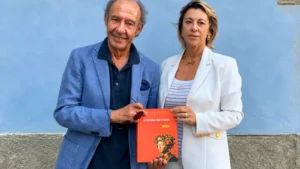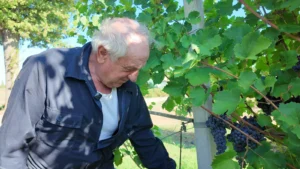
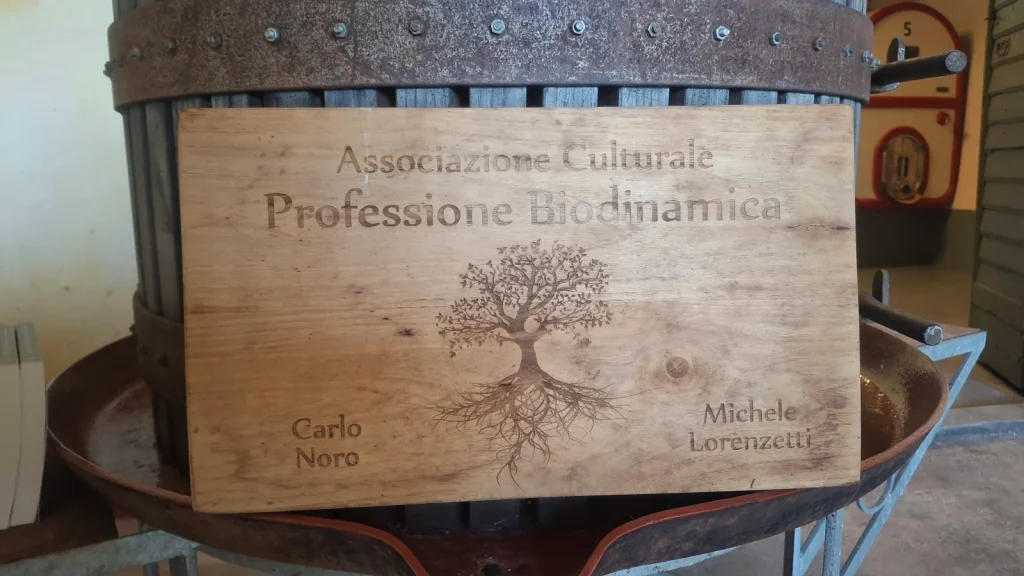
I still have in my mind the image of Michele Lorenzetti bending down, picking up a handful of soil, holding it in his palm and then studying it thoughtfully as he slowly lets it run through his fingers. There is nothing theatrical about the gesture, no ostentatious rituality, only a precise, almost instinctive movement belonging to someone who does not observe the land from the outside but knows its most intimate grammar. It was in that moment, far more than through his words, that I began to understand what practicing biodynamics in Gattaia truly means.
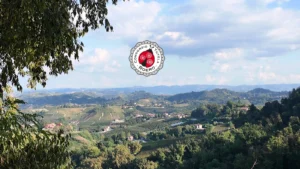
Vicchio, for its part, needed no introduction. As soon as the road began winding through the hills of Mugello, the landscape ceased to be merely a landscape. For me, remembering the summers my grandmother spent in Luco di Mugello, arriving at Terre di Giotto was not simply a press tour—it was a return. And some returns possess an almost cruel precision: they bring you face to face with parts of yourself that you thought had long fallen silent.
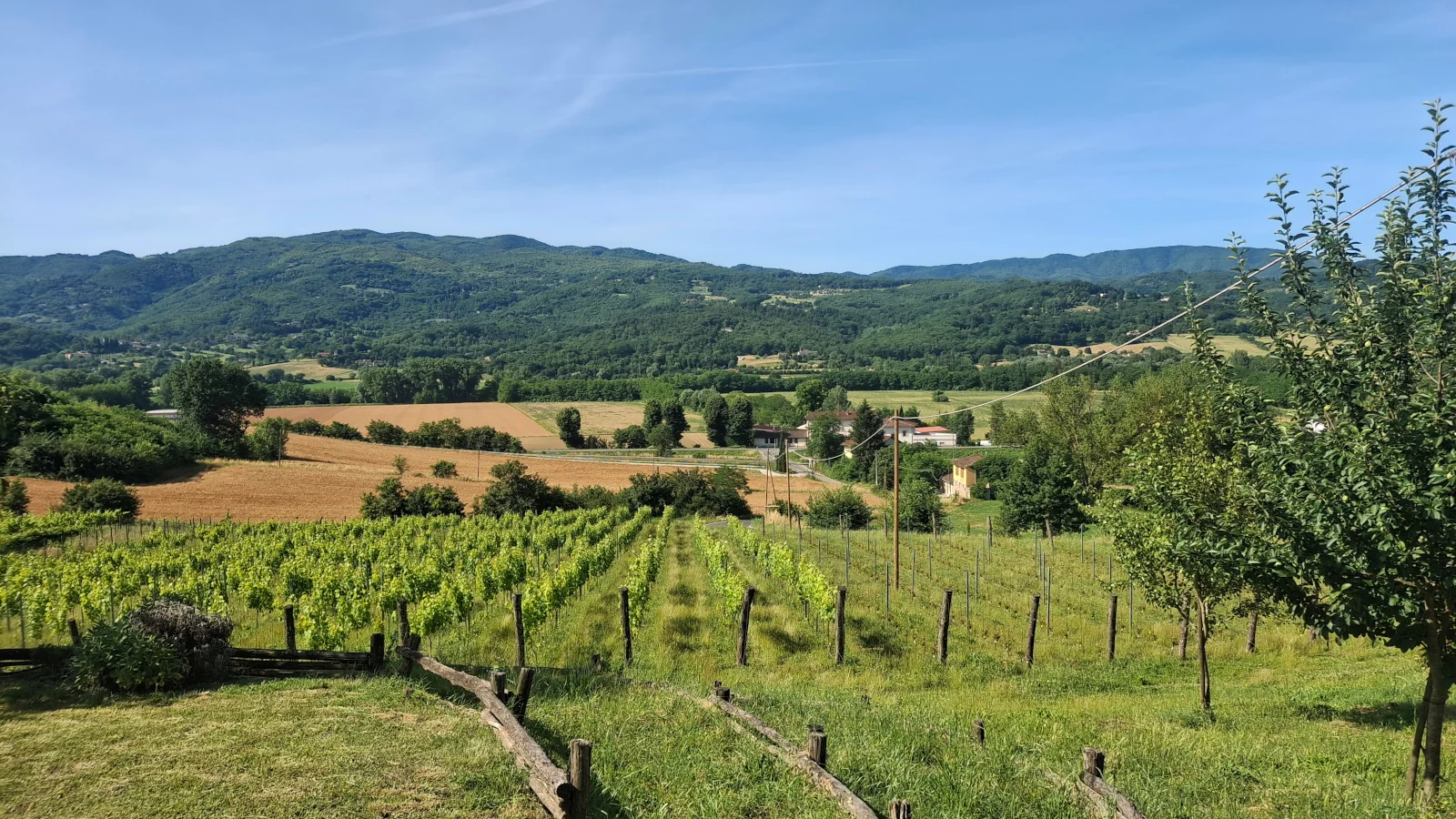
Standing in the estate’s garden, looking out over the horizon while the breezes swept gently across the soft hills of the Tuscan Apennines, I could hear once again the laughter of the little girl I had been running through those meadows. In that instant, my connection to this land became immediate, almost visceral. It was also the moment when I began to understand the profound relationship Michele Lorenzetti has built with this place.
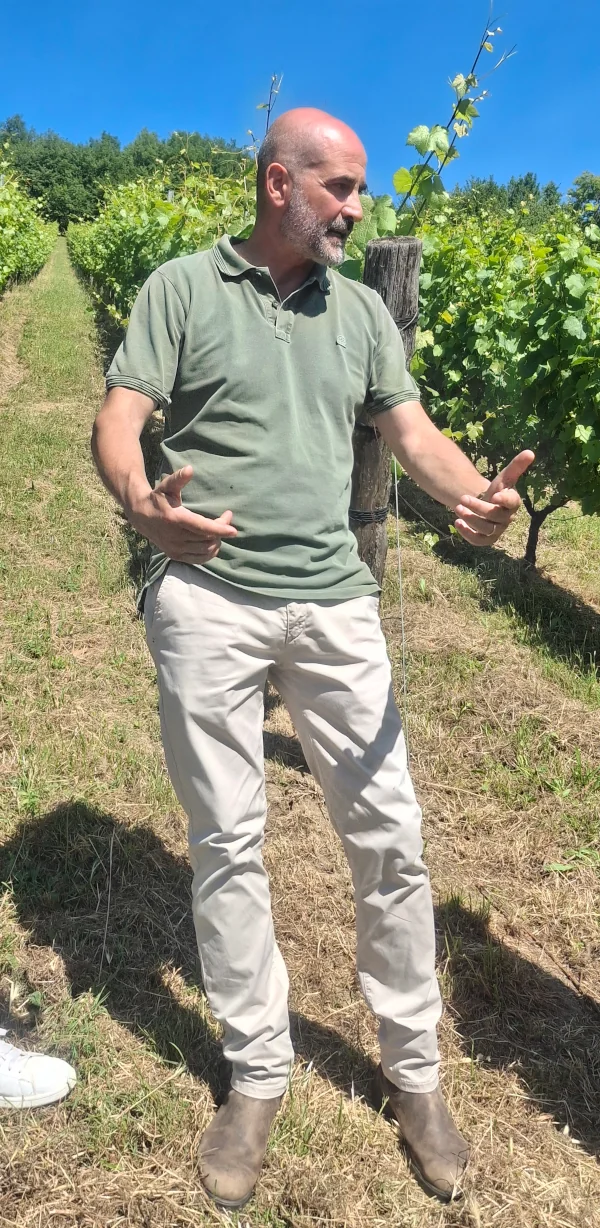 A biologist, oenologist and winegrower, and a consultant in biodynamic viticulture since 2004 for some of the most interesting estates in Europe, Michele escapes every cliché associated with the biodynamic world. Perhaps that is precisely what makes him so compelling. There is no trace in him of the dogmatic mysticism that often accompanies biodynamic narratives. His approach is practical, rational and deeply rooted in observation and verification. Michele does not romanticize nature. He studies it, listens to it, challenges it, and above all, respects it.
His decision to plant a vineyard in Gattaia in 2006 was as radical as it was lucid. After the phylloxera crisis, Mugello had largely disappeared from the map of contemporary Tuscan viticulture. Yet Michele saw something here that others did not. He was searching for a place elevated, light-filled, ventilated and defined by strong diurnal temperature shifts—a balance capable of lifting the vineyard above the fog, in every sense of the word.
He found it between 500 and 600 meters above sea level, on ancient, shallow soils rich in stones, calcareous clays, sandstones and schists. An austere terroir capable of naturally limiting yields while producing wines deeply marked by their pedoclimatic identity.
And here comes his most unconventional intuition: telling the story of Mugello through grape varieties that, at least on paper, seem to belong elsewhere.
Chenin Blanc. Riesling. Pinot Noir.
These varieties were chosen not to imitate French or Central European models but because of their extraordinary ability to interpret and express place. What Chenin, Riesling and Pinot Noir share is transparency. They are varieties incapable of lying. If terroir exists, it emerges clearly. If it does not, the wine becomes empty.
Within this context, Michele’s vision of biodynamics ceases to be merely an agricultural theory and becomes something more subtle.
It is not about “talking to plants” in the simplistic sense of the expression; that would do him a disservice. What I perceived while observing him in the vineyard was instead a process of mutual education. Over time, the vine develops a biological memory of the place and of the balance that the grower builds around it. The winegrower does not impose; he accompanies, suggests and creates the conditions for the vine to learn how to react, adapt and find its own equilibrium.
You can see it in the way Michele brushes against the shoots, observes the developing clusters, picks up the soil and lets it run through his fingers. Grand declarations are unnecessary. The gestures are enough.
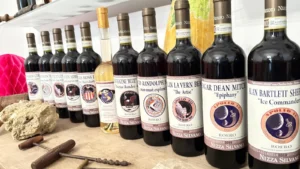
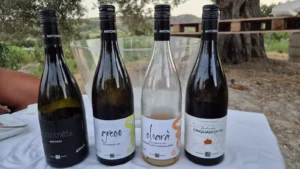
After the vineyard visit, we moved into the covered courtyard, where the glasses were already lined up. There began our journey through Gattaia—not a dialogue among professionals intent on dissecting wines, but among people who live wine, respect it and still know how to be moved by a glass.
The first vertical tasting focused on Gattaia Bianco, made from Chenin Blanc, one of the Loire Valley’s most transparent interpreters of terroir. If there is one word that defines Terre di Giotto’s Chenin, it is tension: not simple freshness, but an architecture built around acidity that becomes the structural backbone of the wine.
In its finest expressions, this Chenin recalls the drive and ageing potential of great Vouvray and Montlouis-sur-Loire wines, where the variety reaches some of its noblest forms. Yet at Gattaia the narrative changes. The chalky verticality typical of the Loire is overlaid with a distinctly Mugello signature of helichrysum, wild calamint and Mediterranean balsamic notes.
The 2023 vintage, produced using whole-cluster French-style pressing, immediately revealed itself as a manifesto of the wine’s potential. Vibrant gold in color, it opens with broom flowers, ginger, saffron, ripe pineapple, loquat, wild calamint and helichrysum. On the palate it is lean and dynamic, crossed by a pink-grapefruit acidity that propels the wine toward a savory, citrus-driven finish with a gentle bitter edge.
The 2020 and 2019 vintages reveal a more textural side of Gattaia’s Chenin, with greater phenolic richness, depth and balsamic complexity. Notes of cedar, resin, wet stone and Mediterranean scrub emerge clearly. Here, salinity is not merely a finishing note; it becomes substance, volume and texture. Yet acidity remains the keystone, cutting through the palate like a blade and restoring balance.
The 2014 may be the most extreme interpretation in the lineup. A rainy vintage marked by pre-maceration, it displays an almost amber hue reminiscent of orange wine. Pine resin, ripe yellow fruit, saffron and white pepper introduce a dense, rich palate that remains surprisingly alive.
Then comes the 2009, the inaugural vintage, offering a measure of this wine’s longevity. The bouquet speaks of time through apricot preserves, bitter orange, cedar and candied ginger, yet the palate astonishes with its youthful vitality. The acidity remains vivid, sharp and luminous. Rather than weighing the wine down, time has sculpted it.
The second flight focused on “Massimo” Riesling, perhaps the white wine that best embodies Michele’s stylistic precision. If Riesling is one of the greatest interpreters of terroir thanks to its ability to unite acidity, minerality and longevity, at Gattaia it finds a distinctly Apennine expression.
While the great Rieslings of the Mosel often express tension through delicacy and filigree-like finesse, Massimo follows a different path. Here verticality never abandons substance. In terms of structure, density and mineral precision, it recalls some of the great wines of Alsace or Austria’s Wachau, where rock generates not only lift but tactile depth.
The 2023 opens taut and vertical with notes of wild calamint, wild incense, flint, cedar, ginger and lime. Salinity gives weight to the palate, but it is the citrus-driven acidity that restores balance with surgical precision.
The 2022 shows a fuller and more structured profile, reflecting the warmth of the vintage. Flint takes center stage, accompanied by hints of kumquat, helichrysum and balsamic mint notes. The glyceric richness is evident, yet varietal tension never allows the wine to become heavy.
Among all vintages, the 2020 may be the most representative. Here the Riesling is finely chiseled and sculpted by chalk, flint, lemon thyme and helichrysum. Salinity and lime acidity define the palate like a scalpel. Absolute precision.
The 2019 divided the table. Unlike many colleagues, I immediately perceived a slight lactic imprecision—later confirmed by Lorenzetti—linked to malolactic fermentation. A subtle nuance that, within a biodynamic context, remained both understandable and interesting.
The 2014, aged in barrique due to production necessities, represents the most atypical interpretation. Amber in the glass, it plays between dried orange peel, ginger, nutmeg, smoky notes and barley candy. The oak is perceptible on the palate through hints of cinnamon and sweet spices, yet the wine retains momentum thanks to an acidity that stretches toward mandarin-like echoes.
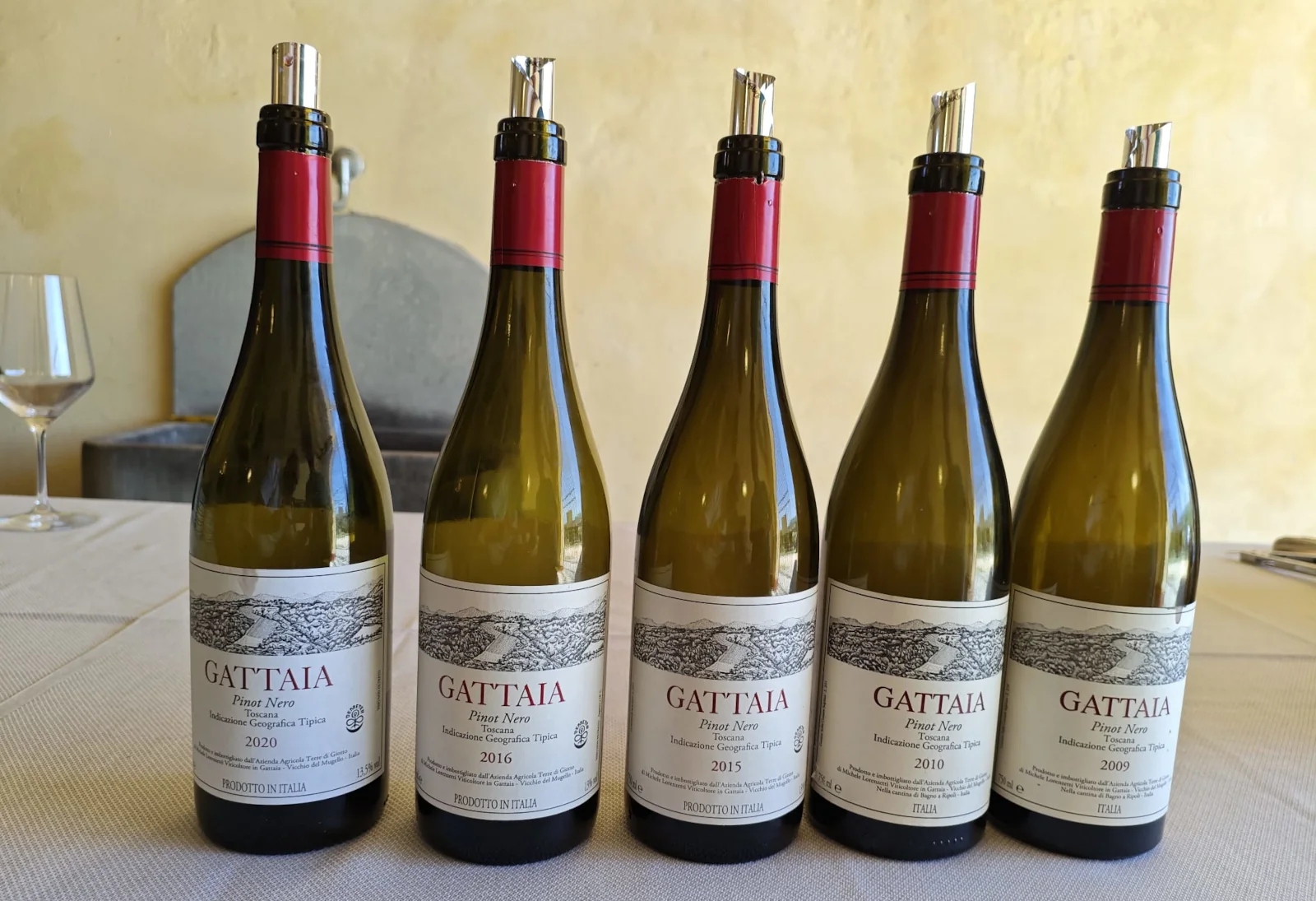
Then comes Pinot Noir, perhaps the wine that most clearly reveals Gattaia’s radical side, precisely because it distances itself from the most canonical reference models.
Where some of Burgundy’s most celebrated expressions are built on whispering elegance, airy finesse and almost weightless texture, Michele’s Pinot follows another trajectory. Here there is more substance, more flesh.
In terms of structure and depth, it recalls the more austere expressions of the Côte de Nuits, such as certain Gevrey-Chambertin or Nuits-Saint-Georges, or even some of the great Pinot Noirs of Oregon’s Willamette Valley, where dark fruit coexists with forest floor and balsamic woodland notes. Yet the use of up to 100% whole clusters takes it beyond any direct comparison. The tannic structure intensifies, the herbal component expands and salinity approaches umami.
At that point, the wine ceases to evoke somewhere else and simply becomes Gattaia.
The 2020, made with 50% whole clusters, already displays this identity. Ruby red with crimson highlights, it opens with bay leaf, resin, cinchona bark, mulberry and cassis. The palate is slender, supported by fine, focused tannins and a gently bitter finish that interacts beautifully with the wine’s saline trail.
The 2016 and 2015 vintages are probably the most radical expressions of Lorenzetti’s Pinot Noir. Here, 100% whole-cluster fermentation amplifies structure, texture and depth. The bouquet turns dark, forest-like and balsamic: eucalyptus, licorice, cinchona, fresh juniper berries, resin, dried mushrooms and tar. The palate is thick and textural, with a tannic-saline framework that almost reaches umami territory.
Perhaps it is precisely here that Gattaia’s Pinot Noir distances itself from classic Burgundian models: less ethereal silkiness, more matter and flesh, yet without sacrificing finesse.
The 2010 and 2009 vintages, produced before the adoption of whole clusters, reveal a different face. The balsamic character becomes more restrained, floral notes of rose and violet finally emerge, while the fruit shifts toward dark cherry and bitter orange. The palate becomes more linear and elegant, yet still retains that distinctive savory and herbal signature that immediately reveals Michele’s hand.
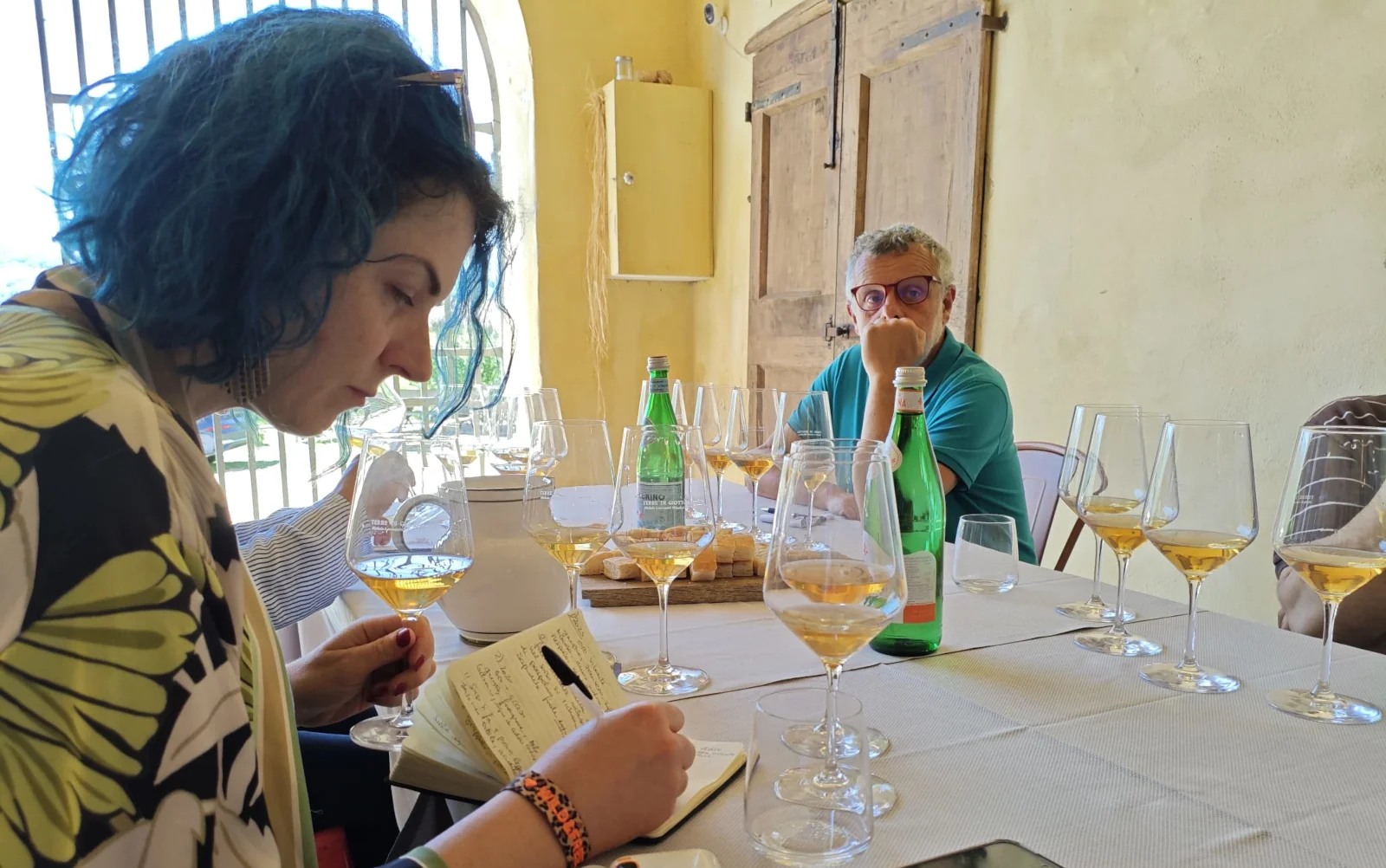
At the end of the tasting, one very precise feeling stayed with me. I found myself thinking that perhaps wine, when truly sincere, is born exactly there—in that invisible space between human gesture and nature’s response.
Perhaps that is why Terre di Giotto’s wines leave such a profound impression. They ask you to stop long enough to listen. And in that act of listening, almost without realizing it, you begin to hear something that goes beyond wine itself—something remarkably close to memory.