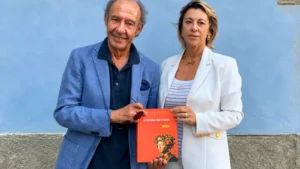
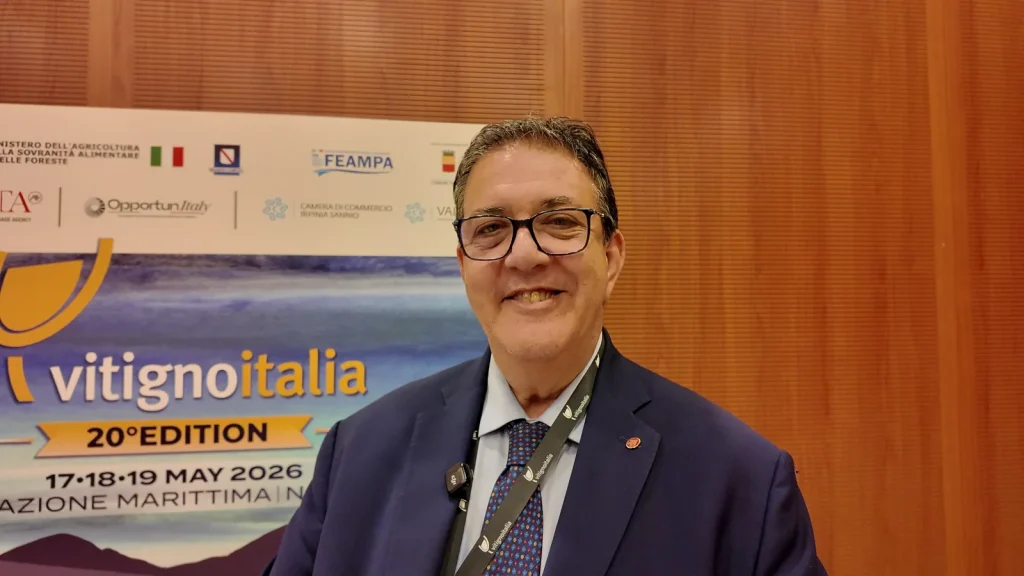
Among the most authoritative voices in Italian food and wine journalism, Luciano Pignataro has spent decades observing the evolution of wine, gastronomy, and regional identities. A journalist, author, and leading commentator on Southern Italy, he was among the first to recognize the cultural shifts that have transformed the way Italians eat, drink, and travel.
On the sidelines of the twentieth edition of Vitigno Italia in Naples, we spoke with him about how the wine world has changed over the last twenty years and the challenges that lie ahead for both producers and communicators.
According to Luciano, the transformation has been profound. It is not simply a matter of changing consumer preferences, but a shift that affects the product itself, the market, and above all the way wine is communicated.
“Everything has changed,” he summarizes. Wines have become more immediate, easier to drink, and more focused on conviviality than they were in the past. At the same time, distribution models have evolved and, above all, digital communication has taken on a central role. Social networks, once seen as a novelty, are now among the main tools through which producers and wineries build relationships with their audiences.
A transformation that has taken on particular characteristics in Campania. For Luciano, the region remains one of Italy’s most interesting wine markets—not only because of the quality of its local production, but also because of the scale of consumption.
With nearly six million inhabitants and a tourism industry that continues to grow, Campania remains a region where demand often exceeds supply. Local wines therefore coexist with an increasingly significant presence of labels from across Italy and abroad, ranging from Champagne to premium red wines, as well as the ever-growing Prosecco phenomenon.
This is also why Vitigno Italia continues to maintain a strong national outlook. Although the event is rooted in Southern Italy, it has become a privileged observatory of Italian wine as a whole, capturing trends, consumer habits, and emerging languages of communication.
And it is precisely on the subject of communication that Luciano offers his most compelling insights.
“Wine communication needs to start again from scratch,” he says without hesitation.
According to the journalist, wine continues to speak through codes that belong to another era. Codes that may have been effective in the past but now risk feeling distant from younger generations. The issue is not merely language itself, but the entire way the narrative is constructed.
For the first time in recent history, he observes, we are faced with generations that master communication tools better than those who came before them. People in their twenties truly understand visual language, timing, and the dynamics of social media. It is they who should be entrusted with imagining the future of wine storytelling.
Luciano Pignataro points to a significant example: Naples’ tourism success. In recent years, the city has managed to free itself from many stereotypes thanks to the spontaneous and direct storytelling of younger generations, who have shown their peers a different side of Naples—one built around experiences, conviviality, landscapes, and quality of life.
Something similar, he argues, should happen in the world of wine.
Today, the sector often continues to communicate in an elitist and insufficiently inclusive way. Wine tastings are frequently perceived as demanding, almost academic experiences. Even the rituals of wine service in restaurants can become intimidating for those who do not possess technical knowledge.
“Wine needs a reset,” is the challenge he puts forward.
It is far from a simple task. Luciano himself openly admits that while he is fully aware of the need for change, he does not necessarily possess all the tools required to interpret it completely. The transition from a predominantly written and descriptive form of communication to a highly visual one demands new skills and new storytelling approaches.
The crucial point is that today people make choices before they seek explanations. First impressions are formed within seconds and often determine the success or failure of a message.
“How do you explain a wine in two or three seconds?” he asks.
It is a question that resonates across the entire industry and one that researchers, communication professionals, and wine experts are actively exploring. A challenge that goes beyond marketing and touches the very way wine culture will engage with future generations.
In this context, events such as Vitigno Italia can offer an effective response. They provide an accessible environment where visitors can approach wine without feeling intimidated, simply for the pleasure of discovery. Masterclasses and in-depth educational experiences remain available for those who wish to delve deeper, but the first encounter with wine should be light, spontaneous, and inclusive.
Because the future of wine, the Neapolitan journalist suggests, will not depend solely on the quality of what is inside the bottle, but on the industry’s ability to find new words, new images, and new languages through which to tell its story. And perhaps, this time, it will be the very young people that the wine world is still trying to reach who will show the way forward.