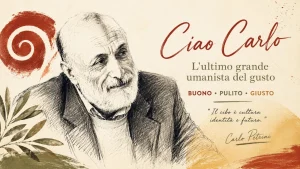
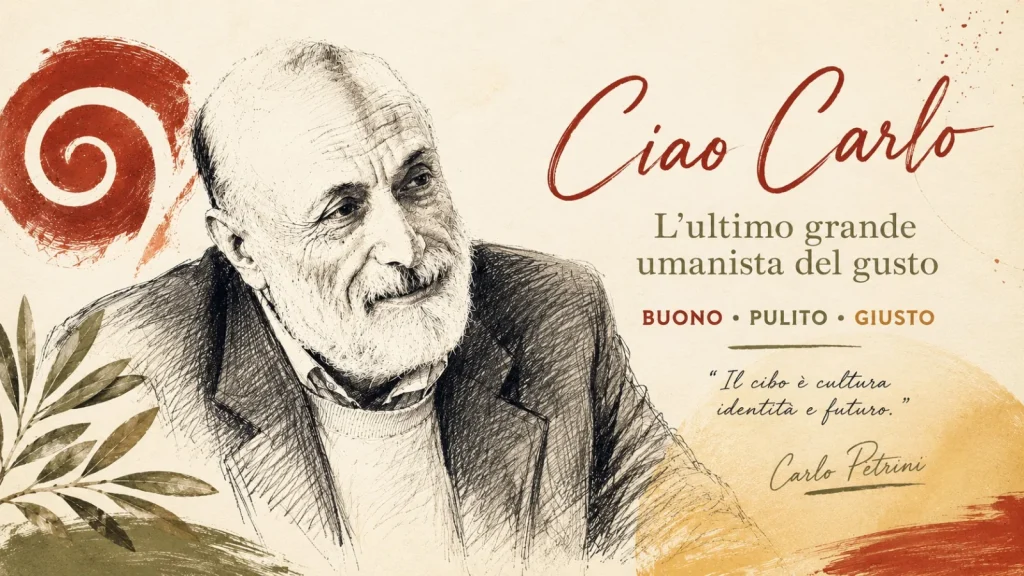
There are men who found movements, and then there are men who change the very vocabulary through which a civilization looks at itself. Carlo Petrini was precisely that: not merely the father of Slow Food, but the man who forced the world to reconsider the deeper meaning of eating.
Before him, food was often consumption, luxury and technique elevated to pleasure. After him, it became memory, identity, social justice, ecology and even cultural resistance. And perhaps his greatest revolution was exactly this: transforming gastronomy from a bourgeois pastime into a moral issue.
To truly understand who “Carlin” was, one must return to Bra, to the slow fogs of Piedmont, provincial piazzas and taverns where wine was storytelling long before it was a beverage. It was there, in 1949, that a man was born who would eventually challenge the global food system without ever losing the accent of his homeland, without ever ceasing to speak the language of farmers, artisans and winemakers.
Petrini did not possess the detached elegance of the academic intellectual; instead, he had the overwhelming strength of great popular storytellers. He could speak to popes and cheesemakers, kings and fishermen, economists and trattoria cooks with the same authenticity. And this is probably why his message travelled across the world: because it did not emerge from abstract theory, but from the earth itself.
The symbolic date of his revolution is 1986. While the world rushed toward the myth of speed, industrialization and compulsive consumption, Petrini performed an almost subversive act: he founded Arcigola, which would later become Slow Food.
It was not merely a gastronomic association. It was a declaration of cultural war.
Three years later, in 1989, the Slow Food Manifesto was signed in Paris by delegations from all over the world. At a time when fast food was celebrated as a symbol of progress, Petrini spoke about slowness, biodiversity, conviviality, producers’ rights and respect for the land. Ideas that, at the time, seemed romantic, yet today appear prophetic.
Because Carlo Petrini had understood far earlier than most that the food crisis would not merely be agricultural or environmental, but would soon become spiritual. He understood that the homogenization of flavours would inevitably produce the homogenization of thought.
He realized before anyone else that destroying an agricultural variety meant erasing a fragment of civilization, and that a farmer forced to abandon the land represented not merely an economic problem, but a collective cultural defeat.
And this is where his figure transcends the boundaries of gastronomy.
Petrini taught our sector a truth too often forgotten: wine, food and cuisine are never ends in themselves. Every food choice reflects a model of society, just as every bottle speaks of landscape, labour, dignity, exploitation or respect.
This is why his impact on food and wine culture was immense. Before Slow Food, the narrative of taste was often dominated by elites, aesthetics and luxury. Petrini placed small producers, marginal territories, forgotten grape varieties and rural economies back at the centre of the conversation.
He restored cultural dignity to farmers in an era that considered them remnants of the past.
“Good, clean and fair.” Three words that became a global manifesto. Apparently simple, yet profoundly revolutionary:
Good, because pleasure is not a sin.
Clean, because gastronomy cannot exist on a devastated planet.
Fair, because there can be no excellence built upon human exploitation.
Within this triad lies perhaps the entirety of Petrini’s thought — and also his greatness.
Yet his most visionary achievement was probably understanding that food deserved academic dignity. With the creation of the University of Gastronomic Sciences — the first university in the world dedicated to an interdisciplinary approach to food — Petrini made a radical gesture, affirming that gastronomy was not folklore, but knowledge.
An intuition that forever changed our sector. For decades, gastronomes had been considered little more than informed enthusiasts. Petrini transformed them into figures capable of interpreting food through history, anthropology, economics, environment, politics, agriculture and culture, giving intellectual structure to what had previously been mere sensitivity.
And then there is Terra Madre. Perhaps his most poetic project.
In 2004, Petrini imagined something that until then had seemed impossible: connecting African farmers, Asian fishermen, South American breeders, European chefs, young agronomists and indigenous communities. Not to create a global market, but a global conscience.
An alternative, human globalization.
In a world dominated by multinational food corporations, Terra Madre gave voice to those who normally had none; not to major brands, but to the last people in the supply chain, those who safeguard seeds, traditions, biodiversity and memory.
And it is impossible not to feel moved by how far ahead of its time this vision truly was. Today we constantly speak about sustainability, ethical supply chains, regenerative agriculture, biodiversity and climate crisis. Petrini was speaking about all of this when such battles still seemed marginal.
And yet, reducing Carlo Petrini to an environmentalist would be a mistake.
Above all, he was a humanist. He loved wine not merely for its taste, but because he saw in every bottle the story of a people; bread because it spoke of labour; taverns because they preserved stories and human relationships. More simply, for Petrini, food was the place where human beings encounter both their fragility and their community.
In an age that transforms everything into fast content, Carlo Petrini taught us the value of slowness and the happiness of a shared table.
In a food and wine world increasingly seduced by luxury and spectacle, he stubbornly defended the dignity of the land.
And perhaps, in the end, Carlin’s greatest legacy is precisely this: making us understand that eating is never simply about eating. It is choosing which side we stand on.