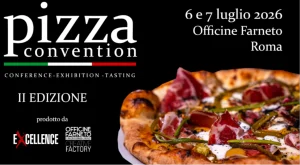
Not just flour, dough, and master pizzaioli. The second edition of Pizza Convention, held in Rome on July 6 and 7, put the spotlight on an issue set to shape the future of the industry: the legal recognition of the pizzaiolo profession.
Despite generating around €15 billion annually and standing as one of the most recognizable symbols of Made in Italy worldwide, the pizza sector still lacks a clear legal framework defining a profession that involves hundreds of thousands of workers and businesses. It was this awareness that fueled the discussions throughout the congress, transforming the event into a platform for dialogue between institutions, professionals, and industry associations.
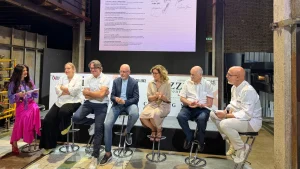
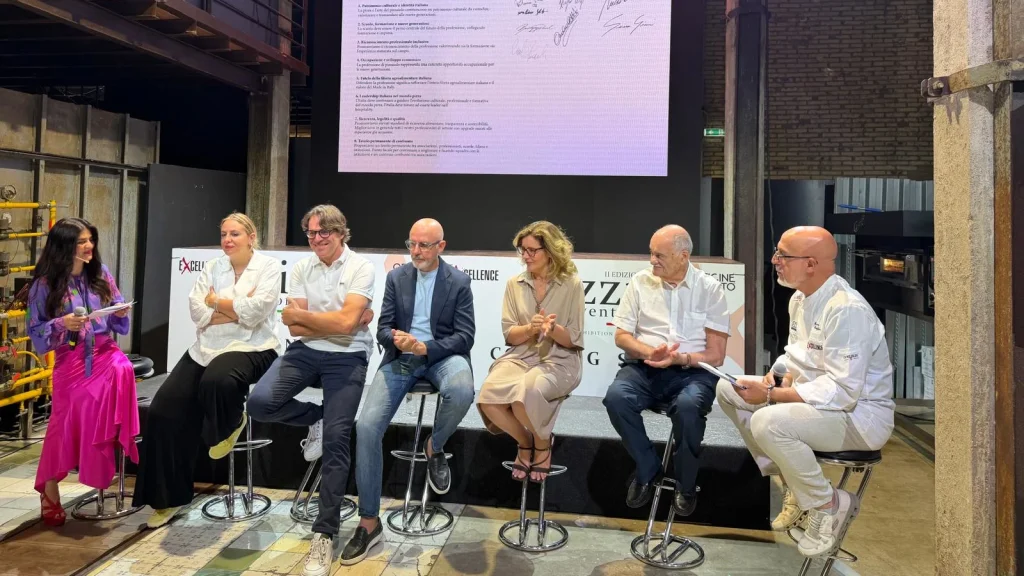
The most significant moment of the two-day event was the panel dedicated to the policy manifesto “Pizzaiolo: A Profession Worth Protecting,” which brought together Senator Gisella Naturale, Vice President of the Senate’s 4th Standing Committee on European Union Policies; Selena Vacca, expert in agri-food legislation; Antonio Pace, President of the Associazione Verace Pizza Napoletana (AVPN); and renowned pizzaioli Franco Pepe, Roberta Esposito, Corrado Scaglione, and Renato Bosco.
The shared goal was to launch a concrete path toward officially recognizing a profession that has become one of the foremost ambassadors of Italian gastronomic culture.
“This is a journey I have been pleased to support for several years,” said Senator Gisella Naturale. “When I was asked to work on a legislative process, I became the first signatory of a bill dedicated to this recognition. It is something the sector has been calling for more and more strongly, and we hope it will encourage younger generations by offering them a professional future that must begin in our own country. The profession of pizzaiolo is intrinsically linked to the history of our land, and we cannot afford to lose sight of this priority.”
Antonio Pace, President of the Associazione Verace Pizza Napoletana, echoed the same sentiment.
“Here in Rome, a concrete and determined commitment emerged to define the profession of pizzaiolo through legislation. This is a fundamental step toward strengthening the dignity of a centuries-old profession by giving it formal recognition and legal protection.”
According to Roberta Esposito, owner of La Contrada, the discussion also reflects a shift in the way pizza is perceived and communicated.
“This opportunity to meet and exchange ideas with my colleagues and institutional representatives has been particularly meaningful, especially regarding the way pizza is presented today: no longer simply as a product, but as an evolving cultural phenomenon, placing the emphasis on the knowledge, craftsmanship, and heritage behind it.”
For Franco Pepe, one of the leading figures in contemporary pizza, the dialogue with public institutions suggests that meaningful change may finally be within reach.
“The feeling is that, after years of discussion, things are finally becoming serious. The fact that we are now able to engage with policymakers gives us real hope for the future, a future that must inevitably begin with education.”
Renato Bosco also emphasized how official recognition of the profession could become a powerful driver for the industry’s continued development.
“Recognizing the profession of pizzaiolo means establishing a clear milestone for a trade that has continued to grow year after year. We hope this achievement will become a powerful catalyst for attracting more young people to a profession of immeasurable value.”
Finally, Corrado Scaglione, of Enosteria Lipen, highlighted the educational responsibility shared by today’s pizza masters.
“The political institutions have made an important commitment by focusing on issues that are fundamental to us. We must continue to raise professional standards by investing in young people, because they are the future of pizza. As ambassadors of this craft, our mission is to pass on knowledge, professionalism, and awareness so they can become fully qualified professionals.”
The convention also devoted significant attention to promoting female talent. The Maestre Pizzaiole award was presented to Petra Antolini (Settimo Cielo, Pescantina), Marzia Buzzanca (L’Aquila), Amalia Costantini (Mater, Fiano Romano), Isabella De Cham (Isabella De Cham Pizza Fritta, Naples), Roberta Esposito (La Contrada, Aversa), and Filomena Palmieri (Da Filomena, Castrovillari). These six professionals continue to shape the evolution of contemporary pizza in a sector where women still account for only around 2% of those working behind the pizza oven.
Young talent also took center stage through the Sorì Under 35 Competition, won by Pasquale Cirillo of Pizzeria Golfo di Napoli (Rome) and El Anbri Abdessamad of Loop (Albignasego), while Luca Di Francesco of Enzima (Ladispoli) claimed victory in the second round.
The Vera Pizza Napoletana Championship selected Emanuele Rossi as the overall winner, followed by Davide Rossi and Salvatore Palluda, tied for second place, together with Massimiliano Barrà, all of whom qualified for the final in Naples.
In the frying competition organized by Zucchi Professional of Oleificio Zucchi, awards went to Riccardo Branciamore of Frumento and Valerio Esse of Lina Pizza in Teglia, both based in Rome.
Through live cooking demonstrations, in-depth discussions on ingredients, food pairings, and the future of the sector, Pizza Convention 2026 confirmed that the pizza world is experiencing a period of remarkable maturity and evolution. Yet, as repeatedly emphasized throughout the congress, the industry’s continued leadership now requires one essential step forward: granting legal recognition to a profession that has represented one of the strongest symbols of Italian gastronomy for centuries.