From dishes rooted in memory to social media success, and now the arrival of his son Daniele in the kitchen: the story of a chef who has turned memories into a form of hospitality.
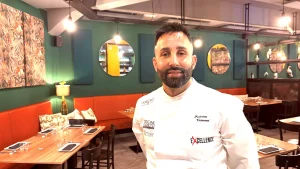
There is one word that keeps returning whenever you talk to Fabrizio Sepe. It is not technique. It is not innovation. It is not even tradition.
It is memory.
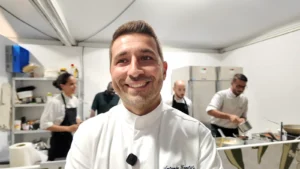
The memory of the dishes that arrived at the family table when he was a child. The recipes passed down by grandmothers and mothers. The Sundays scented with simmering sauce and anticipation. It is a memory that runs through his entire cuisine and, ultimately, helps explain the success that has made him one of the most recognizable faces of Roman gastronomy on social media in recent months.
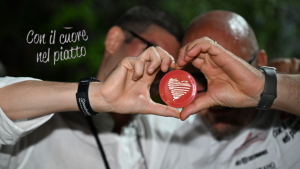
Those who watch his videos might think the secret lies in his spontaneity, in the direct way he tells stories through recipes, or in that gesture that has become his trademark: his hand closing in front of his mouth whenever a dish turns out particularly well. In reality, that gesture says far more than it seems.
“It’s like when a child tastes something delicious,” he explains with a smile.
And perhaps that is precisely the point. Fabrizio Sepe still looks at food with the same enthusiasm as someone who can be genuinely moved by a flavour capable of taking him back in time.
There is no carefully constructed nostalgia in his cooking. No search for the vintage effect that often accompanies today’s narratives about tradition. Instead, there is a desire to rescue dishes that risked disappearing from both family tables and restaurant menus, giving them a renewed relevance.
Because the world has changed, and people have changed with it. We live differently, eat differently and work differently. Some preparations need to be lighter, certain ingredients rethought, some techniques simplified. Yet the soul of the recipe can remain untouched.
That is the balance Sepe seeks every day: keeping memory alive without turning it into an exercise in nostalgia.
After all, the messages he receives always tell the same story. Someone writes that a recipe reminded them of their mother. Someone else remembers their grandmother. Others recreate a dish they saw on social media for their own children. It is a cuisine capable of building a bridge between generations, and perhaps that is where its true strength lies.
For this reason, Fabrizio tends to be skeptical of grand definitions. When people talk about fine dining, he prefers another expression: substance-driven cuisine.
A cuisine that does not need to amaze at all costs. A cuisine that can be served in an elegant restaurant as easily as in a neighbourhood trattoria. A cuisine that places the pleasure of sharing a meal at the centre of the experience.
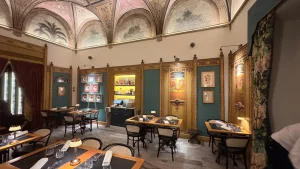
At Bottega delle Tre Zucche, this philosophy is immediately evident. It is not only about what arrives on the plate. There is an idea of hospitality that involves the entire team, starting with the family itself.
Guests are welcomed by name. Their habits, preferences and allergies are remembered. A favourite dish is set aside for someone who asked about it the week before. These details may seem small, but in an increasingly fast and impersonal world, they make an enormous difference.
It is a way of doing hospitality that begins with empathy long before it reaches technique.Perhaps that is why, at a certain point in the conversation, the most interesting subject ceases to be cuisine and becomes family.
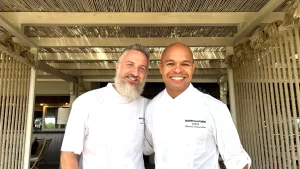
Because while Fabrizio tells his own story, another story inevitably emerges: that of Daniele, the son who has chosen to follow the same path. It was never something his father took for granted. In fact, when Daniele first expressed the desire to attend culinary school, the family made it clear that he was free to choose any other career. His answer was simple: he wanted to become a chef.
First came experiences away from home, then Switzerland, and finally a return to Rome. A journey that allowed him to build his own professional identity and bring into the kitchen a perspective different from that of the previous generation.
More international. More technological. More attentive to themes such as lightness and wellbeing.
Fabrizio watches this evolution with pride and with the sense of humour that always accompanies him. He jokes about the “fit” recipes that he initially struggled to understand, only to admit that many of those lighter preparations actually work—and taste good too.
In the end, that is the beauty of kitchens that are truly alive: they never stop evolving.
On one side stands someone who preserves the heritage of memory. On the other, someone trying to reinterpret it through a new lens. In between lies the daily dialogue between two generations united by the same passion.
Perhaps the success of Fabrizio Sepe begins right here. Not in the pursuit of perfection, but in the ability to remember that food is never just food.
It is a story to be told, a memory to be preserved, an emotion to be shared.
And sometimes, it is also a way of feeling at home.