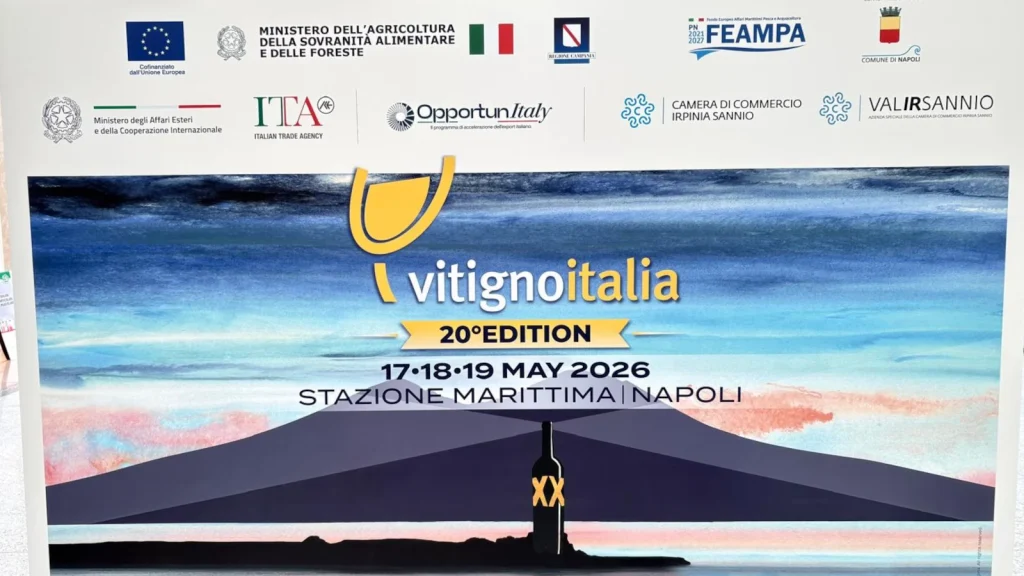
Twenty years told through thousands of glasses, encounters, territories and new visions of wine. The twentieth edition of VitignoItalia once again transformed Naples’ Stazione Marittima into a major crossroads for Italian wine, confirming itself not only as one of Southern Italy’s leading wine events, but also as a privileged observatory on the changes currently reshaping the contemporary wine world.
Two hundred and fifty wineries from across Italy, more than two thousand labels available for tasting, masterclasses, in-depth discussions and a strong presence of international operators and buyers defined an edition marked by exceptional participation. An event capable of blending the technical language of the industry with a more convivial atmosphere, increasingly open to younger generations. A significant aspect at a time when wine is facing new challenges related to consumption trends, markets and, above all, communication styles.
What made this twentieth edition even more meaningful was the central role of Naples itself. A city that in recent years has undergone a profound transformation in its international perception and that today is able to attract tourism, investors and industry professionals with a strength very different from the past. It is precisely this renewed appeal that has helped strengthen VitignoItalia’s role as a national platform for dialogue among territories, producers and markets.
“The twentieth anniversary of VitignoItalia marked an event that achieved remarkable success in terms of public attendance, operators and participating companies,” explained Maurizio Teti, organizer of the event. “Two hundred and fifty wineries from all over Italy represent an important number, as do the 2,000 labels showcased and the rich program of masterclasses and discussions.”
Beyond the numbers, however, what seems to have stood out most was the presence of younger audiences. “I saw many young people here, and finally wine was discussed in a convivial way,” Teti said. “The new generations need a completely different type of communication — less didactic and more engaging. Producers absolutely need to embrace this change by opening their wineries and finding new ways to connect with them.”
A reflection that perfectly summarizes one of the major challenges facing the sector today: preserving the cultural depth of wine while making it accessible through contemporary and less self-referential forms of communication.
Since its inception, VitignoItalia has chosen not to limit itself to a purely regional dimension. “The original idea was to create something rooted in Campania but within a national framework,” Teti emphasized. Campanian wineries account for about 40% of exhibitors, but alongside them the presence of consortia and producers from all over Italy continues to grow year after year.
The international component was equally significant, with 35 foreign buyers attending the event in Naples to meet producers and discover the territory. A presence that extended beyond the exhibition halls through dedicated educational tours, such as this year’s visit to Irpinia. A way of turning wine into a tool for storytelling and integrated territorial promotion.
“When we started twenty years ago, Naples was far less attractive from a tourism perspective,” Teti observed. “Today the city is far more internationally recognized, more dynamic, more cool. And it is much easier to welcome buyers and operators.”
The event also explored themes related to the sea, sustainability and local gastronomic culture. These topics were highlighted by Fiorella Zabatta, Regional Councillor for Agriculture of the Campania Region with responsibility for fisheries, during a showcooking session dedicated to pairings between Campanian seafood and local wines.
“Today the culture of the sea perfectly complements the culture of wine,” she explained. “Pairing seafood with wine has increasingly become part of our gastronomic habits.”
Zabatta also underlined the strategic importance of the fishing sector in Campania, describing it as “a sector of excellence and primary importance,” with strong attention paid to environmental sustainability and marine ecosystem protection. From wide-mesh fishing nets to sonar technologies designed to preserve younger fish stocks, sustainability increasingly emerges as a common thread connecting agriculture, fishing and wine production.
“Wine has always been one of the products that best represents our territory,” she added. “And it is only natural that wine events increasingly pair wine with food and local products. It reflects what already happens every day on Italian tables.”
Another important theme discussed during the event was the relationship between finance, innovation and the agri-food supply chain. A topic addressed by Massimo Lazzari, Head of Agribusiness at BPER Banca, who attended VitignoItalia to discuss the bank’s commitment to the agricultural and wine sectors.
“The agri-food supply chain is one of the driving forces of the Italian economy,” he explained. “For this reason we have developed a specialized service dedicated to the sector, including agronomists within our teams who facilitate dialogue with agricultural businesses.”
An approach aimed at building financial tools increasingly aligned with the real needs of agricultural enterprises, especially in a historical phase marked by strong international instability.
“Sustainability today is an essential driver,” Lazzari emphasized. “Companies that invest in sustainability and innovation are more resilient and better equipped to face the permanent crises we are experiencing.”
Words that effectively summarize the current state of the wine industry itself: a sector constantly evolving amid new sensibilities, shifting markets and the need to rethink both language and business models.
Looking ahead, VitignoItalia already appears ready to enter a new phase of its history. “This is a moment for reflection,” Maurizio Teti concluded. “We will probably work on a smarter, faster format while maintaining the same content and the same desire for dialogue and in-depth discussion. Our core business remains the wineries, and we want them to find concrete opportunities here even in a complex market situation.”
With one certainty that, after twenty years, seems clearer than ever: in Naples, wine is not simply about tasting, but about cultural storytelling, territorial identity and the ability to create meaningful connections.