Yes, I admit it—the idea of having to taste 100 artisanal panettoni from all over Italy is a bit intimidating. But with the friends from vinodabere.it, you don’t back down, and fortunately the tasting is organized into three panels, which reduces the number of samples. Not by much, but still…
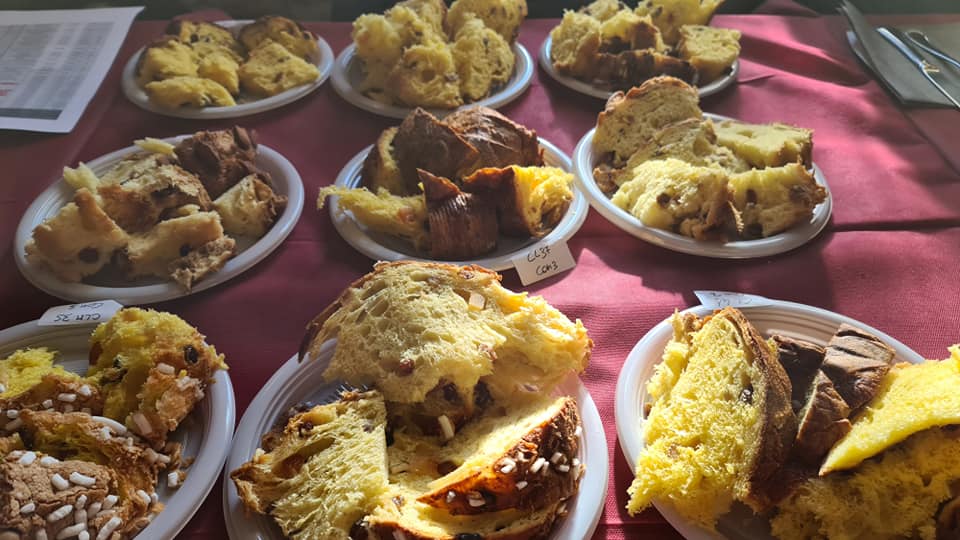
Always mindful of safety measures, we begin the tasting. Strictly blind, of course, to ensure the most objective evaluation possible. It’s quite unusual to see panettoni labeled as F10, A2, CL12 or CLM 32… four main categories to distinguish between classic, almond-topped classic, alcoholic, and “creative” versions. A necessary classification, given the very different character of each type and the distinctly different first impression on the palate.
It’s my first time judging this kind of product, and the initial tastings are all about calibrating the senses. But I can assure you—this kind of experience is fascinating. You can tell when the butter is good… and when it’s not. You understand whether the leavening process has worked properly or if the texture remains too dense and “doughy.” Even on the nose, you begin to distinguish between a pastry chef’s product and a baker’s. The same goes for the quality of raisins, candied fruit, and almonds: that’s where you really notice whether the approach has been generous or not.
With alcoholic and “creative” panettoni, the game changes. Some samples on the table are perfect expressions of balance between dough and filling, while others are overwhelmed by excess filling—more reminiscent of indulging in bread and Nutella than of refined pastry.
And then come the surprises. Panettoni ranging from vermouth to limoncello, from prickly pear to rose—anything and everything. Better the classic or the creative? I have no doubts: better the one that’s well made.
Because nothing more than panettone requires, at the same time, taste, balance, and style. Stay within that line, and you have a panettone that leaves a mark. Go beyond it, and the risk is ending up with something confusing and cloying. Probably a “non-panettone.”
That’s the point—how far can you go before it stops being panettone?
As for the tasting results: some of the usual names confirm their place in the top ten. Above all, Sal De Riso, who places three panettoni among the top twenty. But there are also some very interesting outsiders, both in the classic style and in more creative approaches.
Well deserved is the first place of the “Rosso ‘nduja e cioccolato” by Antico Nero di Aspromonte. A panettone that’s hard to define, yet precisely for that reason surprising—capable of moving from sweet to savory, all the way to a spicy finish. Strangely (given the ingredients), it is very balanced and pleasant.
The panettoni featured in the ranking published on vinodabere.it are all worth exploring. If I had to choose just one, I’d be in trouble. Each of them has a distinct identity and could satisfy very different palates.
My perception of panettone has definitely changed after this experience. It won’t be enough anymore to simply “eat a panettone.” I’ll look at it—at the box too, since I’ve seen some wonderful packaging—then unwrap it and appreciate its aroma. I’ll dissect it in every detail, from raisins to candied fruit, from the crumb structure to the filling. Then I’ll taste it and decide whether it’s worth continuing.
One question remains: will I really want to spend €40 per kilo on a panettone?
Well… after all, it’s only once a year.
One thing is certain. If until now I had become a bit of a pain when it comes to wine—“the glass, the temperature, what are we drinking, how do we pair it…”—from now on you’ve also created a panettone obsessive for next Christmas… 😄