2024, 2023 and 2022 compared: three vintages narrate the present of the Gallo Nero through freshness, tension and territorial memory.
It’s raining, the departure board scrolls with delays and my train decides to add its own share. Monday morning, a race against time: when I finally arrive at Firenze Santa Maria Novella, Maurizio Gabriele has just stepped off his train from Rome. We cross paths almost on the run, a quick greeting, no real pause. We set off again immediately, heading to Stazione Leopolda. The first day of Chianti Classico Collection 2026 begins like this: with a quickened pace, umbrella in hand and the feeling of already being inside the rhythm of the tasting before even stepping in.
At the Leopolda you enter a familiar flow: accreditations, quick greetings, just enough time to get oriented and then straight into what, for those who attend these technical tastings, remains one of the most intense settings of the year. Waiting for us is Maurizio Valeriani, director of Vinodabere, with the entire team.
 Our panel is composed as follows: Maurizio Valeriani, myself, Maurizio Gabriele, Riccardo Mugnaini, Antonio Paolini, Stefano Puhalovich, Susanna Schivardi, Gianni Travaglini. A large group, with different sensibilities and experiences, but a shared objective: to read the new vintages of Chianti Classico with clarity and honesty.
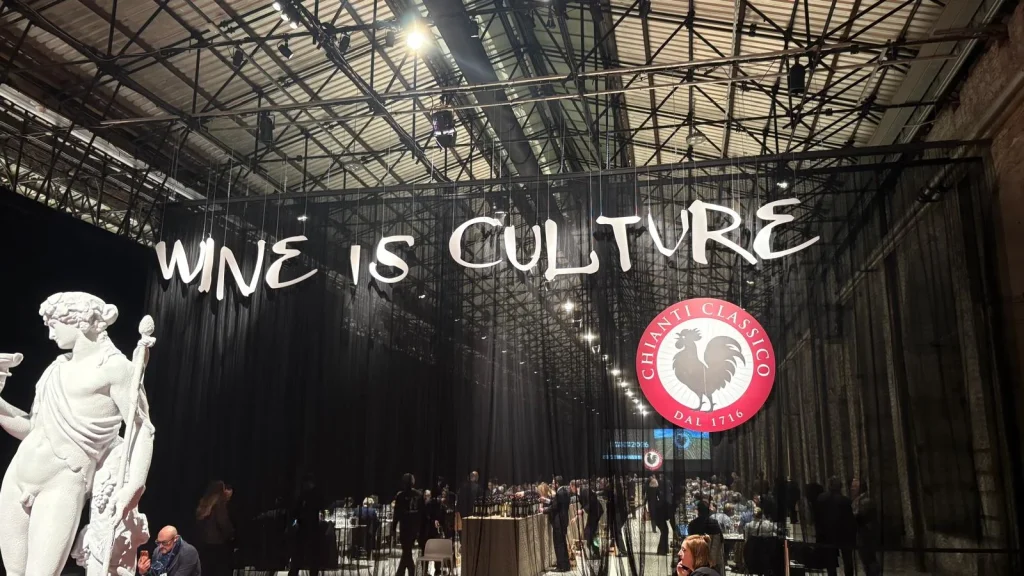
The Chianti Classico Collection, now in its 33rd edition, brings together 223 wineries this year – a record attendance – and 680 labels. The numbers are certainly impressive (including 190 Riservas and 185 Gran Selezione), yet the feeling is that the 2026 edition aims to look beyond the denomination’s accounting. The theme chosen by the Consortium is “Wine is Culture” and, in Chianti Classico, it does not sound like a slogan but rather a natural claim. It is a territory whose borders have been historically defined for centuries, hills that connect medieval Siena and Renaissance Florence, rural architecture transformed into heritage, villas and farm estates, archives, agricultural and landscape traces preserved and handed down. Here wine is not merely the result of an agricultural practice: it is a cultural product because it is born within a system of history, landscape, belonging and collective protection. And in this concept I recognize myself effortlessly. As a graduate in Fashion Culture and Styling, I am often asked what wine has to do with my background: and I always return to the same point. If clothing tells who we were, how we lived, what we desired and defended, then a glass of wine is one of the highest forms of cultural history: it layers generations, efforts, aesthetics, identities. This year, in the 2026 campaign, I perceived it with rare clarity: finally wine returns as a narrative protagonist, not merely as performance in our scoring grids.
When we begin tasting, however, all of this must withstand the most severe test: the glass. And technical tasting gives no discounts. The focus is precise and we follow it through: vintage 2024 and 2023, then Riserva 2023, Gran Selezione 2023 and 2022. A sequence that at times seems endless. Yet precisely within this fatigue the day finds its meaning: because a tasting is never just a tasting, it is an interpretation.
To truly understand what we are drinking, it is necessary to bring everything back to the growing season in the vineyard.
The 2024 vintage was the surprise that did not need to raise its voice. On paper, the climatic pattern could have suggested critical issues: frequent rainfall, even close to harvest, and a non-linear season. In the glass, however, the interpretation changes. It is a dynamic, fresh vintage, highly readable from a varietal standpoint. Elegant floral aromas emerge, a crisp and precise fruit often crossed by a clear orange citrus note, and that Sangiovese texture that restores territorial identity and drive.
It is a vintage that already in preview shows identity and balance: lower alcohol, lively progression on the palate, a tension that lengthens the sip without stiffening it; a profile that aims more at elegance than power.
The 2023 vintage carries a different weave. A rainy spring, canopy management as a daily exercise, and in some vineyards downy mildew made its presence felt after the rains of May and early June. Here too, ventilation and altitude limited the attacks, but production was affected: 200,000 hectoliters, a figure that tells how selective the work had to be.
Then came the hot summer. Vineyard management was decisive in containing critical issues, but—especially in some Riservas and Gran Selezione—a more angular tannic texture emerges, a certain roughness that reflects phenolic ripeness not always perfectly achieved.
It is a profile I do not feel like reading “against” the vintage: rather, it is its voice, coherent with a demanding season where structure and concentration are present, but harmony is not as immediate as in 2024. The 2023 vintage asks for a different pact: patience, time, and the willingness to revisit it in a few years, when the tannins will have found their line.
When we arrive at the 2022 Gran Selezione, the register shifts again. The season was warm but linear, without extreme events: the vines were able to adapt to temperatures, spring rains created useful reserves and mid-August rains rebalanced ripening. In the glasses one perceives greater relaxation: ripe tannins, less sharp acidity, an overall composure. Tasting it alongside 2023 and 2024 makes it clear how much climate influences style.
The hours pass quickly and slowly at the same time. We step in and out of the tasting room, return to the table with a palate asking for mercy and a mind that instead wants to keep reading.
By the end, the picture of the awarded samples takes shape in a fairly unanimous way:
Best Chianti Classico 2024:
- Chianti Classico 2024 – Cigliano di Sopra
- Chianti Classico 2024 – Fattoria San Giusto a Rentennano
- Chianti Classico Retromarcia 2024 – Monte Bernardi
- Chianti Classico Morino 2024 – Mori Concetta
- Chianti Classico 2024 – Calcamura
- Chianti Classico 2024 – Montesecondo
- Chianti Classico 2024 – Ormanni
- Chianti Classico 2024 – Casale dello Sparviero
- Chianti Classico Castellare 2024 – Castellare di Castellina
- Chianti Classico Il Classico 2024 – Il Poggiolino
- Chianti Classico Tenuta de’Carlini 2024 – Belvedere1
- Chianti Classico Tornus 2024 – Castello di Tornano
- Chianti Classico Contessa di Radda 2024 – Geografico
- Chianti Classico 2024 – Setriolo
- Chianti Classico 2024 – Castello di Gabbiano
- Chianti Classico 2024 – Castello di Querceto
- Chianti Classico Al Limite 2024 – San Leonino
- Chianti Classico 2024 – Tenute Casenuove
- Chianti Classico Vignole 2024 – Tenuta di Vignole
Best Chianti Classico 2023:
- Chianti Classico 2023 – Castello di Monsanto
- Chianti Classico Sacello 2023 – Arillo in Terrabianca
- Chianti Classico 2023 – Castello di Bossi
- Chianti Classico 2023 – Castello di Radda
- Chianti Classico 2023 – Querciabella
- Chianti Classico 2023 – Tenuta di Carleone
- Chianti Classico 2023 – Istine
- Chianti Classico 2023 – L’Erta di Radda
Best Chianti Classico Riserva 2023:
- Chianti Classico Riserva Lama dei Cortacci 2023 – Castellaccio
- Chianti Classico Riserva 2023 – Castello di Albola
- Chianti Classico Riserva 2023 – Villa S. Andrea
- Chianti Classico Riserva Capaccioli 2023 – Capaccioli Poggio Nicolini
- Chianti Classico Riserva 2023 – Brancaia
- Chianti Classico Riserva Brolio 2023 – Ricasoli
Best Chianti Classico Gran Selezione 2023:
- Chianti Classico Gran Selezione Sorleone 2023 – Villa a Sesta
- Chianti Classico Gran Selezione Castello di Brolio 2023 – Ricasoli
Best Chianti Classico Gran Selezione 2022:
- Chianti Classico Gran Selezione Vigna Gittori 2022 – Riecine
- Chianti Classico Gran Selezione Vigneto Cerbaiola 2022 – Castello di Gabbiano
- Chianti Classico Gran Selezione 2022 – Carpineto
- Chianti Classico Gran Selezione La Prima 2022 – Castello Vicchiomaggio
- Chianti Classico Gran Selezione Vigna Contessa Luisa 2022 – Conti Capponi
- Chianti Classico Gran Selezione Sergio Zingarelli 2022 – Famiglia Zingarelli
- Chianti Classico Gran Selezione Effe 55 2022 – Capraia
- Chianti Classico Gran Selezione Il Puro Casanova 2022 – Castello di Volpaia
- Chianti Classico Gran Selezione Riserva Ducale Oro 2022 – Ruffino
- Chianti Classico Gran Selezione Terrazze di San Leonino 2022 – Fontodi
- Chianti Classico Gran Selezione Castello Fonterutoli 2022 – Castello di Fonterutoli
When you leave the room at the end of the day, a certain satisfying fatigue clings to you: the mouth begs for silence, but the mind continues to reorder aromas and impressions. Outside, the rain has just stopped and Florence stands there, kissed by a February evening, still damp, with the asphalt holding the glow of the streetlights.
As I walk back toward Santa Maria Novella station, I truly realize that the day does not end when you close the door of the Leopolda. It continues in the mental notes you repeat to yourself on the train, in the messages that start pouring onto your phone, in the WhatsApp groups that explode with reflections and comments, with “did you taste it too?”, with comparisons over a tannin, an acidity, a citrus nuance, a sensation of drive.
That is when you understand the depth of the concept “Wine is Culture.” Because wine does not remain trapped in a glass: it flows into conversations, stretches into memory, creates bonds. And days like this—beginning with rain and ending with a more intimate Florence—do not close; they transform into anticipation: of the wines we will revisit, the bottles we will reopen, the stories we will write in our magazines in the following days and that will keep us company long after the final sip.