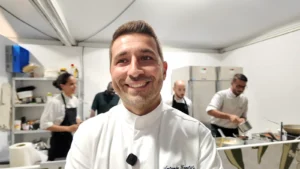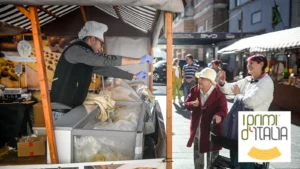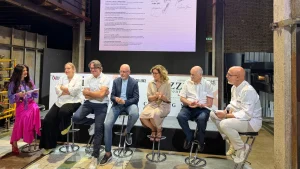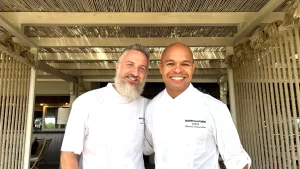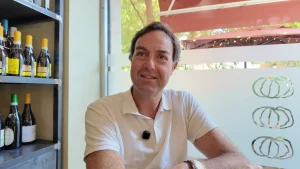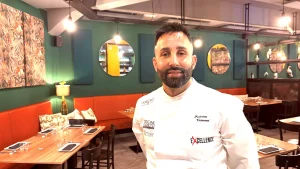
Today we are with Alessandro Stocchi from the Parmigiano Reggiano Cheese Consortium, on the occasion of an event held as part of the DOPera DOP promotional campaign — a European project devoted to celebrating DOP excellence and the authentic stories behind it. A conversation that takes us on a journey through a product that is far more than just a cheese: it is a voyage through taste, time, and the very heart of Italy.
To think of Parmigiano Reggiano merely as a cheese is to overlook its deeper essence — a sensory and cultural journey. Stocchi tells the story with the passion of someone who lives every day in close connection with the land, its traditions, and its people.
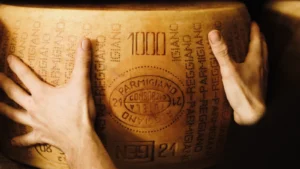
This journey begins in a well-defined and deeply rooted area: the provinces of Parma, Reggio Emilia, and Modena, a small portion of Bologna to the left of the Reno River, and another slice of Mantua province to the right of the Po. It is only here that Parmigiano Reggiano can be made — only here that its balance of soil, history, and culture finds its truest expression. For nearly a thousand years, the same cheese has been produced in this land using the same simple ingredients: milk, salt, and rennet. No additives, no preservatives.
But beyond these natural elements, Stocchi mentions two others that truly define Parmigiano Reggiano: craftsmanship and time. In the dairies, the milk is still worked by hand, with gestures passed down through generations. The human touch, he explains, is what gives each wheel its unique character — something that no machine could ever reproduce. And then there is time, the invisible yet essential ingredient that shapes the cheese’s sensory universe. From the younger wheels to those aged beyond 90 months, each one tells a different story, revealing an evolving spectrum of aromas, textures, and flavors.
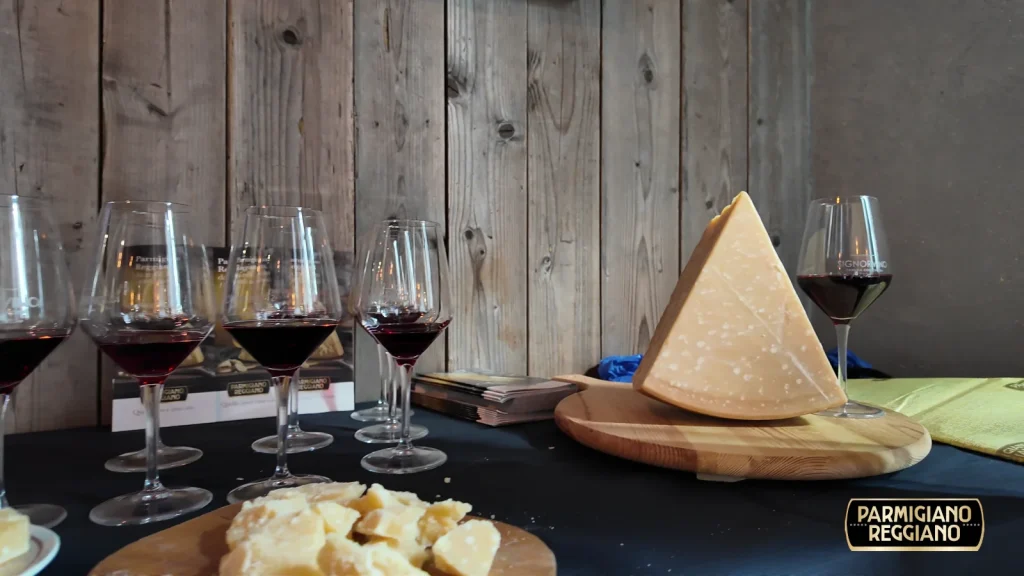
This diversity makes Parmigiano Reggiano incredibly versatile — perfect for pairing with wines, sparkling wines, beers, and even spirits, from the aperitif to the pre-dessert moment. But to truly appreciate it requires knowledge, training, and cultural awareness. This is where APIR – the Parmigiano Reggiano Tasters Association, founded in 2006, comes in: its mission is to study and promote the art of tasting Parmigiano Reggiano, both on its own and in culinary pairings.
“Our role,” Stocchi explains, “is to help people understand how to interpret the different maturations, recognize the organoleptic characteristics, and appreciate the complexity of a product that evolves over time. Our courses, structured over two levels, allow participants to become true Parmigiano Reggiano tasters — but above all, to embark on a journey into its entire production chain. It’s an act of love and loyalty toward one of the most authentic symbols of Made in Italy.”
That authenticity goes beyond tradition and is rooted in the land itself. The milk, for instance, must come exclusively from the production area, and the cows’ diet is entirely natural: hay and fresh grass, at least 75% of which must come from local meadows. Each wheel of Parmigiano Reggiano is therefore a faithful portrait of its territory — a concentration of rural culture and artisanal know-how.
This is why no imitation can ever be truly the same. “I’m not talking about quality,” Stocchi clarifies, “but about difference. Even those who try to replicate the production process elsewhere will always get something different, because they lack that deep bond with the land that makes Parmigiano Reggiano unique.”
More than a cheese, it is a cultural heritage made of hands, time, nature, and identity — a journey through Italian taste and memory that continues to move and inspire anyone who approaches it with curiosity and respect.