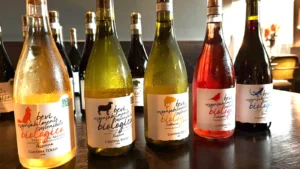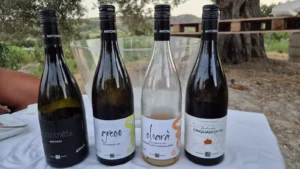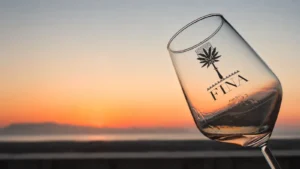
Perhaps using the word “glamour” to open an article about wine might seem a bit daring, but the moment the judging table filled with 75 glasses of rosé, I must confess that the urge to pull out my smartphone and take a photo was simply irresistible.
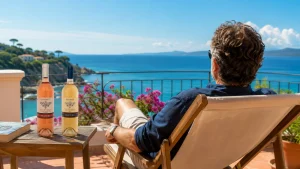
There is no doubt that the visual component plays an important role in the success of rosé wines. Whether it’s a delicate Provençal style or a deeper Cerasuolo, the appeal of a rosé cannot be questioned.
But beyond appearance there is also taste, and this is why the Concours Mondial de Bruxelles decided to experiment with a new format designed to test the rosés awarded in Brussels alongside different categories of food.
This is how the Food & Rosé Selection was born—an additional proving ground for the medal-winning rosés and, I believe, a delicious opportunity (in every sense of the word) to show that rosé wines are not only beautiful to look at, but also fantastic partners for food of every kind.
Could there have been a more fitting location than Abruzzo for this type of competition?
Once the format was defined, L’Aquila was chosen as the venue for the event, which unfolded over the course of a three-day program that was both enjoyable and demanding.
The first day passed between accreditation, a welcome message from the Abruzzo Region, the first tastings of the various Italian expressions of rosé, and repeated strolls under the portico of the Palazzo del Consiglio Regionale, discovering the region’s gastronomic excellence. Biscuits, every kind of honey, ventricina and other cured meats, artisanal pasta and—dulcis in fundo (and I must say it worked perfectly as a mid-afternoon snack)—a small egg topped with a generous shaving of summer truffle.
It was from the second day that we had to start behaving like serious professionals 🙂
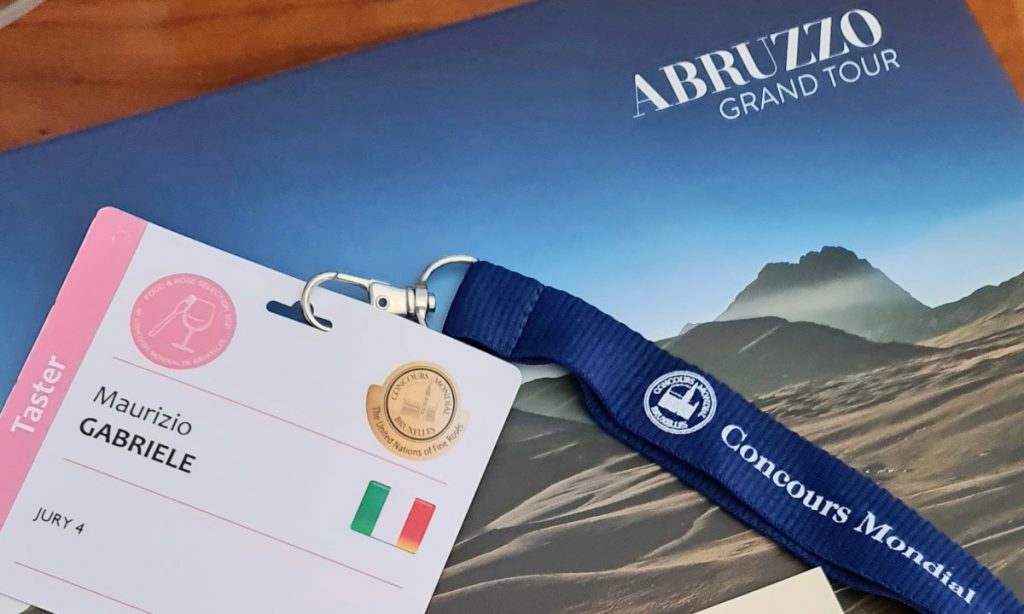
The working days began with interesting conferences, but our attention quickly shifted to the tables. Many glasses, a tasting placard reminding you that you are there as a juror, and suddenly you must forget the truffle egg from the day before and step into the role of the true professional.
Alright, I’m ready to give my scores but… wait—there are no scores to give?
The tasting sheet is a true “Wine 4.0” system. You don’t assign points—you write impressions, and then an AI system interprets the phrases and adjectives you use.
I was left with a doubt: will the combination of microprocessor + AI system really understand what I mean when I write something like “note of sweaty horse”?
Luckily the glasses contained medal-winning wines, so there were no horses involved—nor any “mouse” notes or salami-skin aromas…
So, we selected the best wines to pair with appetizers, raw and cooked fish, raw and cooked meats, cured meats, spicy dishes and desserts—and then what?
It was on the third day that a very interesting service table appeared next to us.
The task of the day seemed simple—at least at first glance. Our jury was assigned cured meats. On our table we would find the 15 wines that all jurors had previously selected as the best matches for cured meats. Our job was to taste them again and determine the top three rosés for this category.
Easy task? Not at all—especially when your plate ranges from a delicate capocollo to a rather aggressive spicy sausage.
But ours was a determined jury, and after the millionth taste we managed to identify our magnificent three. And I was happy to discover later that the wine that generated the most discussion—but ultimately received our vote—was Italian. Forgive my touch of national pride…
Now, what happened after the tastings?
One might imagine relaxed afternoons, lying back and taking it easy—but not at all. Three buses were always waiting for us, ready to take us on a joyful whirlwind of kilometers, arrosticini, cheeses, cured meats, wines—many wines—and vineyards.
Every now and then we even added cultural interludes, such as visits to the Castle of Capestrano and the artistic beauty of L’Aquila, but I must admit that the arrosticini served in the courtyard of Cataldi Madonna winery won everyone over.
Even me—and I normally don’t eat anything related to sheep.
As I write this, I cannot help but think of my cardiologist. A cardiologist who is also a sommelier and a nutritionist. The last time we met he kept repeating the word “hypo!”—as in “you’re fine, but you should follow a hypo-something diet…” and so on.
In short, everything “hypo”… and I know he’s waiting for me.
Perhaps I could distract him by talking about wine… though I sincerely hope he doesn’t read this article. If he does, I’m probably doomed.
But in the end, who won?
Certainly the Concours Mondial de Bruxelles, represented by Baudouin Havaux (I confess—I always forget a “u” somewhere in his name and end up copying and pasting it), Karin Meriot, and Carlo Dugo. And I should not forget Evi and Angélique, who did an incredible amount of work behind the scenes.
The Abruzzo Region also won, with Emanuele Imprudente, as did the Development Agency of the Chamber of Commerce of Chieti and Pescara, represented by Marco Pesce—wonderful hosts who took us around their territories and flavors.
The students of the “Leonardo Da Vinci” Hospitality Institute also won—always present with their black branded aprons. Young students, a little nervous on the first day but already super professional by the second day of service.
And of course, the rosé wines won—true stars of the event. Not only beautiful, but also delicious. Versatile, food-friendly, stimulating, and sometimes surprising.
Even our five Italian wines won. Only five—proof that we are present, but also that rosé remains a sector where we can still do much more.
Wait… what kind of overly flattering article have I written here? Everything beautiful, everything good, everything perfect…
No, I don’t like that. Let me add one suggestion.
If this is an international competition, the language of the competition should be equally international. There is still room for improvement on that point.
But I’ll conclude by saying that—hopefully you all agree—this can simply be considered a youthful mistake.
I leave L’Aquila with joy in my heart.
Seeing a city full of young people, restored homes, renovated monuments, reopened businesses and above all a strong desire to live again and move beyond first an earthquake and then a pandemic, has been for me a true injection of optimism.