
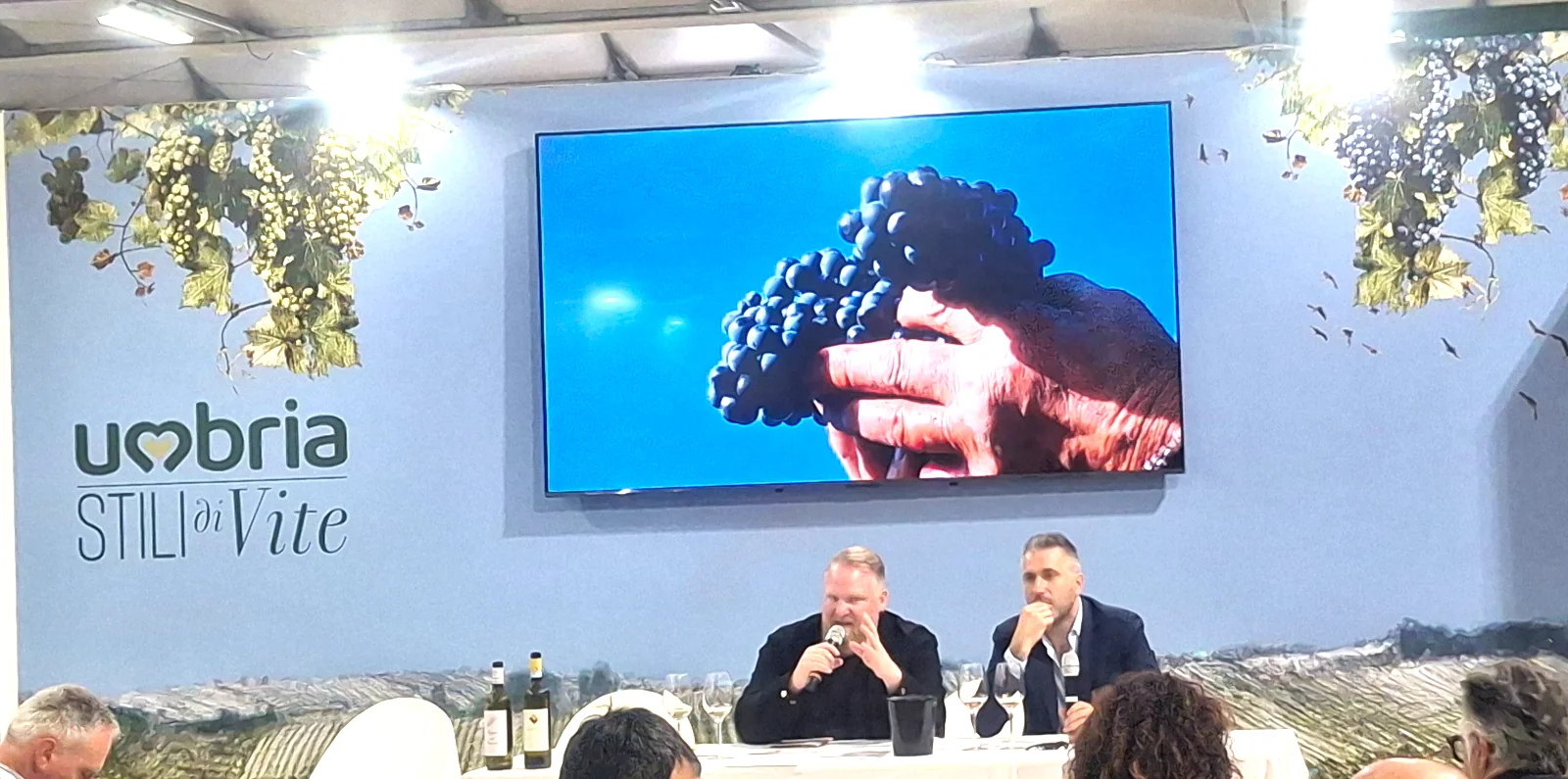
My discovery of Umbria at Vinitaly 2026 began in a packed room, with a masterclass capable of conveying far more than a simple tasting. “Choosing Montefalco: sustainability and identity in the glass,” organized by the Consorzio Tutela Vini Montefalco and led by Simon Staffler, director of Falstaff Italia, became the starting point of a journey that then continued through the pavilions, stand after stand, tasting after tasting. A path that successfully revealed the authentic face of a denomination that is now mature, self-aware, increasingly multifaceted—capable of speaking through monumental reds, surprisingly distinctive whites, untouched landscapes, and one of the most identity-driven gastronomies in Central Italy.
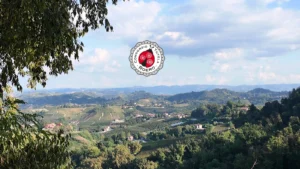
Montefalco, together with the municipalities that make up its protected area, has been a true wine land for centuries. Historical documents recount vineyards already present in the 11th century, municipal statutes protecting the vine from the 1300s, and 19th-century chronicles identifying these hills as the enological pinnacle of the Papal States. Here, viticulture has never been episodic but rather a cultural form deeply rooted in the landscape. The hills embracing Montefalco, Bevagna, Giano dell’Umbria, Castel Ritaldi, and Gualdo Cattaneo seem made for vines: varied soils, constant ventilation, temperature swings, bright exposures, and a biodiversity still tangible among olive groves, cultivated fields, and woodlands.
The Consorzio Tutela Vini Montefalco, founded in 1981, has had the merit of transforming this heritage into a contemporary vision, coordinating producers and promoting Montefalco Sagrantino DOCG, Montefalco DOC, and Spoleto DOC worldwide. Not just protection, but a continuous effort focused on quality, identity, and international credibility for a territory that is now reaping the rewards of decades of growth.
The first glass of the masterclass reminded everyone that Montefalco is not only a land of reds. Trebbiano Spoletino, the protagonist of the Spoleto DOC, is one of the most original white varieties in Italy. Ancient, vigorous, resilient, capable of late ripening and maintaining acidity even in warmer vintages, this grape has an almost unique profile in Central Italy. It is not defined solely by vertical freshness but by a rare dual nature: on one side, citrus tension, acidic backbone, and aromatic lift; on the other, volume, structure, texture, and a salinity that adds depth. It is a white wine that can be agile or austere, fragrant or complex, immediate or long-lived.
Spoleto Trebbiano Spoletino DOC, produced with at least 85% of the native grape, represents the most classic expression of this identity: fresh, pleasant aromas, a structured and intense palate, and a citrusy, persistent finish. It is enjoyable in youth but also capable of evolving gracefully over time. In the Superiore version, with higher alcohol and extract, it gains further depth and breadth.
In the glass of Ninni – Spoleto DOC Trebbiano Spoletino “Poggio del Vescovo” 2024, vinified exclusively in stainless steel, this identity emerges clearly. A full straw yellow with greenish reflections, aromas of white peach, lime, aromatic herbs, and a subtle powdery mineral note. On the palate it enters fresh, then expands laterally with substance that fills the mouth without weighing it down. The sapidity gradually takes the lead, providing solidity and persistence.
With Bocale – Trebbiano Spoletino 2024, the register changes. Aging in wood gives a deeper golden color and a nose moving between ripe peach, sage, broom flowers, and hints of tomato leaf. The sip remains lively and citrus-driven, but broader and more gastronomic.
From white, we move to the red heart of the denomination. Montefalco Rosso DOC is still sometimes considered merely a prelude to Sagrantino, but that is a misreading. Here Sangiovese dominates (60–80%), accompanied by Sagrantino (10–25%) and other permitted varieties. It is the wine that tells the everyday, gastronomic face of Montefalco: intense yet measured, territorial yet versatile. It is also a denomination where technique is crucial: blending grapes with different ripening times—Sagrantino naturally being later—means managing separate harvests, calibrated extractions, and different aging processes before the final synthesis. A red capable of combining structure and elegance, complexity and drinkability.
Goretti – Fattoria Le Mura Saracene Montefalco Rosso 2023 (Sangiovese, Merlot, and Sagrantino) showed an intense ruby color with carmine reflections. On the nose: Ferrovia cherry, mulberry, cassis, then licorice root, quinine, Persian rose, and clove. The palate is full yet composed, with fine tannins and fruit dancing along a trail of bitter orange and final sapidity.
Scacciadiavoli – Montefalco Rosso 2023 instead chooses a deeper, more spicy register: black pepper, licorice root, underbrush, mulberry, cherry. On the palate it is enveloping, with a central, fine tannin and a pleasantly bitter finish of orange and rosemary.
Then comes the wine that made Montefalco famous worldwide: Montefalco Sagrantino DOCG. Few Italian grape varieties have such a strong bond with their place of origin. Produced from 100% Sagrantino grapes, it represents the essence of these hills, their traditions, and their ability to generate unique wines. Extraordinary intensity, complexity, and longevity are its defining traits. Precisely for this reason, it requires time: cellar aging, bottle refinement, and patience in the glass.
It is a different variety for a different wine. The thick skins, rich in polyphenols, give tannins famous for both quantity and quality. Specific studies have highlighted a unique tannic composition, less aggressive than its reputation suggests when ripening is correct and extraction is intelligent. The result is wines of great intensity, complexity, and longevity, capable of combining power and finesse.
Romanelli – Montefalco Sagrantino DOCG “Medeo” 2019 appears impenetrable in color. The nose leans toward dark tones of mulberry, cassis, fresh juniper berries, and bay leaf. The palate is dense, marked by a tight yet finely crafted tannic weave, crossed by a pleasant spicy vibration.
Antonelli San Marco – Montefalco Sagrantino DOCG 2020 speaks a more austere and profound language: cassis, blueberry, underbrush, bay leaf. On the palate, the tannin builds grip and tension, supported by an acidity reminiscent of bitter orange that extends the finish.
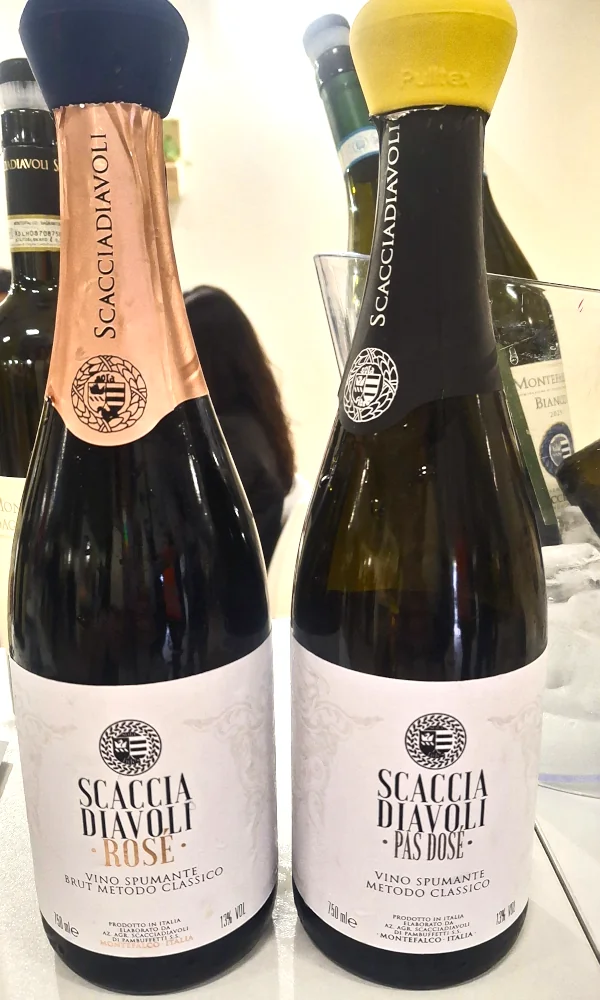 Outside the masterclass, the journey continued among the stands, confirming how Umbria is experiencing a brilliant moment. Scacciadiavoli remains a must-visit also from a wine tourism perspective. The monumental, partially underground fortress winery uses gravity for natural transfers: grapes and must enter from above, while wine descends to lower levels dedicated to aging. Founded in 1884 by Prince Ugo Boncompagni Ludovisi of Piombino, it was already avant-garde in the 19th century, with Umbria’s first specialized Guyot-trained vineyard. Today, the Pambuffetti family preserves its legacy. Worth noting are also the territorial sparkling wines: the Metodo Classico Rosé from Sagrantino, fresh and fragrant with red apple, citrus, and bread crust notes, and the Spoleto DOC Trebbiano Spoletino sparkling wine—creamy, mineral, spicy, and highly distinctive.
Trebbiano Spoletino indeed confirms its versatility also in sparkling wines. Spoleto Trebbiano Spoletino Spumante DOC, also made from at least 85% Trebbiano Spoletino, leverages the grape’s natural acidity to produce original sparkling wines—tense and fragrant—where citrus notes and immediate freshness blend with noble yeast and bakery nuances.
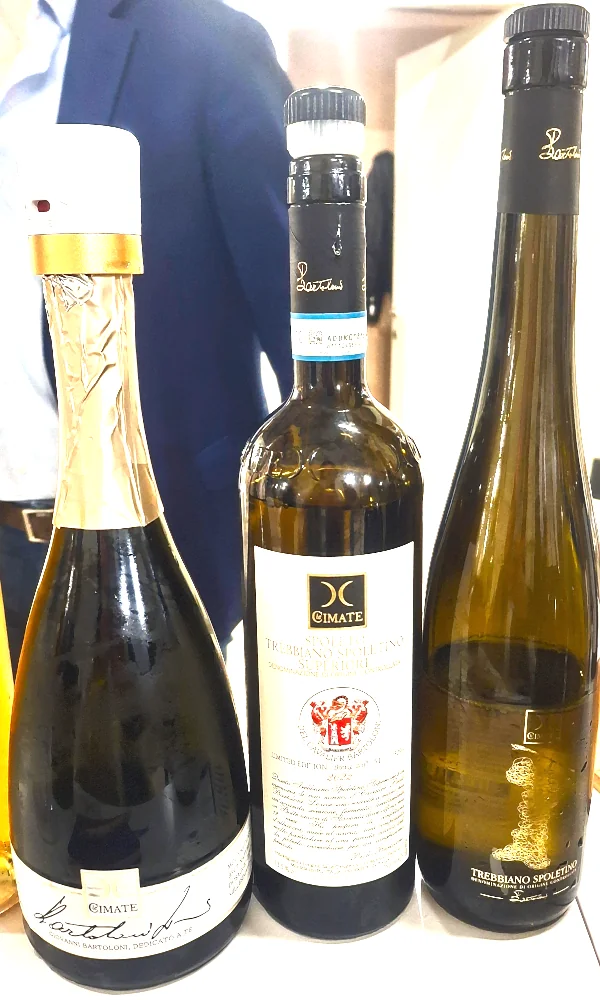 Another interesting face is Le Cimate, a project by the Bartoloni family launched in 2011 but rooted in a much older agricultural history. “Le Cimate” is not a constructed name: it refers to the hilltop where the estate stands, 28 hectares of clay-limestone soils purchased in 1993 from the Diocese of Spoleto, overlooking the Martani Mountains and Montefalco. Here, rural tradition, technological innovation, and sustainability coexist naturally in a modern, energy self-sufficient winery.
In the glass, this is confirmed by Trebbiano Spoletino Superiore “Del Cavaliere Bartoloni,” a high-level interpretation of the grape. After brief skin maceration, it ferments in French barrels, where it ages for twelve months, followed by further bottle aging. It presents an intense straw yellow with golden reflections. The aromatic profile is broad: acacia, dried apricot, ripe fruit, and mineral hints. On the palate it is full, structured, enveloping, with perfectly integrated wood supporting the substance without dominating it. The finish is long, elegant, and clearly suited for aging. A white wine to wait for.
In Bevagna, in the most authentic heart of the Sagrantino area, Mevante coherently interprets the Umbrian idea of total hospitality: wine, cuisine, landscape, and hospitality speaking the same language. The estate, established on east-facing hills since the 1990s, is now run by siblings Paolo and Antonella Presciutti, Roman entrepreneurs of Umbrian origin deeply connected to these lands, to the point of investing in the revival of a highly identity-driven agricultural reality. The name itself, Mevante, evokes the Levant—the rising sunlight that faces the vineyards and accompanies each working day.
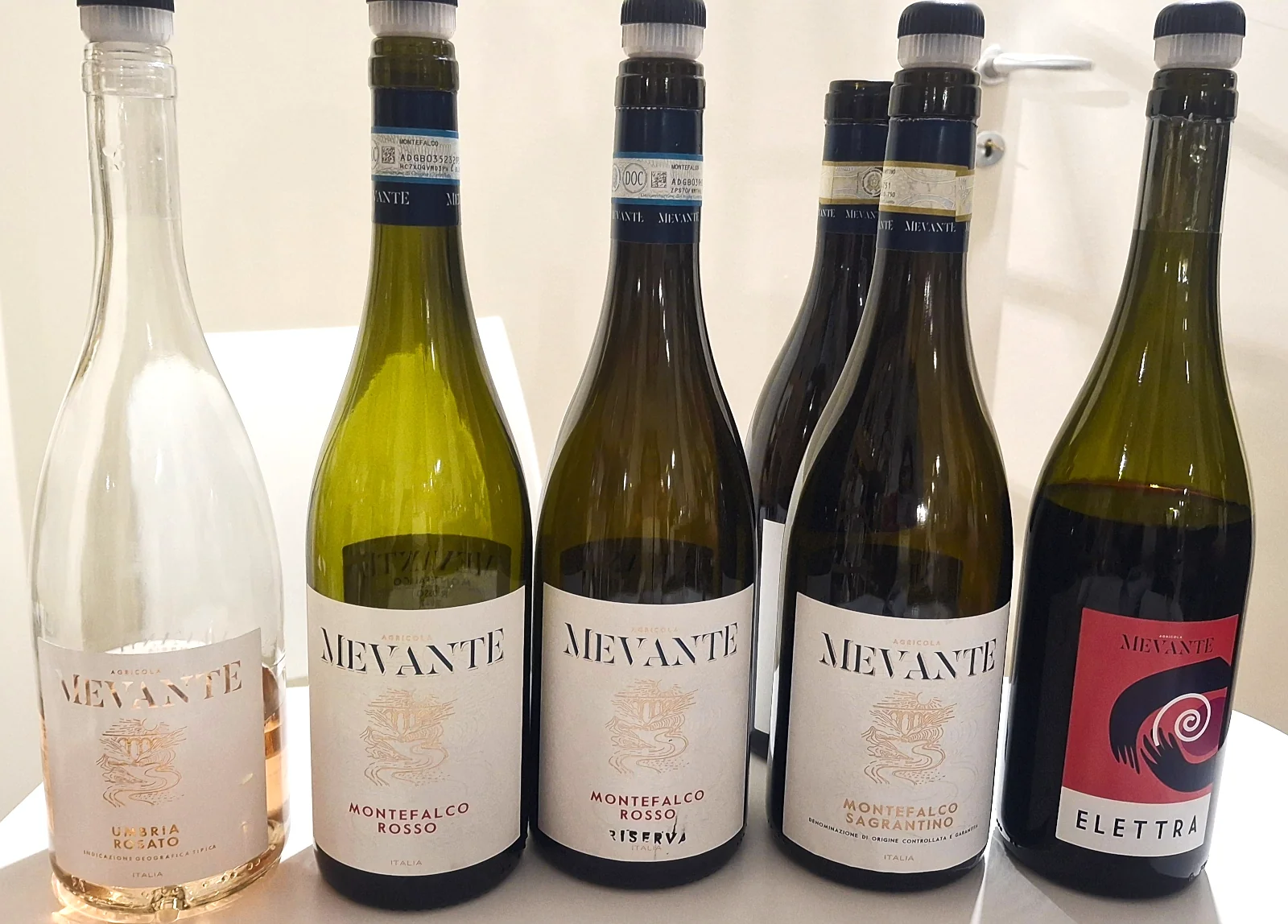
The property extends over a single 10-hectare block on soils of clay alternating with marl, silt, and ancient fluvial-lacustrine deposits—a matrix that gives depth, energy, and recognizability to the wines. The winery reflects a measured, intelligent philosophy: organized on two levels, allowing gravity-fed transfers that reduce mechanical stress on the wine and preserve aromatic integrity. Underground aging rooms naturally maintain constant temperature and humidity, favoring slow, precise maturation with minimal energy consumption.
From this balance comes a Montefalco Sagrantino DOCG of notable depth, where plum jam meets dark spices, balsamic hints, and a clean licorice finish. Substantial matter, always guided by order and tension.
Here, however, the story does not end in the glass. It continues at the table, in the estate’s agricultural restaurant, where Umbrian tradition is reinterpreted with contemporary sensitivity without betraying its soul: vegetables grown on-site, farm-raised cured meats, and local recipes executed with precision. It is one of those places that remind you how, on these hills, wine is never separate from food, landscape, and the very meaning of hospitality.
Finally, Arnaldo Caprai, a symbolic name in the contemporary rebirth of Montefalco and the definitive international recognition of Sagrantino. A reality that needs no introduction, capable of marking a before and after in the recent history of the denomination. From the pioneering vision of Arnaldo Caprai to the leadership of Marco Caprai, the winery has transformed a great local grape—long known mainly within regional borders—into one of Italy’s most recognizable and ambitious red wines.
Thanks also to continuous work in agronomic research, enological precision, and territorial valorization, Sagrantino has progressively revealed a more complete profile: not only power and structure, but also balance, elegance, and aging potential. In this direction also fits the consultancy of Michel Rolland, initiated in 2015, which supported a new stylistic phase without ever distorting the grape’s identity.
The 25 Anni 2020, tasted at OperaWine, remains one of the most authoritative expressions of this vision: blackberry jam, plum, nutmeg, pepper, pine resin, cocoa, and mint intertwine in a complex, layered profile. The palate is broad, enveloping, and endless, with dense yet composed tannins and freshness supporting the progression.
The entry of Angelini Wine & Estates into the company’s ownership structure represents a further sign of confidence in Montefalco and in the international potential of Sagrantino. More than a simple corporate operation, it appears as the definitive recognition of the value achieved by this territory: confirmation that Sagrantino now possesses the stature, identity, and credibility to sit permanently at the table of Italy’s great red wines alongside the most celebrated denominations.
What strikes today about Umbria is not only the quality of its wines—now well established—but the completeness of its narrative: within just a few kilometers coexist highly original whites, gastronomic reds, long-aging wines, medieval villages, olive groves, great cuisine, and sincere hospitality. Montefalco is no longer just the homeland of Sagrantino, but a mature, multifaceted denomination—modern without losing its roots. And, for this very reason, one of the most fascinating in Italy.