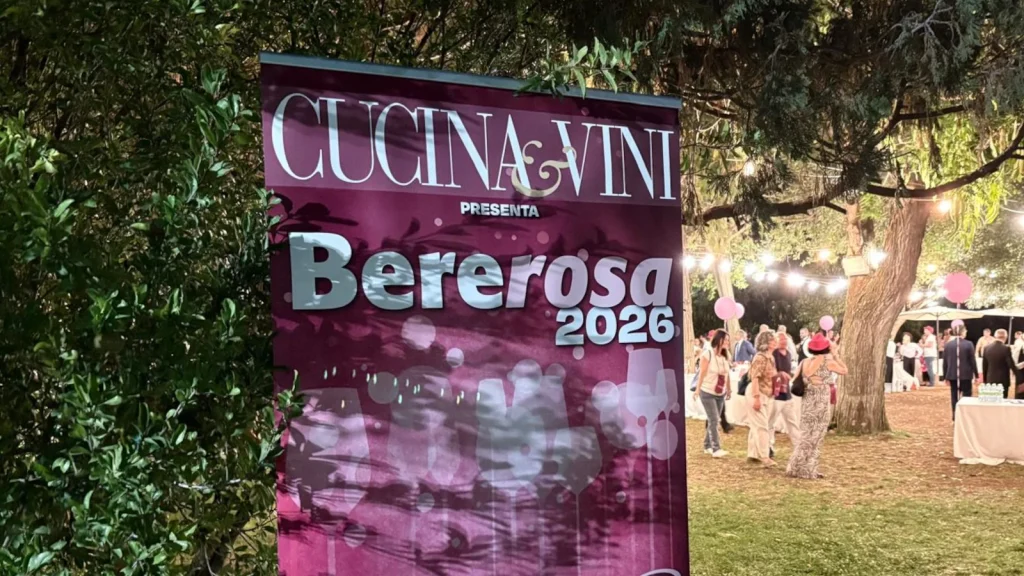
For years, rosé wine searched for legitimacy. It had to live with the prejudice of being a “lesser” wine: too simple for seasoned enthusiasts, too summery to be taken seriously, too closely associated with passing trends to earn an identity of its own. Today, however, that chapter appears to be over. Not because rosé has suddenly become a different wine, but because the way people perceive it has changed.
Explaining this evolution is Francesco D’Agostino, founder of Bererosa and director of Cucina & Vini. For more than twenty years he has observed the evolution of rosé wines and, perhaps before many others, understood that their future would not depend on trying to imitate great reds or great whites, but on embracing their own distinctive identity.
“For a long time, I also focused on telling the story of the great rosés,” he admits. “I still look for them because Italy produces extraordinary rosé wines that deserve a place on the finest tables in the world. But over time I realized that this is not where the true strength of rosé lies.”
Its strength, he explains, is something else entirely. It lies in its immediacy, its ability to be understood without barriers, and its capacity to bring joy. “To me, pink represents joy, even in wine.” It is a simple sentence that perhaps captures better than any technical definition what this category represents today.
Until a few years ago, rosé often seemed to be trying to prove something. Today, consumers choose it precisely because of what it is. Not a compromise between white and red wine, but a style with its own personality, capable of accompanying a wide range of occasions while remaining authentic. And, above all, it is no passing trend.
According to Franceso, the market is simply placing rosé where it has always belonged. Great, complex rosé wines will continue to exist, but their broader mission is to bring more people closer to wine. That philosophy has inspired Bererosa since its very first edition in 2010, when dedicating an entire event to rosé wines seemed almost like a gamble. “I thought nobody would come,” he recalls. Instead, the venue was packed from the very first edition.
The idea had actually taken shape years earlier. In the early 2000s, D’Agostino published one of Italy’s first guides devoted entirely to rosé wines. It was a pioneering project that revealed just how little the public knew about the category. “Mostly producers were reading it,” he says with a smile. Many consumers still believed that rosé was simply made by blending red and white wine. Today, that perception has completely changed.
The audience has changed as well. Walking through Bererosa 2026, one cannot help noticing the large number of visitors under thirty. For Francesco, this is one of the most encouraging signs of recent years.
Yet it is precisely when talking about younger generations that he offers perhaps the most thought-provoking reflection of the interview.
“Young people are not to blame.”
He says it without hesitation.
According to D’Agostino, the problem is not that younger generations dislike wine. The problem is that no one has introduced them to it.
“My generation is responsible. We stopped putting wine on the family table.”
In the past, wine was naturally part of everyday family life. Children grew up seeing it at lunch and dinner, gradually learning what it represented. That cultural transmission has been interrupted. Soft drinks, cocktails and spirits have taken its place, while wine has gradually disappeared from the food culture experienced by entire generations.
For this reason, he believes there is no need to invent a completely new language for wine. What is needed is to bring wine back to people.
“Events like this are meant to do exactly that: introduce wine to young people.”
This philosophy also shapes his approach to communication. Much is said today about finding a new language to attract new consumers. Francesco D’Agostino is not convinced that this is the real issue. The technical language of wine tasting, he explains, is rooted in sensory science and cannot simply change. What can—and should—change is the storytelling: the ability to communicate wine in ways that resonate with different audiences without sacrificing accuracy or cultural depth.
Colour, of course, has also played an important role. “Pink is probably the most attractive colour in wine today,” he observes. But attributing rosé’s success to marketing alone would be simplistic. Twenty years ago, many rosés lacked a clear identity. Today, quality has improved dramatically. Styles differ, regions differ, but almost every rosé now expresses a genuine sense of place. According to D’Agostino, that is the real revolution.
Looking back, he would make the decision to create Bererosa again without hesitation, just as he would once again publish a guide dedicated to sparkling wines at a time when very few believed there was an audience for it. More difficult, instead, is discussing what he would not do again. Among those experiences he mentions Lazio Prezioso, a project in which he invested significant time and energy to promote the wines of the Lazio region. He does not question the quality of those wines, but acknowledges how challenging it remains to build a shared vision in a region that, in his opinion, still bears the weight of its history.
Meanwhile, Bererosa 2026 closes another successful edition. Weather forecasts had caused concern throughout the morning, with many visitors calling to ask whether the event would be postponed. In the end, the park filled with people just as it had in previous years, and the final balance was overwhelmingly positive.
Perhaps that is the image that best describes the current moment for Italian rosé wine: a wine that no longer feels the need to justify its existence, but has finally found its rightful place in the glass—and in contemporary wine culture.