There are stories that are not born in a laboratory, but around a table. They carry the soft sound of hand-rolled pasta, the rich aroma of ragù simmering slowly, and that suspended light of Italian Sundays, when everything slows down and seems to remain there, just a little longer.
Leonetta’s story begins like this. In a family kitchen, in Mugello, in Le Caselle, a hamlet of Vicchio, where grandmother Leonetta guarded her world of simple yet perfect gestures. It was not just cooking: it was a ritual repeated over time, an act of love.
Tagliolini, tortelli, lasagne, flour-dusted hands, long tables, overlapping voices. And then, inevitably, came the liqueur: poured slowly after coffee; homemade, secret, intense. For years, for her grandson Andrea, it remained only a color, a fragrance, something that could only be imagined. Until the right moment came.
“As soon as I reached the age when I was allowed to taste it, I understood how special it was, and almost immediately I began asking her to give me the recipe. In vain. My grandmother’s answer was always the same: ‘As long as I’m alive, you’ll drink mine.’” Within that sentence lies everything. Her character, yes, but above all a way of loving, preserving, protecting, remaining necessary. That recipe was not just a formula; it was her space, her way of continuing to be there, every single time, within that final gesture that closed the meal and opened memory.
And then, one day, that recipe finally arrived. Written down, fragile, silent.
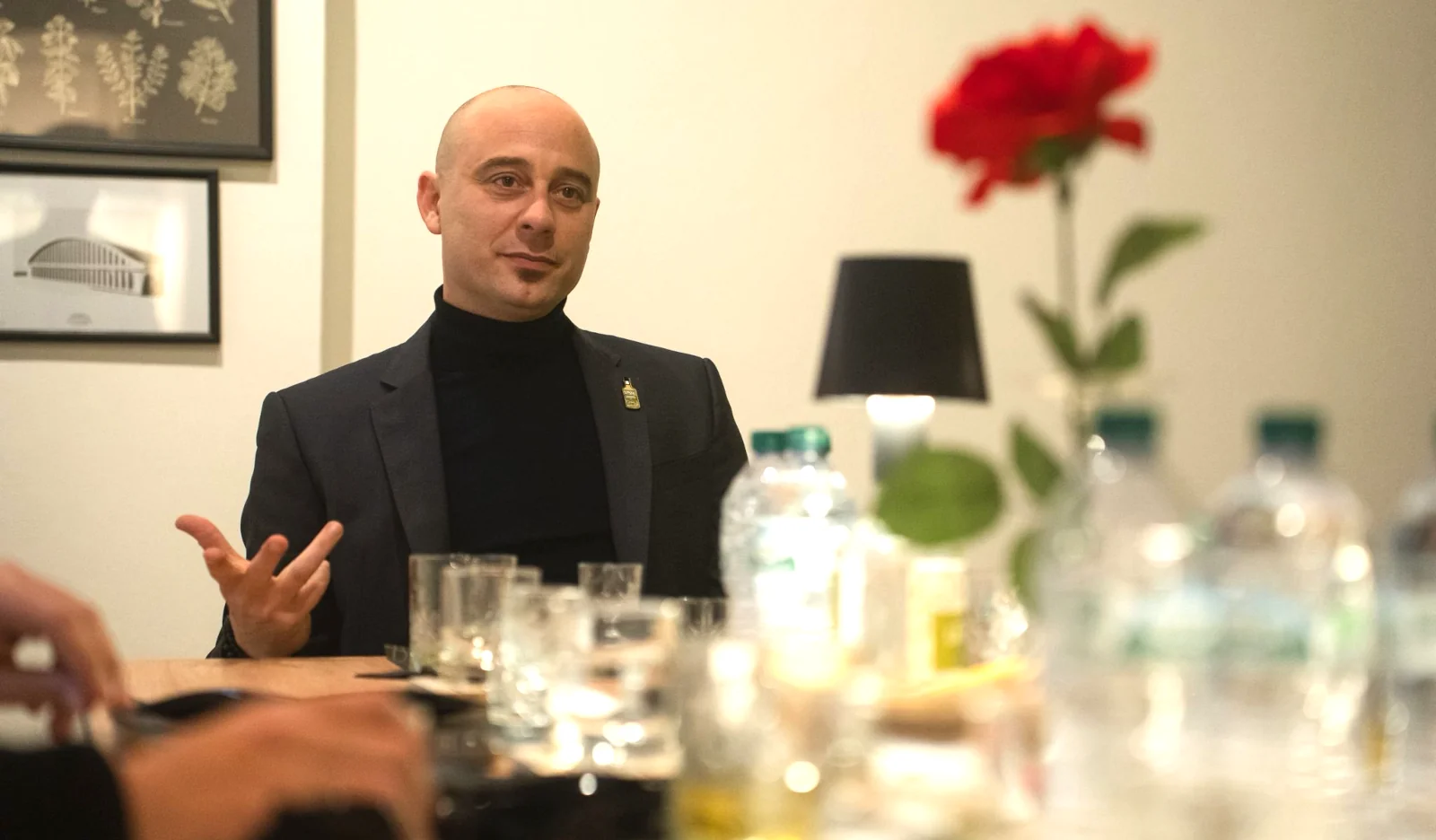
Andrea Fiesoli did not simply recover it. He listened to it, understood it, and made a choice that is far from obvious: not to turn it into something cold, replicable, distant. Leonetta, in his words, had to become “a story to drink.” Not a product, but a narrative. Something capable of holding together family, territory, and inherited gestures. A memory born in Mugello in 1932 and carried through to today without losing its authenticity.
Bringing all of this out of a kitchen is a delicate balance. It means resisting the temptation to simplify, to standardize. It means remaining faithful, even while growing. This is why Leonetta never raises its voice. It does not try to impress. It remains elegant, measured, recognizable. It can stand on its own as a digestif, or enter the language of mixology without ever losing itself. It is a memory that does not stop, but continues to live.
Today every choice follows this direction: quality, first of all, even at the cost of producing less. Carefully selected raw materials, local herbs, long timing. Because here sustainability is not a word, but an attitude. It means protecting a body of knowledge, a landscape, a way of doing things that cannot be reconstructed once lost.
The day dedicated to the press begins in Florence, at Santa Maria Novella station. Waiting for us is Andrea’s father, holding a “Tuscany Liquors” sign. A simple gesture, almost ironic, yet one that already says a great deal: here, you are welcomed. During the drive to Scarperia, something almost imperceptible happens. At first we are strangers. Then, mile after mile, the distance shortens. Words come more easily.
For me, having grown up in Luco di Mugello, that journey is different. It is not just a transfer, but a return to summers at my grandparents’ house, to a kitchen that smelled of sauce from the early morning, to gestures learned without even realizing it. And perhaps for that very reason, once we arrive, everything feels natural.
Andrea welcomes us by opening the doors of his showroom as if they were the doors of his home, without distance, without construction. Breaking the ice, in every sense, is Adamo Balsamo, a bartender with an international background between India and the United Kingdom, now Leonetta’s Brand Ambassador. His way of working is direct, essential, without superstructures. He does not add, he does not cover: he leaves space.
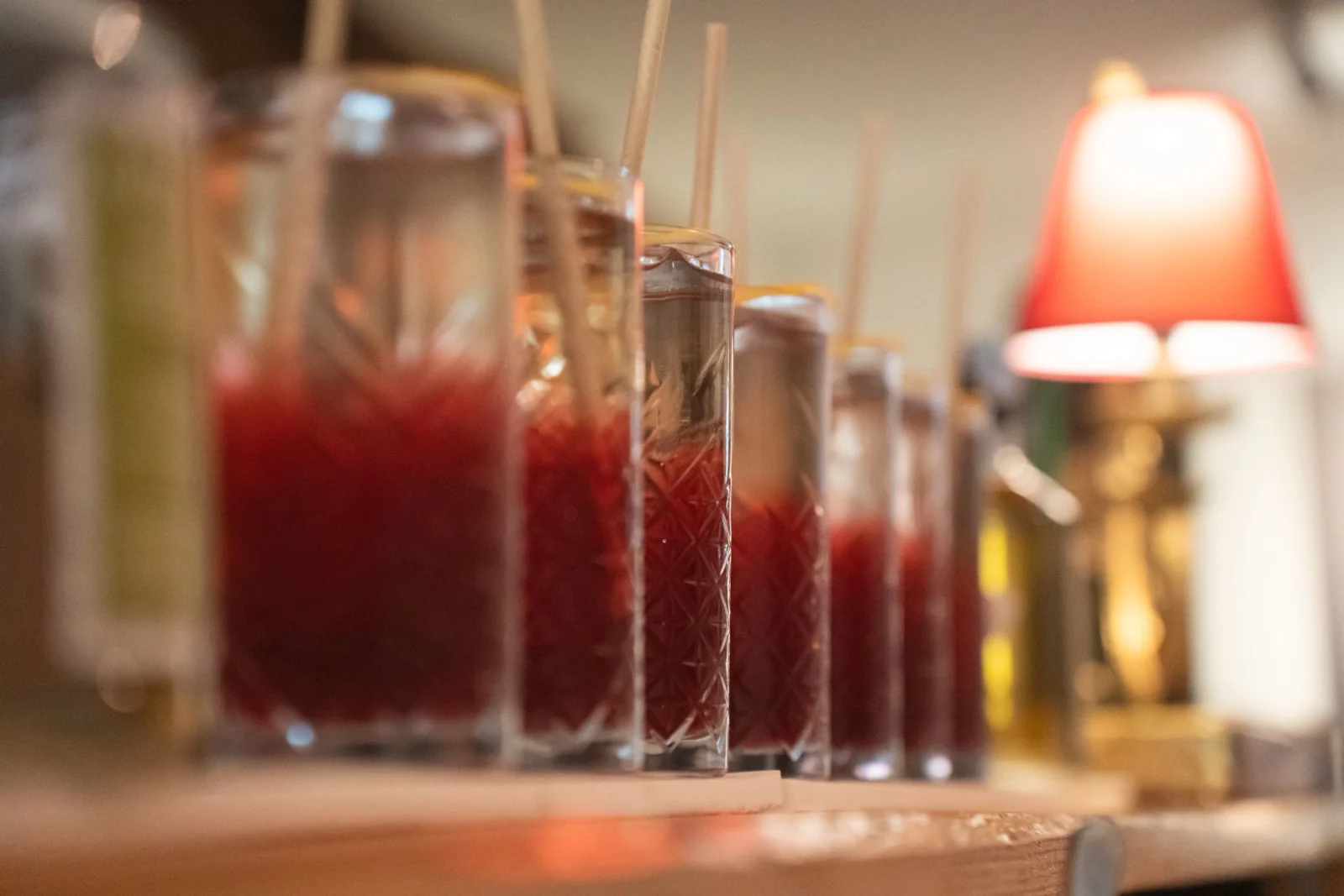
The cocktail he presents is a contemporary highball built around Leonetta. Blanco tequila infused at low temperature with wild blueberries, compact ice, a light spray of bergamot essential oil, lemon peel. Everything is calibrated, measured.
And it works, because Leonetta remains at the center; it is not transformed, but accompanied. Lunch at Gottino 138 unfolds the way things should unfold in Mugello: without forcing. The owner, having discovered my Mugello origins, jokes with me about the “potato tortello test” — one of those jokes you fully understand only if you belong to this place — and in an instant you feel part of something.
Then comes a surprise: Leonetta panna cotta with fresh fruit. And here the liqueur changes role, opens up, becomes an ingredient. It does not close the meal, it accompanies it. It is exactly what Andrea means when he speaks of Leonetta as part of the experience rather than as a simple ending.
After lunch we move into the tasting room. The atmosphere changes, becoming more intimate. Words thin out, leaving space for listening. It is there, between quiet exchanges and full silences, that Leonetta truly begins to tell its story. Mugello is in the glass. Not evoked, but present.
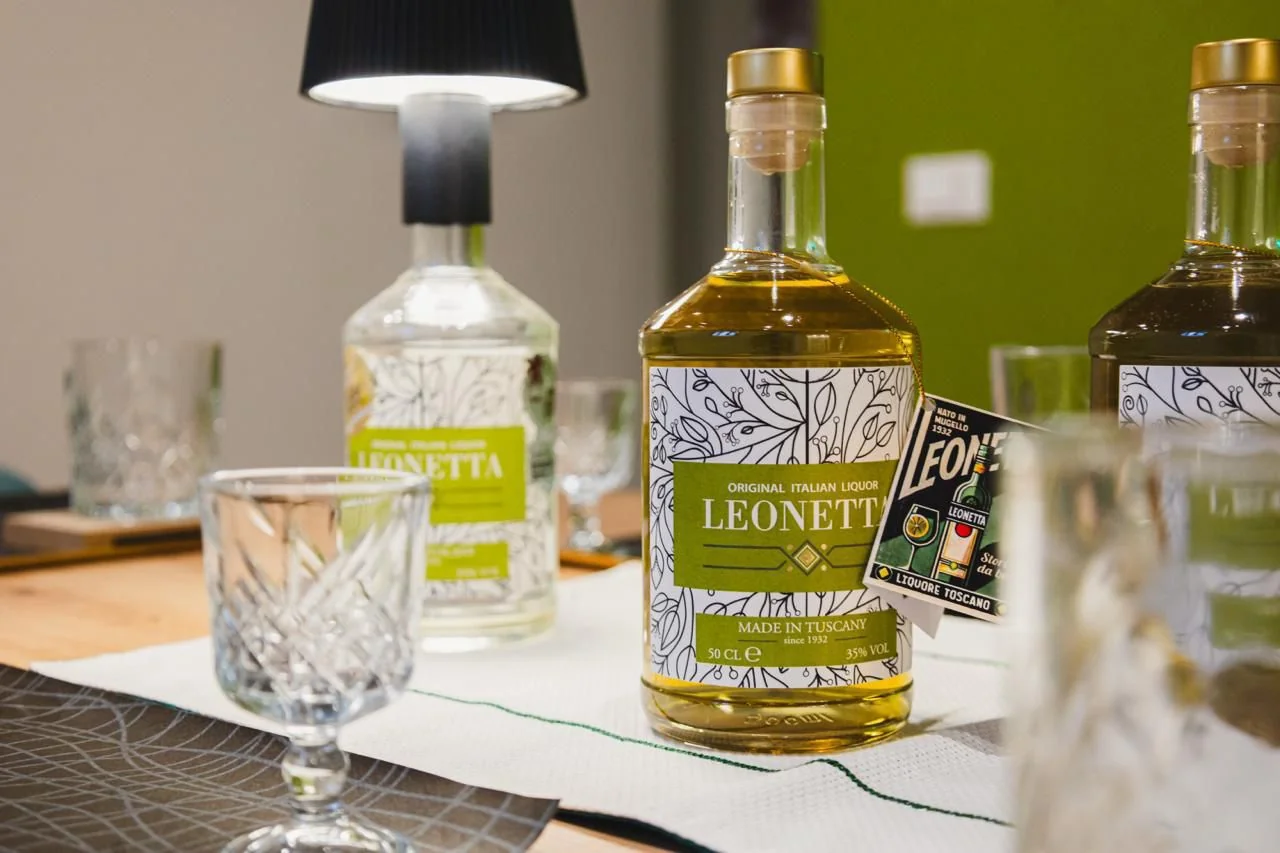
Leonetta appears in a crystalline golden hue with green-gold reflections. The aromatic herbs of Mugello are not scenic references, but living substance. Gentian, pine resin, bay leaf, fresh juniper berries, verbena leaves, cardamom, peppermint: a balsamic opening that then unfolds into deeper vegetal notes, among olive leaf, sage, flowering rosemary, helichrysum, and myrtle. The sweetness of candied citron and ginger accompanies a full palate, supported by a citrusy freshness that extends the finish into an elegant and measured persistence.
Alongside the classic version, Leonetta Premium Barrel Aged represents a further step in the pursuit of refinement. Three months of aging in 16-liter medium-toast French oak barriques accelerate the dialogue between liqueur and wood, giving life to an intentionally limited production. The color turns toward amber, while the aromatic profile gains new depth: bay leaf and eucalyptus open the scene, followed by shea butter, cocoa beans, bourbon vanilla, and carob. The spice evolves toward nutmeg and white pepper, while on the palate the enveloping softness recalls chestnut honey and cocoa butter, in a long and coherent finish.
But the more one listens to it, the clearer it becomes that this is not only a matter of notes, aromas, or technique. It is something you recognize. It arrives gently, without forcing, and suddenly brings everything back: the kitchen, the table, the flour-dusted hands, the intertwining voices. And her, at the end, pouring that liqueur with the same gesture as always.

It is not nostalgia. It is something deeper. It is continuity. And then you understand that Leonetta has not changed; it has simply found a new way to remain, without losing anything of what it once was.