Key Insights from Benvenuto Brunello 2025
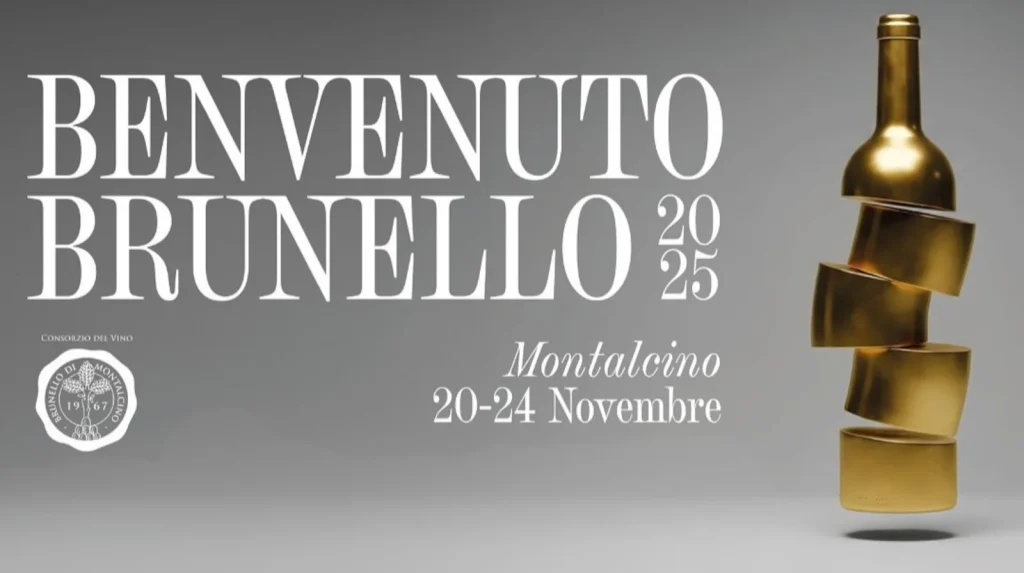
Montalcino, in late November, has a different kind of energy. The Chiostro di Sant’Agostino fills once again with notebooks and glasses for Benvenuto Brunello which, in its 34th edition, confirms its role as Italy’s longest-running preview event. From 20 to 24 November, 122 wineries took center stage along with around 100 journalists and wine experts, nearly half from abroad, with the U.S. delegation leading the way alongside the U.K., Canada, Korea, and several Northern European countries. After the days reserved for the press, the Chiostro gave way to the walk-around tastings, where producers, wine lovers, restaurateurs, and sommeliers exchanged impressions and visions on Brunello 2021, Brunello Riserva 2020, and Rosso 2024.
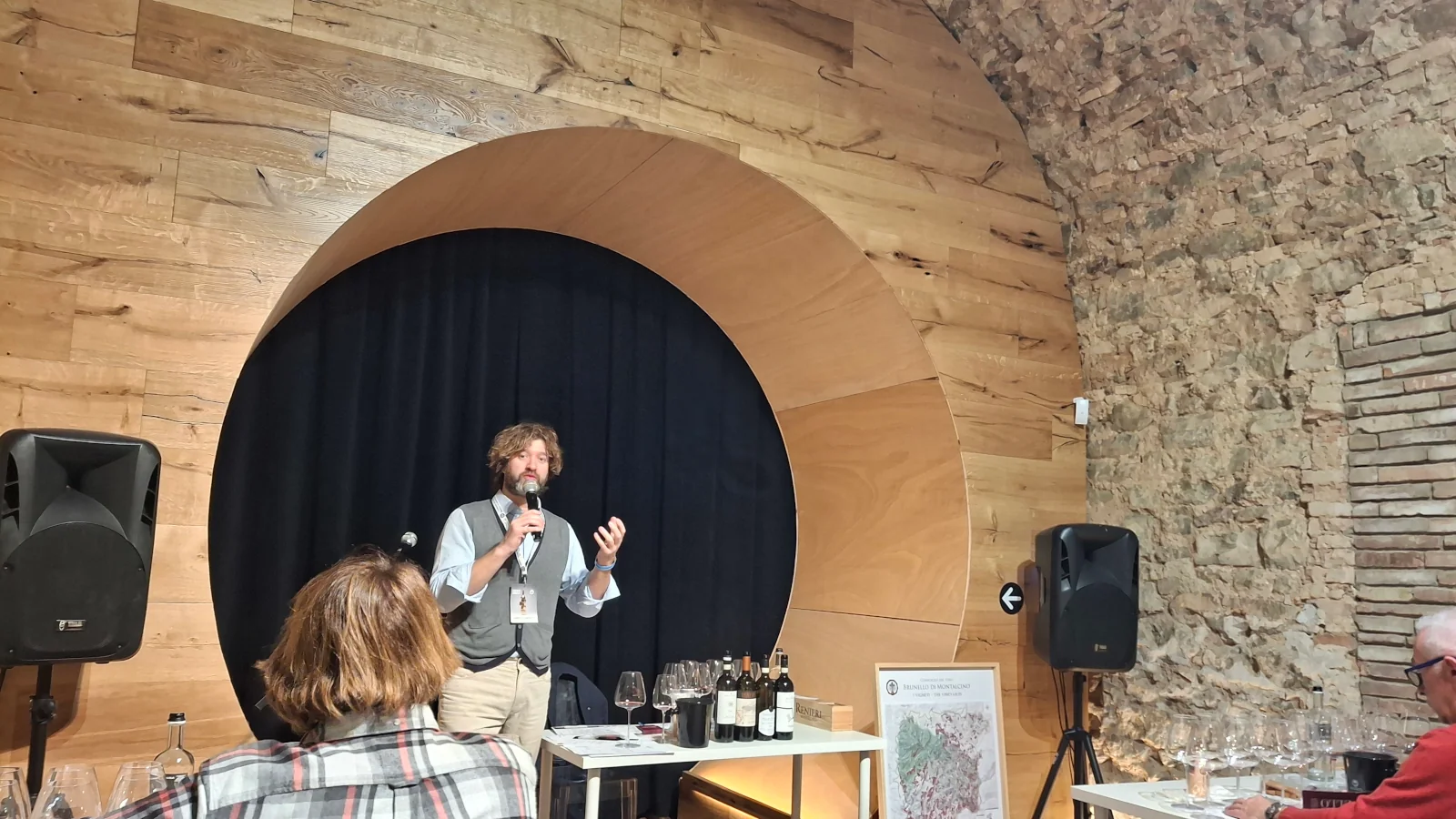
Within this program, I had the chance to attend the masterclass “Brunello at the Summit: Riserva 2019 and Vigna 2018” led by Giambattista Marchetto: a journey designed to observe Brunello from the height of its most identity-driven expressions—those that narrate the territory through parcels, exposures, and micro-histories. Marchetto offered three key words to define the idea of “summit”: depth, meaning a wine’s ability to dig into time and stretch across years; patience, because without time there is no Brunello; and plasticity, the notion that Brunello is not a single wine, but a sum of expressions—none more representative than another—shaped by differing slopes, altitudes, and hands. Each winery was asked to choose one identity word: a simple gesture that made the tasting sharper, almost intimate.
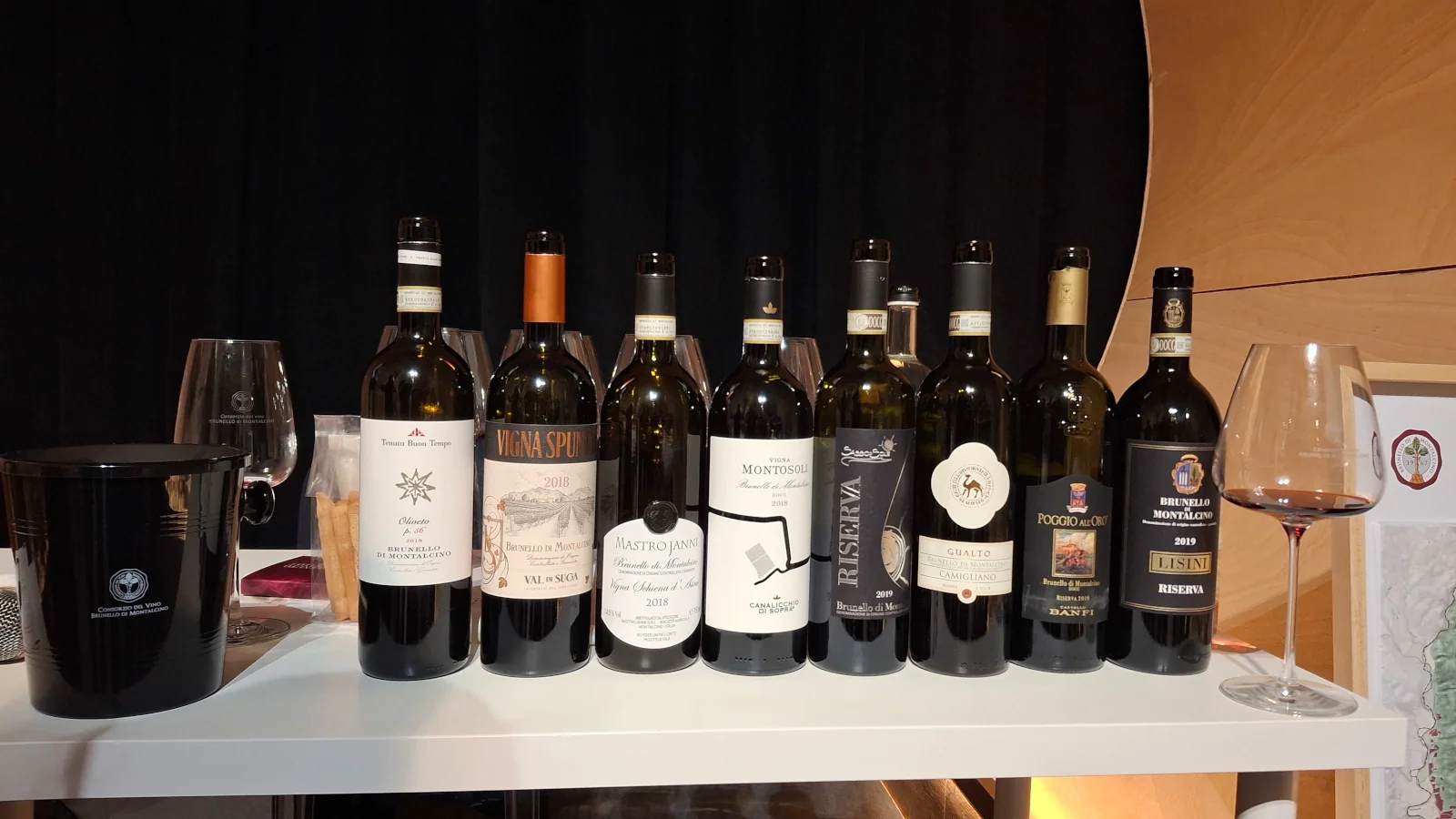
The first stop was Tenuta Buon Tempo with Brunello di Montalcino Oliveto P.56 2018. We are in the north, just after descending from Montalcino, in the heart of Podere Oliveto, already mentioned in 1941 when it belonged to Rossini Martelli and was farmed in sharecropping, mainly with olive trees. The first vineyard arrived only in 1994, right in parcel 56: today it is the estate’s oldest vineyard, where the best clusters are harvested. Per and Janet, coming from opposite ends of the world and united by a love for the art of wine, saw in this place the chance to realize a dream: to craft a Brunello with restored concentration, energy, and evolutionary power. “Concentration” is in fact their key word. Oliveto P.56 is born at 350 meters from carefully selected grapes: a medium-dense carmine shifting to garnet; on the nose mulberry, the balsamic lift of bay leaf, dried violet, and a faint blood-tinged note. On the palate, fruit-driven acidity leads the sip and melds with a central, fine tannin that conveys an austerity still opening up. The fresh, rainy 2018 vintage was interpreted with a search for density and depth: a powerful but balanced wine that asks for time.
We then move to Val di Suga with Brunello di Montalcino Vigna Spuntali 2018. The estate takes its name from the Suga stream. Vigna Spuntali lies on the southwest side at 300 meters, in a dry Mediterranean climate, well ventilated, with sandy soils from pietraforte degradation, surrounded by olive trees and Mediterranean scrub of myrtle, rosemary, and helichrysum. The chosen key phrase is a triptych: “Volume, Fleshy Texture, Pleasure.” The color is a deeper ruby than the previous wine; cherry is accompanied by bay leaf balsamic notes, then hints of rosemary and a touch of iron. The palate shows a soft entry, with a more yielding tannin integrated into the acidic backbone. Val di Suga opted for a slightly earlier harvest to preserve agility and elegance: the result is a subtle yet fleshy wine, highly enjoyable.
In Castelnuovo dell’Abate, Mastrojanni presents Brunello di Montalcino Vigna Schiena d’Asino 2018, a great classic of the southeast sector, where the Orcia river and Mount Amiata create a unique microclimate. Founded in 1975 by lawyer Mastrojanni, the estate entered the Illy group in 2008 and began organic conversion in 2022 with Francesco Illy. Schiena d’Asino is a vineyard of old vines, facing southeast and southwest at 385 meters, on ancient lacustrine soils of lignite-rich clays, sandstones, sands, and conglomerates. The chosen key word is “Being There”: to bottle only when the wine is ready to express the best of the vintage. The color is a vibrant, dense carmine with garnet reflections; the nose is a pot-pourri of violets and roses, with the sweet nuance of violet candy, bay leaf, juicy cherry, forest floor, and smoky notes reminiscent of flint. The palate is a manifesto of elegance: subtle yet persistent freshness, horizontal depth, great fruit-driven length. Here 2018 yields a fresh, vertical Brunello with a rich soul.
The vineyard series closes with Canalicchio di Sopra and its Brunello di Montalcino Vigna Montosoli 2018. We are on the northeast slope, across 60 hectares (19 under vine) within a UNESCO landscape. Canalicchio is foundational in Brunello’s history: the estate’s first bottle dates to 1966, and in 1967 it was among the 12 founding wineries of the Consorzio. Montosoli, a historic cru, is interpreted here with rigor: vineyards planted in 1997 between 215 and 255 meters, on galestro and clay-loam soils rich in silt and stones that raise pH. The result is structured, mineral, savory wines, sustained by acidity and ideal for aging. The chosen key words are “Transparency” and “Infinity.” In the glass, a concentrated ruby with carmine glints; on the nose bay leaf, dried mint, licorice root, dark mulberry and cassis, dried rose, forest floor, roots, and tree bark. The palate is full and taut, with central fine tannins, fruit-driven freshness, and a saline trail typical of the cru: an endless finish, dynamic tannins, a wine that demands time—and will reward it.
From vineyards to the 2019 Riserve, a masterful vintage in Montalcino that needs no introduction. Leading the series is Sassodisole – Brunello di Montalcino Riserva 2019: the Terzuoli family, long-time growers, farms ten hectares in the northeast between 280 and 320 meters on Pliocene soils of medium texture with stones. “Always” is their key word: a wine to enjoy today and a decade from now. In the glass, a vibrant ruby with carmine nuances; on the nose eucalyptus, mulberry, cassis, wet leaves, tobacco, nutmeg and cardamom spices. A dynamic sip, fruity tannins, blood-orange acidity, and a saltiness that lengthens the fruit. Pure plasticity: a Brunello without special effects, yet profoundly unique.
Next comes Camigliano, a place with an ancient soul: a village set among woods and Etruscan traces, later a fortified medieval outpost. A territory that has preserved its rural essence—a trait reflected in the winery’s style. All Camigliano wines rest in cement before bottling, a stage that relaxes the wine after the constraints of wood, allowing Sangiovese’s varietal identity to emerge with pride.
Brunello di Montalcino Riserva Gualto 2019 is the estate’s super-selection, and in 2019 it finds an ideal ally. The color is a compact ruby; the nose opens with a deep balsamic profile of eucalyptus, wild incense, and licorice root, followed by mulberry, cherry in spirit, and forest floor recalling humus and mushroom, with balsamic cardamom to close. On the palate, the southeast exposure brings a perceptible alcohol note (14%), but structure and freshness balance it harmoniously. The tannin is central, fine, vibrant, stretching in progression and leaving whispers of dried fruit. An intense yet balanced Riserva, “rooted in Camigliano’s classicism,” with promising aging potential.
Lisini – Brunello di Montalcino Riserva 2019
Lisini is one of the pillars of Montalcino’s southwest side, on the hills overlooking Sant’Angelo in Colle, where sea currents from the Maremma reduce rainfall and fog, creating a unique microclimate. Here, 27 hectares of vineyards lie between 350 and 500 meters. The production philosophy is traditional: strict selection, healthy grapes even in difficult vintages, long aging in large Slavonian oak casks.
The 2019 Riserva—made only in the best vintages—was conceived as a “synthesis of the territory,” the key phrase chosen by the winery. In the glass it displays a dense, vibrant ruby. The nose is instantly ethereal, then layers into cherry in spirit and crème de cassis, followed by a deep eucalyptus balsamic note. Rhubarb and tamarind emerge over hints that recall chinotto, then elegant cardamom spice, damp tobacco, and chocolate intertwined with mentholated and fruity cherry accents—an interplay reminiscent of After Eight and Mon Chéri.
On the palate, structure is immediately evident, typical of Montalcino’s warmer southern sector, yet 2019 brings balance: freshness embraces savoriness and lengthens the sip with returns of fruit in spirit. The tannin is flavorful, dense, and progressive: it “hammers” without ever blocking the flow, integrating with the acidic spine to create depth. This is a wine destined for important evolution: once the tannin completes its polymerization, it will reveal the full maturity of the fruit and the complexity already glimpsed in the glass.
Banfi concludes with Brunello Riserva Poggio all’Oro 2019, from a single vineyard planted in 1979 at 250 meters on a natural northwest-facing terrace. Poggio all’Oro, planted in 1979, is the estate’s first cru and is produced only in exceptional vintages.
The soils are a complex mosaic: brown clay-silt sediments, stones, calcareous pebbles, significant structure, and optimal drainage. A terroir naturally inclined to longevity, which Banfi interprets as an “iconic” expression—the word chosen to represent its identity.
In the glass, the 2019 shows a dense, vibrant ruby. The nose is deep: eucalyptus and licorice root open onto meaty notes of humus and iron nuances. The forest floor is humid, rich in roots and tobacco leaves; fruit emerges later, evolved, in cherry gelée and dried orange wheel. A pot-pourri of dried flowers—rose and violet—completes a complex yet precise aromatic profile.
The palate is dense and structured: you feel the matter, the fruit flesh embracing a present tannin, fine in grain but still short in molecular expression, just at the beginning of its polymerization, with a slightly earthy touch adding chew and depth. Acidity acts as natural balance, lightening the weight of the sip and guiding it toward a savory, persistent finish.
Poggio all’Oro 2019 is a Brunello that unites power and elegance, breadth and discipline, in one of the vintages that most exceeded initial expectations. Iconic not by self-proclamation, but because it embodies what Banfi aims to express: a solid, recognizable Brunello, built to challenge time without losing its territorial imprint.
This immersion in the “high” vintages was the perfect prologue to the preview of Brunello 2021. A vintage marked by a particularly dry summer, significant diurnal shifts, and a very cold spring, culminating in the April frost that delayed the vegetative cycle and, in some cases, reduced yields. A still-warm September pushed harvest into the second decade and early October. The result? Soft tannins, freshness not always incisive, perceptible alcohol, ripe fruit: not an epic vintage, but a decent one, especially given the climatic complexity. The major question concerns the future evolutionary capacity of such warm vintages, now increasingly frequent. Yet the glass suggests that producers have learned to navigate these difficult years.
 Among the wines that stood out for me:
– Brunello di Montalcino 2021 – Fuligni, for aristocratic balance;
– Brunello di Montalcino Ciliegio 2021 – La Magia, for energy and fruit expression;
– Brunello di Montalcino 2021 – Corte dei Venti, for clarity and detail;
– Brunello di Montalcino “Poggio Severo” 2021 – Lisini, for territorial coherence;
– Brunello di Montalcino “A Diletta” 2021 – Col di Lama, for drive and finesse.
2019 remains the high benchmark—sculpted and profound; 2018 expresses freshness of slopes and the value of finesse; 2021, with its more immediate maturity and less taut freshness, is the mirror of a territory that has learned to interpret warm years without losing identity. Not an epic vintage, but an honest one—and in that honesty, one senses the shift underway.
At Benvenuto Brunello 2025, the denomination chooses the path of transparency, placing place, vineyards, and detail back at the center.
This is where Montalcino is moving: toward a more sincere, plural narrative, where every vintage is a piece of truth and not a stylistic exercise.