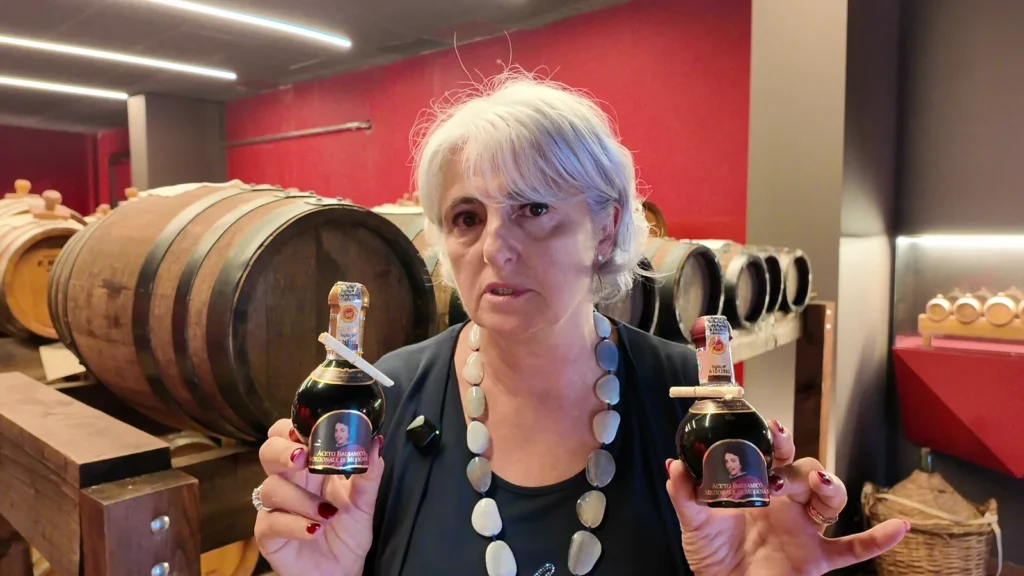
In the attics of Modena, balsamic vinegar has never been merely a condiment. It is a story of families, barrels passed down through generations, cooked grape must and decades of patient waiting. A heritage that is now finding new ways to remain alive without losing its connection to its origins.
Some products tell the story of a place through flavour. Others seem to preserve its very memory. Traditional Balsamic Vinegar of Modena PDO belongs to the latter category. Its history is certainly one of grapes, wood, fermentation and acetification, but above all it is a story of families, time and a domestic tradition that remained hidden for centuries in the attics of Modena’s homes.
Perhaps this is the first thing that helps us understand what makes it so distinctive. Long before it became a protected product, commercially available and internationally recognised, Traditional Balsamic Vinegar was part of family life. It was carefully preserved, passed down through generations, sometimes mentioned in wills and regarded as a precious dowry. The word “Balsamico” first appeared in Modena’s historical records in the 1747 Inventory of the Ducal Cellars, although the product’s roots can be traced much further back, to the Roman practice of cooking grape must and the subsequent development of fermentation and acetification techniques.
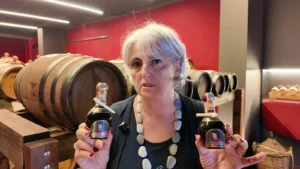
“Balsamic vinegar has a very long history, and our family’s story is closely intertwined with this tradition,” Mariangela Grisoli explains during our visit. “Its origins probably lie in what we now know as Traditional Balsamic Vinegar of Modena PDO, a product that, until 1983, remained essentially within the attics of Modenese families.”
This domestic tradition had a ritual of its own: the birth of a child.
“When a child was born, the family would start a new battery of barrels,” she explains. “The balsamic vinegar would mature as the child grew, and nobody would touch it until it was eventually given as a dowry to the young man or woman when they reached adulthood and left the family home. That is why we often say we are not producers of balsamic vinegar, but custodians of something handed down to us by our grandparents and great-grandparents.”
The batteria, or battery of barrels, remains at the heart of production today. It consists of a series of small wooden barrels of progressively different sizes, in which the vinegar evolves through annual transfers and topping up. The only ingredient in Traditional Balsamic Vinegar of Modena PDO is grape must, obtained from grapes grown in the province of Modena and cooked over direct heat until it reaches the desired concentration. The production specifications require every stage, from harvesting to bottling, to take place within the province.
The cooked must is left to rest before beginning its slow transformation in the barrels. Each year, the producer starts with the smallest barrel: the quantity drawn off is replenished with vinegar from the next barrel in the series, and the process continues until reaching the largest, or mother barrel, which is topped up with newly cooked must. This is a continuous process, involving far more than prolonged ageing: it is a genuine microbiological and aromatic evolution. As the Consorzio’s press materials point out, time is only one of the “ingredients”, alongside the quality of the grapes, the way the must is cooked, the different types of wood, the size of the barrels, the microclimate of the acetaia (traditional vinegar cellar) and, above all, the knowledge of the person who looks after it.
The figures convey the extraordinary scale of this waiting: Traditional Balsamic Vinegar of Modena PDO cannot be drawn off for the first time until at least twelve years have passed. For the Extravecchio designation, the minimum is twenty-five years.
It is precisely when discussing time that Mariangela makes an interesting distinction: “Density is not synonymous with age. It is a consequence of the process, but Traditional Balsamic Vinegar PDO should never become like molasses. It needs to have a certain density, while still retaining a pleasant fluidity.”
The product specifications describe a smooth, flowing, syrup-like consistency, accompanied by a complex, persistent aroma and a balance between sweetness and acidity.
But time concerns more than just the liquid. It also concerns the barrels themselves.
“In our acetaia, we have a barrel dating back to the late nineteenth century,” Mariangela tells us. “My grandfather used to say it had always been there. We don’t know exactly when it was first put into use, but it was certainly already old at the beginning of the twentieth century.”
This does not mean that the barrel contains vinegar that is a hundred or two hundred years old. Production is dynamic, continuously renewed through the transfer process. But the wood carries with it a microbiological, aromatic and family history that survives across generations.
“There is no such thing as hundred-year-old vinegar,” she clarifies. “There are hundred-year-old barrels. And those barrels contain a microcosm that allows the vinegar we draw off today to develop extraordinary aromas.”
Even the small imperfections of the barrels become part of the story. “Sometimes tiny cracks can develop. But the sugar content of the balsamic vinegar can help seal them. We jokingly say that the barrels heal themselves.”
Such a slow production process inevitably results in limited volumes. According to the Consorzio’s 2025 figures, there are approximately 200 acetaie, producing a total of 16,900 litres annually, with a retail market value of around €7 million. Seventy per cent of production is exported.
It is hardly surprising, therefore, that Traditional Balsamic Vinegar occupies a very different position from Aceto Balsamico di Modena PGI, which historically developed through a different production process. As early as 1839, Count Giorgio Gallesio described two methods of balsamic vinegar production in Modena: one based exclusively on cooked grape must, from which today’s PDO derives, and another using both grape must and wine vinegar, which gave rise to the modern PGI product.
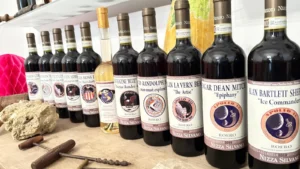
Even the bottle itself has become a means of identification. In the late 1970s, the Modena Chamber of Commerce commissioned Giorgetto Giugiaro to design a distinctive bottle, now required by the production specifications for all producers. The small 100 ml bottle, with its spherical body and rectangular base, accompanied by a numbered seal, is one of the most immediate ways to recognise the authentic product.
“If it isn’t in that bottle,” Mariangela emphasises, “it may still be an excellent product, but it isn’t Traditional Balsamic Vinegar of Modena PDO.”
The paradox is that a product so deeply rooted in Italian culture has found a significant share of its success abroad. Mariangela also attributes this to the powerful appeal of Italian gastronomy around the world.
“In Italy, we have grown up surrounded by very strong regional traditions. Everyone has their own flavours and habits. Abroad, however, there is an enormous appetite for Italian cuisine and our products. And balsamic vinegar also has the advantage of adapting easily to very different culinary cultures.”
Both the production specifications and tradition generally recommend using it without cooking, adding it at the very last moment to preserve its aromatic complexity. Classic pairings range from Parmigiano Reggiano to meat, vegetables and desserts, but its versatility is one of the reasons behind its international success.
Today, however, perhaps the most interesting question concerns not only how to promote the product, but also how to ensure the survival of the family culture from which it originated. Homes are changing, attics are disappearing and younger generations are moving away. As a result, many batteries of barrels risk being left without anyone who knows how to care for them.
“In recent years, we’ve realised that as older generations pass away, several family-owned batteries risk being abandoned,” Mariangela explains. “Sometimes because the necessary knowledge hasn’t been passed down, and sometimes because there is no longer a suitable place to keep them.”
This has led to the revival of an ancient practice known as baliatico: looking after batteries of barrels belonging to other families.
“Someone can entrust their battery to us. We take care of it, carry out the transfers, top up the barrels and do everything else that is needed. But the vinegar remains theirs. Once a year, they come back and collect their own Traditional Balsamic Vinegar.”
Perhaps this is the image that best captures the contemporary meaning of Traditional Balsamic Vinegar of Modena: not a tradition frozen in time, but one that is finding ways to continue.
After all, in Modena people often say that balsamic vinegar grows old. Yet the Consorzio’s press materials suggest a different perspective: the process takes so long that, inevitably, the people caring for the vinegar grow old too. And that is precisely why balsamic vinegar becomes a bridge between generations, almost another member of the family.
More than a condiment, then: memory in liquid form.