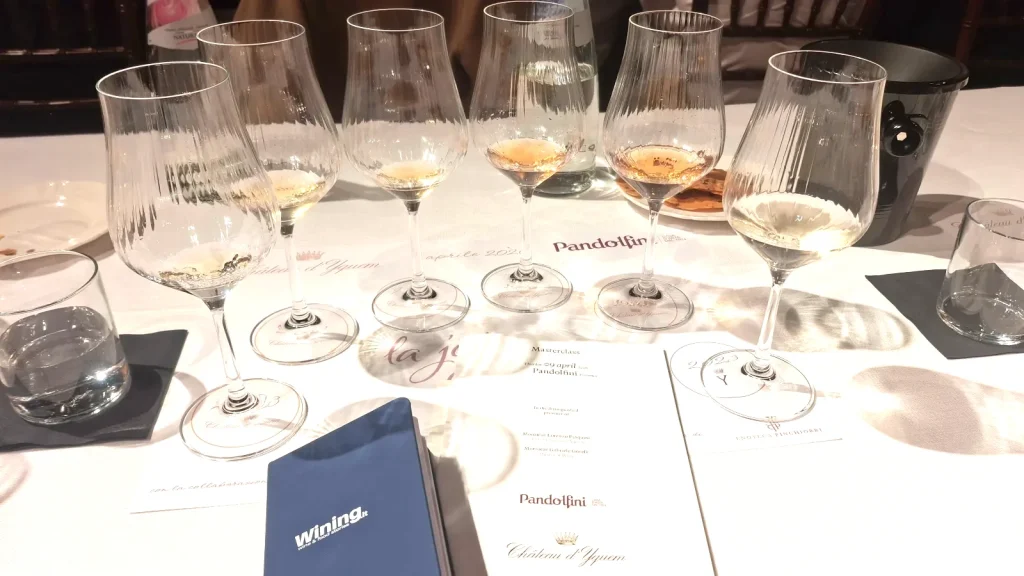
There are tastings that linger because they manage to tell a place, a story, a vision of time. This was the case with the masterclass dedicated to Château d’Yquem, held in Florence on April 9th in the rooms of Pandolfini, the oldest auction house in Italy, where the allure of collecting met the culture of wine in a day destined to leave its mark.
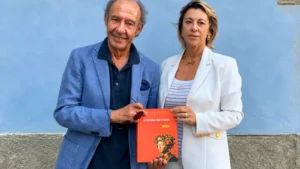
Guiding the experience were Gabriele Gorelli, the first Italian Master of Wine, and Lorenzo Pasquini, CEO of the estate: two distinct yet complementary voices, able to alternate technical rigor, historical memory, and genuine enthusiasm.
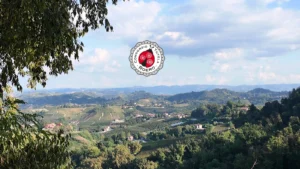
To understand Yquem, one must start from Sauternes, from that hill overlooking one hundred hectares of vineyards—a unique mosaic of parcels differing in exposure, soil composition, drainage, and even geological origin. Five natural springs within the estate create the necessary humidity, while constant winds sweep through the rows, drying the grapes.
It is within this fragile and miraculous balance that Botrytis Cinerea—the noble rot—develops. A natural phenomenon that elsewhere may be a risk becomes destiny here. The berries concentrate, lose water, and gain aromatic depth, yet at Yquem nothing is taken for granted: harvesting occurs through multiple manual passes, selecting only perfect bunches. If even a single berry is affected by undesirable rot, the entire cluster is discarded. It is an extreme, almost ascetic viticulture—so much so that in Bordeaux they say that where elsewhere a vine yields a bottle, at Yquem it yields a glass.
By the time George Washington was already appreciating its wines, Yquem had centuries of experience behind it. From the 15th century to its recognition in 1855 as Premier Cru Supérieur—the absolute pinnacle of the Sauternes classification—the estate has built a prestige that remains intact to this day. Since 1999, LVMH has safeguarded its heritage, continuing to combine tradition with contemporary precision.
The Florentine event took place within the context of “La Joie du Vin,” a Pandolfini auction that surpassed €1.14 million, reaching 170% of initial estimates. Leading the sale were several bottles of Yquem, including an extraordinary 1937 vintage hammered at €16,790. Significant numbers, certainly, but above all a reflection of the enduring desire to possess fragments of liquid eternity.
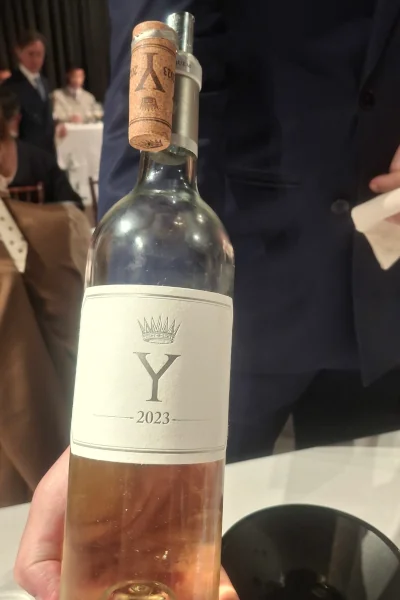
The first wine tasted was Château d’Yquem 2023, presented as a preview. From the harvest onwards, the potential of a vintage destined to leave its mark was clear: 2023 combines the crystalline freshness of 2021 with the solar generosity of 2022, forming a new trilogy of remarkable interest—echoing the famous sequences of 1948–1950 and 1988–1990.
In the glass it shows a bright, luminous gold of medium density. The nose is expansive and seductive: a floral prelude of jasmine and lilac gives way to cooked rhubarb, kumquat, beeswax, and ripe apricot nuances. Gradually, hints of yellow plum and mandarin marmalade emerge.
On the palate, the entry is enveloping, full, and satisfying. The 150 g/l of sugar are perfectly integrated into a structure of great balance. The sweetness is velvety, never overwhelming, while vibrant citrus acidity supports the sip and extends it toward a savory, extraordinarily precise finish.
With Château d’Yquem 2016, the register shifts toward a more chiselled expression. It is a wine of harmony and composure, of restraint concealing depth.
Visually, it shows an intense, clear gold. Aromatically, it combines notes of mango, pineapple, and ripe apricot with a more refined, terroir-driven component of lemon thyme, jasmine, and delicate balsamic hints of wild mint and incense. Acacia honey and mineral nuances emerge on the finish. On the palate, precision stands out: moderate yet firm body, concentrated texture, and bright acidity supporting a significant glyceric mass without weighing it down. The finish is long and vibrant, with echoes of dried fruit and sweet spices. An Yquem of aristocratic elegance.
Château d’Yquem 2006 introduces a more powerful, textural dimension, shaped by a complex and severe vintage. The season was marked by fruit flies and the development of sour rot, factors that required extremely strict selection and the sacrifice of a significant portion of the harvest. Parcels richer in clay responded better, preserving integrity and concentration. This is where the compact, structured character of the vintage originates.
In the glass, it appears as a vibrant gold with almost orange reflections. Its consistency is remarkable—swirling reveals immediate density, substance, depth.
The nose is broad, layered, and intense: candied cedar and dried orange, followed by quince marmalade, saffron, caramel, and ginger. Balsamic and spicy hints of cardamom, verbena leaf, and a refined slightly bitter finish reminiscent of green tea follow. On the palate, it is full, almost monumental. Acidity runs through the mid-palate, governing its mass, yet the sip remains rich, liqueur-like, and tactilely powerful. Notes of bitter orange marmalade emerge, while the texture becomes progressively monolithic and viscous, leading to an extraordinarily long finish of caramel and sweet spices. A wine of power and substance, driven more by depth than lightness.
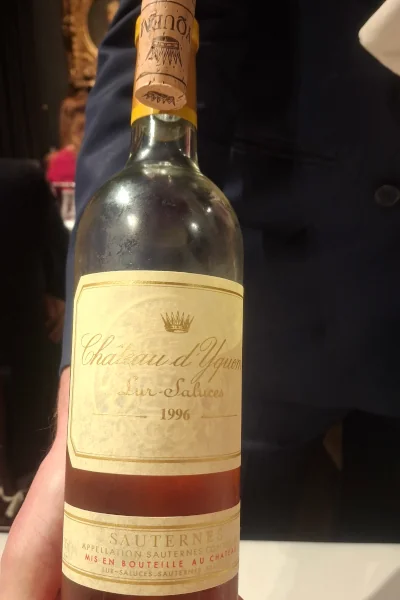
Château d’Yquem 1996 represents the grace of evolution. In the glass, it shifts toward a deep gold fading into light amber, maintaining extraordinary brightness.
The bouquet is finely detailed: ripe orange, mirabelle plum, quince, saffron, light musky freshness, honey, vanilla, and hints of cedar. The palate surprises with its vertical lift, with a dense yet silky core. Sweetness is perfectly calibrated, and the long, saline finish elegantly prolongs the tasting memory. Time here does not consume—it refines.
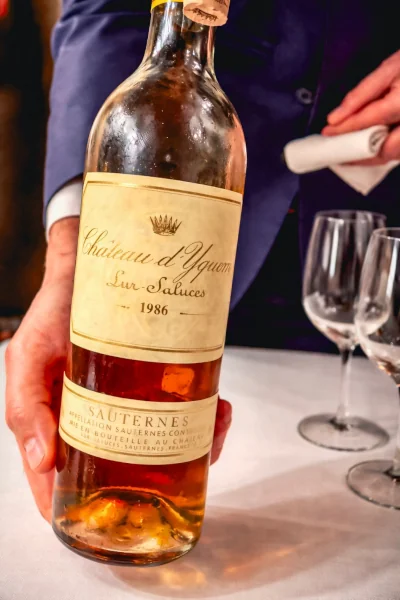
With Château d’Yquem 1986, one enters one of the most fascinating and singular expressions of the tasting. A vintage marked by heavy fog, which often forced harvesting only in the afternoon, when typically morning winds would dry the grapes.
In the glass, it shows a luminous, vibrant amber. The nose is deep and complex: candied citrus, mandarin, orange marmalade, quince, tarte Tatin, saffron, cedarwood, sandalwood, white truffle, and fine spices. The palate is surprisingly tense and energetic. Clay-rich parcels lend a pronounced saline imprint, interacting with a more restrained sweetness (100 g/l) and a refined bitter note of gentian. The result is a deeply expressive, almost umami-like profile, making this 1986 unforgettable for its personality and originality.
To close the journey, Y 2023—the estate’s other soul. First created in 1959 as a dry interpretation of Yquem’s terroir, it is produced from early harvests preceding the late harvest of the grand vin. In 2023, it is composed of 50% Sauvignon Blanc and 50% Sémillon, with a slight presence of botrytis and 6 g/l of residual sugar.
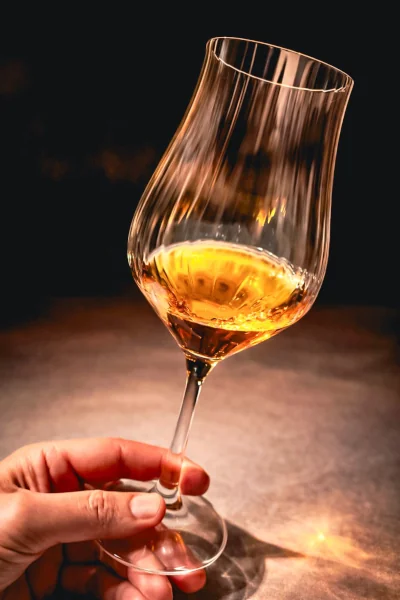 In appearance, it is a crystalline straw yellow, luminous and transparent. The nose stands out for its complexity and precision: delicate lactic notes of yogurt and kefir emerge initially, adding originality. With oxygenation, the profile expands into elegant powdery notes, Mediterranean herbs—thyme, sage, verbena—and fresh citrus sensations of lemon zest and leaf. Floral hints of lavender and crisp yellow fruit complete a refined and dynamic aromatic profile.
On the palate, it is tense, saline, and vibrant, with lime, yellow kiwi, Mediterranean herbs, and a deep mineral trail leading to an elegant, persistent finish. Not a supporting actor, but a different and fascinating interpretation of the same terroir.
Pandolfini’s merit lay in creating the ideal setting around these wines: a measured, cultured, perfectly calibrated encounter, capable of enhancing the narrative without ever overshadowing it.
Completing the picture was the discreet elegance of Enoteca Pinchiorri, whose impeccable hospitality—from service to light lunch—accompanied the day with the natural ease that belongs only to great excellence.
During the masterclass, one concept emerged clearly: Yquem is not a wine, it is an ecosystem of precision.
Nature, obsessive selection, time, and interpretation coexist in a balance that is as fragile as it is extraordinary. Nothing is automatic, nothing is taken for granted. Each harvest arises from unrepeatable conditions and is guided with absolute care.
Every vintage is different, and none pursues the image of the previous one; each expresses only its own truth, pushing itself to the highest point the season allows.
And perhaps it is precisely here that the true greatness of Château d’Yquem lies.
There is no pursuit of static perfection, nor the reassuring repetition of a model, but the rare ability to listen to a terroir and transform each harvest into a unique, unrepeatable work of art.