There are places where wine tells not only the story of the land from which it comes, but also the taste, gestures, and imagination of an era. Fattoria del Colle, in Tuscany’s most unspoiled heart, is one of them.
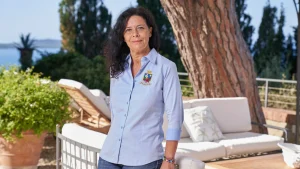
When Livio Socini repurchased the estate in 1919, bringing it back into the family after three hundred years, he was already making a cultural gesture. But it is with Donatella Cinelli Colombini that this place becomes something more: not only a winery, but a laboratory of vision, a meeting point between tradition and contemporaneity, between agriculture and thought.
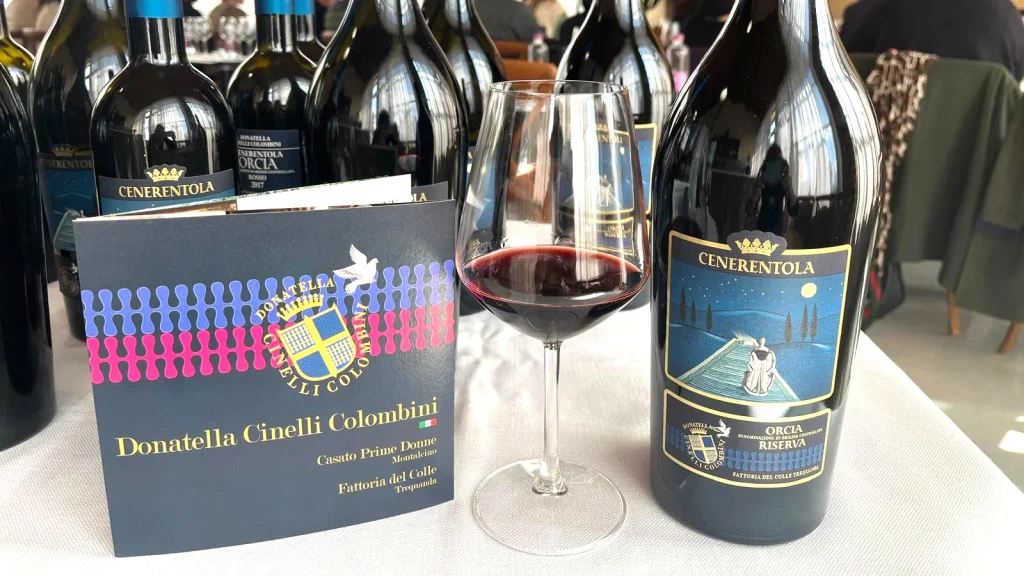
Her trajectory—from studies in medieval art history to the founding of the Movimento del Turismo del Vino, and then to the birth in 1998 of an estate uniting Casato Prime Donne and Fattoria del Colle—tells a precise story: putting wine back inside culture. This is where Cenerentola is born, a wine whose very name declares its destiny: to begin from a marginal position and build identity, beauty, and recognition.
Cenerentola is Orcia, a young denomination—established on February 14, 2000—pressed between two older sisters such as Brunello and Vino Nobile di Montepulciano, yet, as in the fairy tale, it is precisely marginality that generates character. Even more radical is the choice of Foglia Tonda alongside Sangiovese: a native grape variety that had almost disappeared, recovered in the early 2000s, when wine was speaking above all the language of globalization. A countercurrent choice then, an extremely modern one today.
Foglia Tonda, with its exuberant productivity and rich polyphenolic profile, demands care, selection, and patience. It is a difficult grape, but precisely for this reason it gives back wines that are deep, textural, and capable of dialoguing with time. Together with Sangiovese it creates a rare balance between power and elegance, structure and momentum.
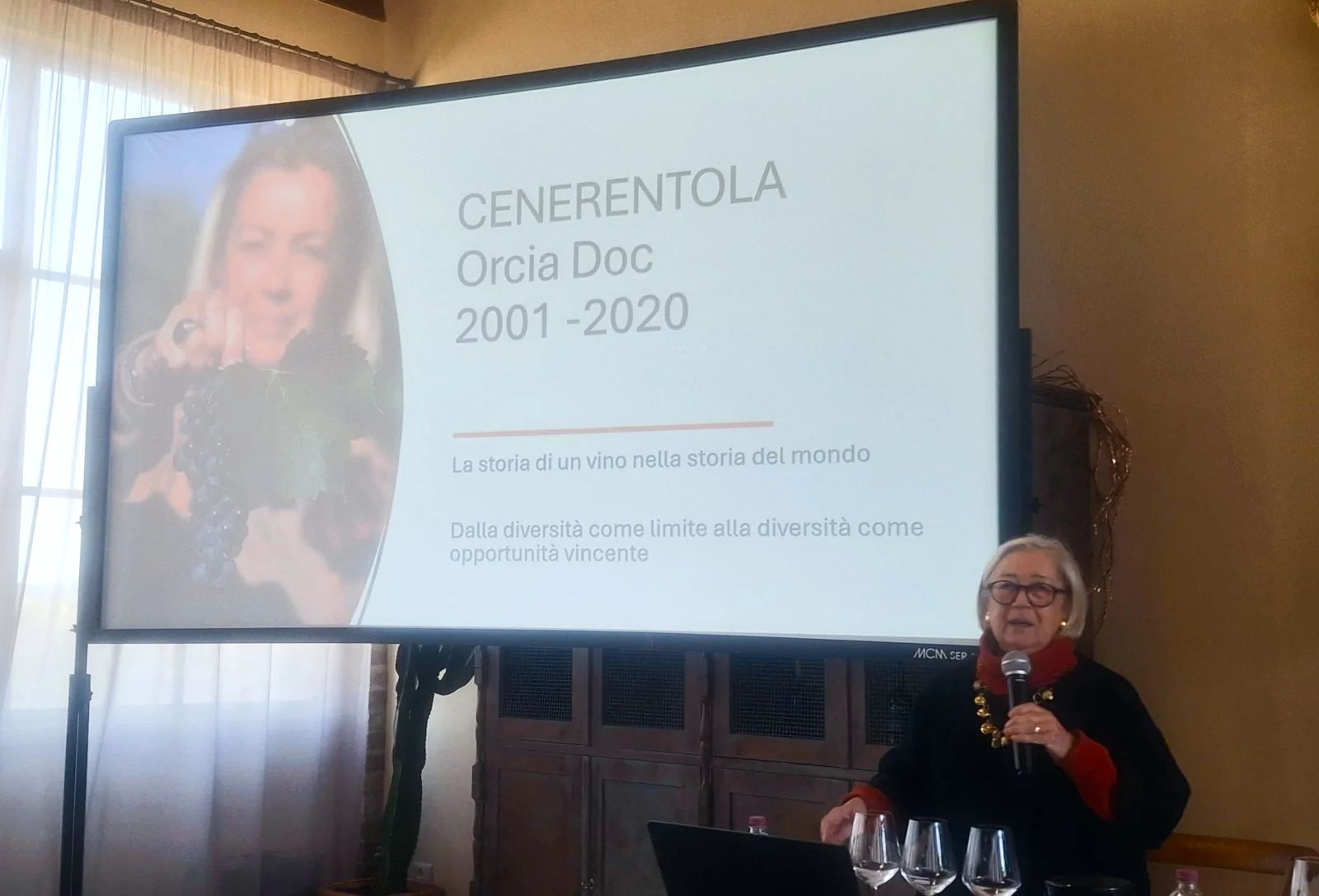
For this reason, the presentation on March 23 at Fattoria del Colle in Trequanda was not a simple preview, but a true cultural event. Donatella and her daughter Violante transformed the preview of Orcia Doc Riserva Cenerentola 2020 into a narrative workshop: reading the wine together with the time that generated it. Not only climate, harvest, and cellar work, but also fashion, design, music, cinema, politics, collective fears, and the desires of an era.
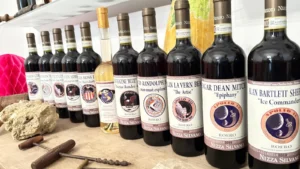
The idea was precise: to taste ten vintages of Cenerentola—2001, 2004, 2006, 2007, 2008, 2013, 2016, 2017, 2018, and the new Riserva 2020—while images, sounds, and symbols from those same years flowed before the audience.
“The score is the same, just as the grapes and the terroir are the same, but the final result changes according to the interpretation of the historical moment,” Donatella explained, evoking the image of Beethoven’s Fifth conducted by Toscanini, von Karajan, or Muti. And perhaps this is the most beautiful synthesis of the entire project: the vineyard is the score, the vintage is the interpretation.
Ultimately, this is the central point: wine is one of the ways in which a society tells its own story. At the beginning of the 2000s, ostentation, declared luxury, and impact dominated; after 2008 came restraint, sobriety, authenticity; then came the season of identity, sustainability, and transparency. Fashion changes, design changes, the way people live and present themselves changes. Inevitably, wine changes register too.
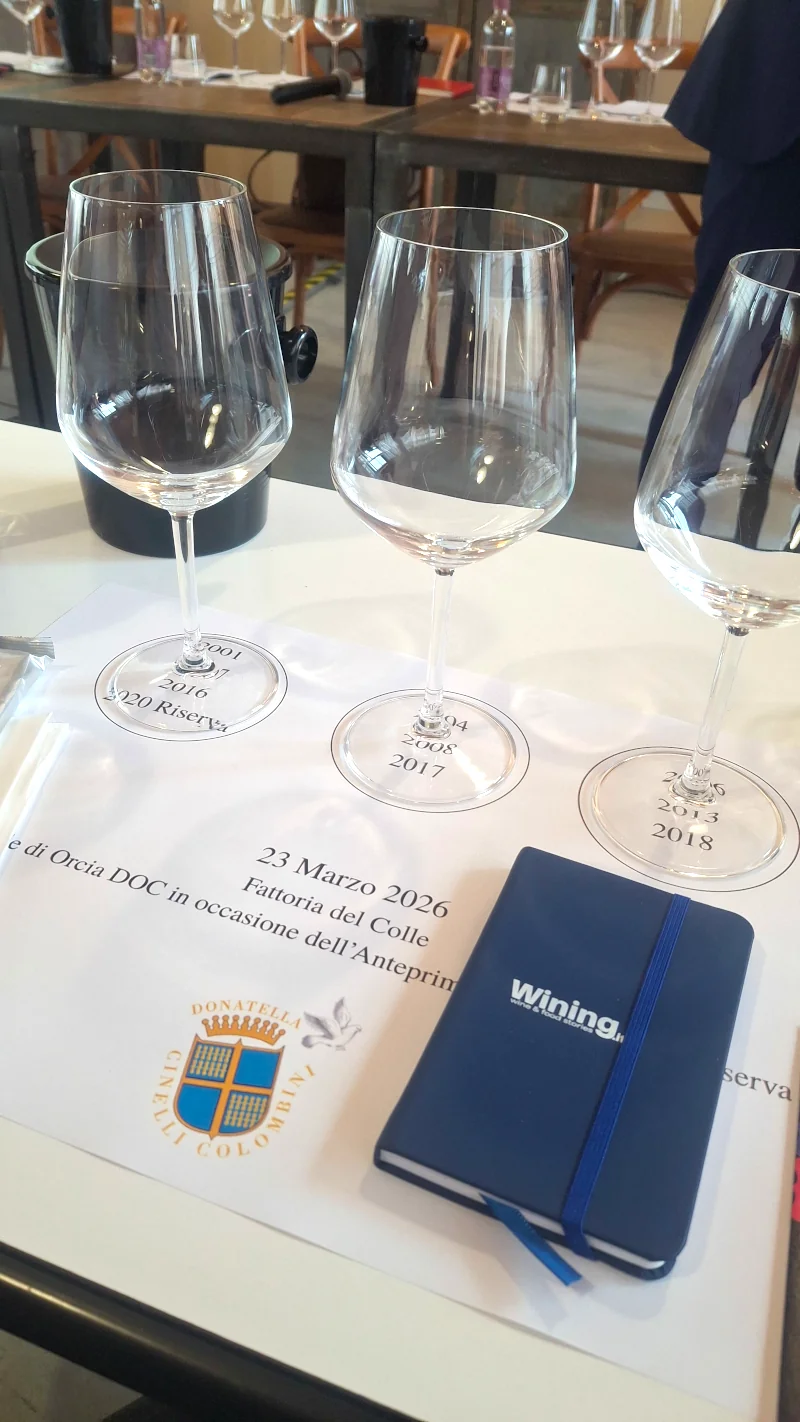 The 2001 vintage, the first of Cenerentola, was born in a lacerated year: the Twin Towers, the war in Afghanistan, the G8 in Genoa, Berlusconi’s return to Palazzo Chigi. Fashion spoke the language of logomania and horror vacui. The vintage, marked by frost and wind on the eve of Easter, reduced yields but concentrated substance, while a bright summer and autumn accompanied full ripening. Vinification took place in temperature-controlled stainless steel vats, followed by twelve months in Allier, Nevers, and Tronçais oak barriques.
In the glass it shows a dense garnet hue with orange reflections, almost visually echoing the polyphenolic richness of Foglia Tonda. The opening is balsamic and deep, with notes of bay leaf followed by sweet and exotic spices—sandalwood, cinnamon, nutmeg, cassia wood—accompanied by a bourbon vanilla note that is by now perfectly integrated. The bouquet then unfolds into dried flowers and a subtle trace of white pepper, while the fruit evolves toward a riper, more enveloping dimension of plum jam. Suggestions of chocolate, blond tobacco, and cigar box then emerge, closing in an elegant woodland register of dry leaves and earthy undertones. The oak is completely absorbed into the aromatic texture, never overwhelming. On the palate, it surprises with a freshness that is still vibrant, supporting a present yet finely integrated tannin. The savory finish extends with elegance into echoes of dried fruit.
2004 is the year in which the world expands: Europe welcomes new countries from the East, Facebook is born, while in fashion fluorescent colors, clingy silhouettes, and a taste for excess still remain. In wine, international critics’ scores begin to carry weight, and in the cellar the transition takes place from Fabrizio Ciufoli to Carlo Ferrini. The vintage is favorable, with regular ripening; vinification takes place in temperature-controlled stainless steel, followed by aging in barriques.
In the glass it appears as a still impenetrable carmine with garnet reflections, a tangible sign of an extractive structure and a more marked cellar imprint. The aromatic profile moves through darker, almost noir registers, where undergrowth dominates with notes of humus—wet leaves and almost sanguine hints—accompanied by cinchona bark that introduces a deep, bittering nuance. The floral side emerges in an evolved pot-pourri form, while the fruit becomes riper and more liqueur-like, with cherries in spirit and chocolate suggestions reminiscent of boero. Completing the picture are touches of caramel and clove. The palate is full yet composed. The tannin is well integrated and the oak, although it has marked the style, now appears more fused into the structure, allowing the dialogue between Sangiovese and Foglia Tonda to emerge with greater clarity.
In 2006 many things changed: Italy won the World Cup, Calciopoli exploded, and climate change began to be discussed with greater insistence. Aesthetics too moved toward more sober tones. The vintage is complex: rainy winter, very hot July, unstable August, dry and bright September. Vinification takes place in temperature-controlled stainless steel, with more careful work on extraction.
In the glass it still presents an impenetrable carmine with garnet reflections, but already on the nose the profile becomes fresher and more dynamic. The fruit expresses itself clearly through blackberry and blueberry, accompanied by a Mediterranean balsamic weave of bay leaf and rosemary. The floral side emerges elegantly in violet and rose. The palate is agile, surprisingly fluid in relation to its visual density. The tannin is present but well managed, while acidity becomes the protagonist, integrating the structure and accompanying the wine without ever hardening it. The savory finish lengthens precisely on notes of tamarind and bitter orange.
2007 is a watershed year: the iPhone is born, Facebook explodes in Italy as well, and the mortgage crisis begins to crack the American system. The vintage is irregular but favorable; vinification is in temperature-controlled stainless steel, followed by twelve months between barriques and tonneaux.
In the glass the wine marks an evident stylistic shift: it presents itself with a medium-density garnet and orange reflections, already elegant in its transparency, with a lighter color that almost suggests Pinot Noir. The aromatic profile opens with fine spices—nutmeg and cinnamon—accompanied by dried Persian rose, cinchona bark, and a diffuse balsamic note of bay leaf, enriched by an evocative touch of mountain herbs, recalling a Ricola candy. The palate is fresh and linear, crossed by a balsamic thread that accompanies the progression. Acidity integrates the tannin perfectly and guides the wine toward a clean and continuous finish.
Then 2008 arrives, and the collapse arrives with it. Lehman Brothers fails, the world loses confidence, fashion turns toward less is more. Valérie Lavigne arrives at Fattoria del Colle, even if 2008 remains a wine still shaped by Ferrini. The season is marked by a very rainy spring, a hot summer well supported by the vegetation, and a slow, regular ripening. Vinification takes place in temperature-controlled stainless steel, while aging continues in tonneaux.
Presented in tasting in Jéroboam format, in the glass it is an increasingly pale garnet with orange reflections. The opening is balsamic and deep, dominated by bay leaf. The profile then evolves toward refined undergrowth, evoking dried mushrooms, fern, and wild incense. Notes of tobacco, cigar box, and cocoa powder follow, while the fruit moves precisely between Ferrovia cherry and bitter orange. The tannin is central, fine, almost powdery, and finds in freshness a perfectly balancing counterpart. The palate extends continuously in an elegant Mediterranean register, between rosemary, bay leaf, fresh juniper berry, and cardamom.
2013 is the year of symbolic discontinuity: Benedict XVI resigns, Nelson Mandela dies, social media becomes profession and market, street style passes from subculture to mainstream. Society seeks authenticity while making everything communicable and replicable. The vintage, irregular, requires attention in the vineyard and in the cellar; vinification takes place in temperature-controlled stainless steel, with an oak presence that is now perfectly integrated.
In the glass it shows a medium-density garnet with orange reflections. The nose is subtle and elegant, built on a refined weave of dried flowers, sweet tobacco, carob, and bourbon vanilla. The fruit moves through notes of cherry and prunes in spirit, accompanied by dried orange. The profile closes on a fine and measured undergrowth of humus, cinchona bark, and licorice root. On the palate, vibrant freshness dominates, perfectly integrating a central, fine, and carefully chiseled tannin. The finish is savory, with a clear mineral imprint.
In 2016, while the world lives through profound fractures—Brexit, the death of Regeni, the constitutional referendum, Trump’s victory—it is one of the most balanced vintages of the decade. In wine, the value of the parcel, zoning, and the centrality of place all grow. Donatella becomes president of Donne del Vino, leading the association through decisive growth over the following seven years. The vintage is built on a mild rainy winter, unstable spring, alternating summer, and serene September with strong temperature swings. Vinification takes place in temperature-controlled stainless steel, aging in 5-hectoliter tonneaux and small casks.
In the glass it presents as a medium-density carmine with garnet reflections. The opening is balsamic and clear, with notes of bay leaf and fresh juniper berry, followed by blood orange, mulberry, and cassis. The palate is seductive, fully resolved. The tonneau integrates perfectly into the wine’s texture, giving a fine, almost silky tannin. Citrusy acidity accompanies the progression with slight bitter notes of tamarind, while sapidity lengthens on Mediterranean hints of rosemary and juniper.
In 2017 the world continues to move through jolts: Trump is sworn in as president, Catalonia attempts an independence referendum, the Me Too movement changes public discourse, Bitcoin and cryptocurrencies feed the idea of a finance detached from traditional systems. Fashion incorporates wellness, vintage, and comfort. But the vintage is among the most difficult of the decade: dry winter, scorching summer, complex ripening, early and selective harvest. Vinification takes place in temperature-controlled stainless steel, followed by twelve months between tonneaux and small casks.
In the glass it translates into a medium-intensity ruby with carmine reflections, more transparent than previous vintages. The aromatic profile opens on a woodland and vegetal dimension, with fern and rose stem, then nettle leaf, tobacco, cardamom, and coriander. On the palate, citrusy acidity supports the structure and carries it precisely through to the savory finish. The tannin has grip, with a slight green note, a sign of phenolic ripening not entirely completed. The alcoholic component also emerges, but freshness rebalances the palate.
2018 is the year in which distrust enters the collective lexicon permanently: yellow vests, Greta Thunberg, Cambridge Analytica, the collapse of the Morandi bridge. Society experiences both the crisis of material infrastructures and of invisible ones. The vintage, marked by a very rainy spring and early summer, followed by a dry and bright September, favors slow and progressive ripening. The grapes are vinified separately in temperature-controlled stainless steel, while aging continues for twelve months in 5-hectoliter French oak tonneaux and small casks.
In the glass it presents a carmine hue with garnet reflections, bright and defined. The opening is mineral, with smoky notes, hints of graphite, and iodine-like recalls. The profile then opens to a more Mediterranean dimension, between wild incense, rosemary, and sage, before making room for a precise fruit of Ferrovia cherry and dried violet. The aromatic close is entrusted to an elegant and measured undergrowth of dry leaves and cedar bark. The palate is taut, built on precision. The tannin is central and well integrated, finding its balance in citrusy acidity. The finish stretches out long and coherent on a persistent savory trail.
And then 2020. The year in which the world stops: Covid, lockdown, emptied cities, home as refuge, forced digitalization, fear of contact. Fashion becomes functional, design mixes vintage and contemporary, recycling becomes a language of survival. That summer Violante gets married: a private gesture that in such a wounded year sounds almost like a form of resistance. The new Orcia Doc Riserva Cenerentola 2020 is born within this atmosphere, in only 200 numbered magnum bottles.
The vintage is marked by a spring frost, a very rainy June, and a torrid summer; it will be September, with its rains and temperature swings, that allows the vines to recover and complete ripening. Sangiovese and Foglia Tonda are vinified separately, while aging continues for twelve months in 5-hectoliter French oak tonneaux and small casks.
In the glass it presents a medium-intensity ruby, bright and defined. The aromatic profile opens on a deep and layered balsamic character: cinchona bark, pine resin, licorice root, and eucalyptus, then cardamom and coriander. The fruit moves through dark and ripe registers, between cassis and mulberry, with a citrus return of bitter orange. In the background emerge sweet spices of bourbon vanilla evolving toward notes of carob. The palate is agile and precise, built on a fine texture. The tannin is subtle and finely chiseled, accompanied by a materiality that expresses itself in a fruity dimension of plum and prune, with an earthy, almost sanguine recall. Citrusy acidity supports the progression, while the savory finish lengthens elegantly on echoes of dried fruit.
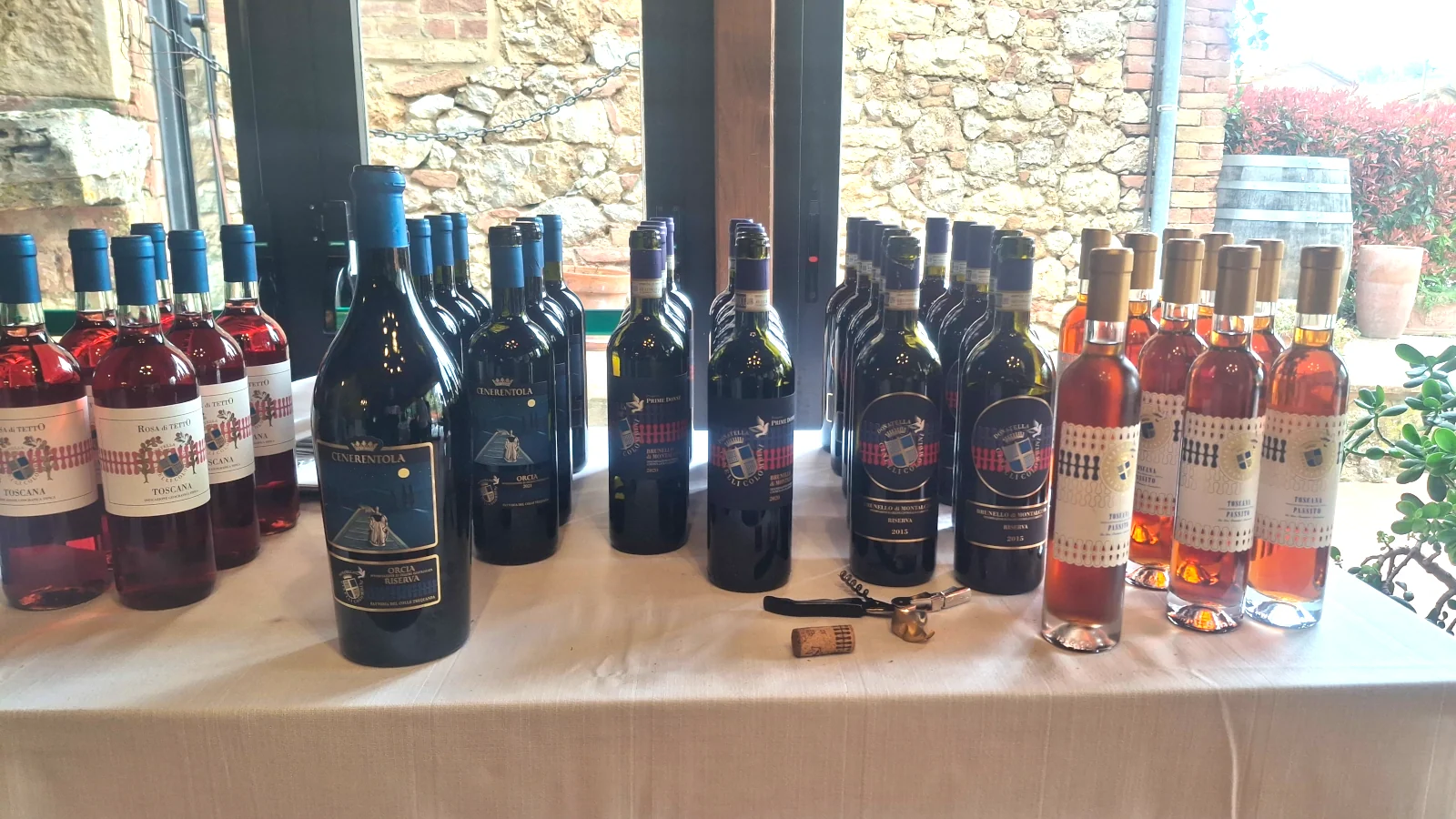
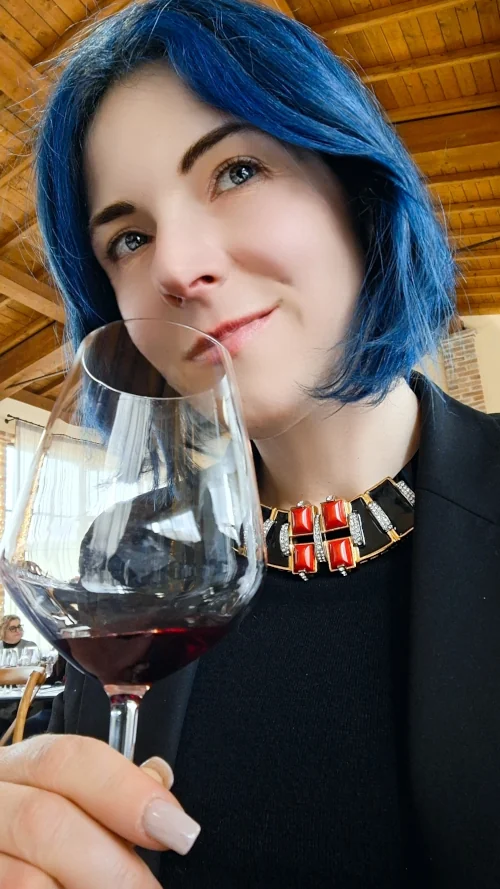 After the tasting, the day continued with a press lunch at Fattoria del Colle, conceived as a natural continuation of the narrative. The menu, curated by chef sommelier Doriana Marchi with the collaboration of the restaurant staff directed by maître Andrea Scala, translated into cuisine the same idea of territorial elegance that had guided the tasting, beginning with Zuppa di Dante with EVO oil and confit cherry tomatoes, both cultured and domestic in its appeal. In the glass, alongside Cenerentola Orcia Doc 2021, there were also Rosa di Tetto IGT Toscana Bio 2024, Brunello di Montalcino Progetto Prime Donne DOCG 2020, Brunello di Montalcino DOCG Riserva 2015, and Passito di Traminer Aromatico IGT Toscana Bio 2018.
After an event such as the one on March 23, what remains is the feeling that wine has returned to occupy the place it deserves: not as a repertoire of technicalities, but as one of the most complete forms through which a society deposits memory of itself. In this, Cenerentola is a perfect name: it tells of a wine born on the margins, in a young denomination, with a nearly forgotten grape variety, yet grown without shortcuts until it became a symbol of identity. And when a wine succeeds in holding an era, preserving its emotion, and revealing its contradictions, then it truly becomes culture.