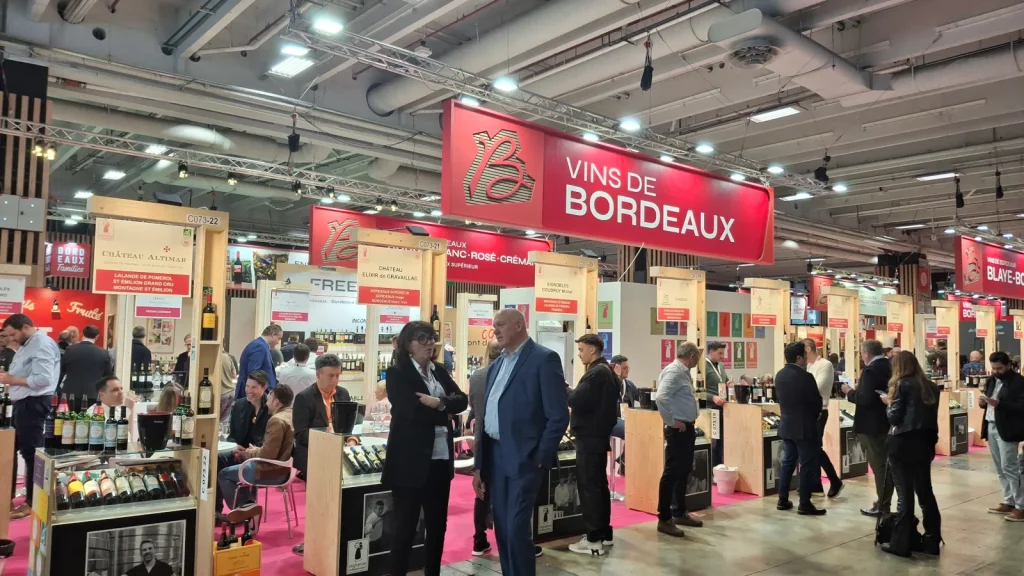
Wine Paris 2026 once again confirms itself as a privileged observatory for understanding the current trajectories of European wine and, more broadly, of global wine. More than a simple commercial showcase, the Paris event is increasingly establishing itself as a space where supply chains, appellations, markets and narratives meet and confront one another with remarkable clarity.
Across the pavilions dedicated to Italy and France, different yet increasingly dialoguing approaches emerge: on one side the depth of territories, on the other the need to communicate them through tools that are readable, credible and suited to an evolving international market. The theme of terroir remains central, but the way it is presented at trade fairs is changing: less abstract emphasis, more synthesis, stronger positioning and a greater ability to translate identity into a professional message.
In this sense, Wine Paris is not only a place where wines are tasted, but also where the level of maturity of a production system is measured: how it presents itself, how it organizes, how it builds relationships, and how it defends its identity without losing commercial clarity.
Paris and the new centrality of international wine fairs
The impression, increasingly shared among operators, buyers and journalists, is that Wine Paris is consolidating a real central role in the international trade-fair landscape. This is not merely a matter of enthusiasm, but the result of several concrete factors that significantly affect the quality of the professional experience.
Paris offers an urban structure capable of supporting an international event of this scale with a fluidity that is less evident elsewhere: three airports, an extensive public transport network, large hotel capacity, widespread dining options and a city able to absorb large flows of visitors without quickly reaching saturation. This is not a marginal logistical detail but a decisive component in the competitiveness of a trade fair.
Looking at ProWein, the comparison should not be read polemically but objectively. Düsseldorf has long represented a powerful reference point for the international wine trade and remains an important hub. However, the trade-fair system today requires not only historical reputation but also urban capacity, ease of access, quality of the surrounding experience and broad international attractiveness. From this perspective Paris starts with a clear structural advantage: it is a city that amplifies the fair rather than simply containing it.
Vinitaly also continues to maintain enormous importance, particularly for Italy and for its role as an institutional and commercial showcase of the national wine system. Yet precisely the success of the event puts increasing pressure on the urban context that hosts it. Verona remains a city of great charm and strong trade-fair identity, but the issue of absorbing visitor flows, mobility, hospitality capacity and the overall management of numbers becomes more relevant every year. For events of this scale, organizational quality is no longer measured only inside the halls but across the entire urban ecosystem.
Wine Paris today appears to have understood this new requirement with remarkable clarity. This explains at least part of its growth. It is not simply about “replacing” other fairs but about responding more effectively to a phase of the market in which the value of professional encounters increasingly depends on the context in which they occur.
The key point remains the ability to create relationships. This year as well, the matchmaking system offered interesting opportunities, despite the inevitable missed appointments and occasional searches for contacts along the corridors. Overall, however, the value of the fair remains intact: Wine Paris is still a place where contacts can be built, dialogue generated and the real positioning of territories and wineries verified.
Global wine: identities, markets and new geographies
Walking through the pavilions, one trend emerges clearly: international wine is increasingly moving along two parallel axes. The first is the strong reaffirmation of territorial identities; the second is the growing commercial pressure that pushes producers to become more readable, more concise and more distinctive.
New World countries have invested significantly to strengthen their presence in Europe.
The United States expanded its exhibition space with a selection focused on Pinot Noir from the Sonoma Coast and Cabernet Sauvignon from Napa Valley, clearly targeting the premium segment.
Argentina and Chile reaffirmed their identities through iconic varieties such as Malbec, Torrontés and Carmenère, while New Zealand used the European showcase to celebrate its Sauvignon Blanc from Marlborough and Pinot Noir from Central Otago.
At the same time, Europe responded by reinforcing the value of appellations and native grape varieties. Spain and Portugal expanded their presence with increasingly structured collective stands, while Germany, Austria and Greece focused on strongly identity-driven varieties such as Riesling, Grüner Veltliner and Assyrtiko.
Among the most closely observed developments at the fair was also the organized participation of China, with producers from Ningxia and Yunnan showing increasingly evident qualitative evolution.
Within this increasingly crowded and competitive geography, France and Italy maintain a unique specific weight but must face a more demanding international market. Being historic is no longer enough. Clarity is required.
Italy: territorial identities and tasting highlights
At Wine Paris 2026, Italy showed a broad and well-articulated presence. Not only in terms of the number of companies and consortia but also in the ability to highlight individual territorial identities without dissolving them into a generic representation of “Made in Italy”.
This is where the fair becomes particularly interesting from a journalistic perspective: not so much in the obvious greatness of Italy’s wine heritage, but in the quality with which certain wineries translate their territory into style, vision and production precision.
Among the most convincing tasting highlights, Avignonesi and Valdicava offered two different yet equally meaningful interpretations of contemporary Tuscany.
Avignonesi: Montepulciano between agricultural coherence and stylistic definition
Avignonesi now clearly expresses a vision that goes beyond individual labels. The company’s mission is to create value within what it defines as a “good wine industry”, founded on organic and biodynamic agriculture, careful distribution, transparency and corporate responsibility. This path, begun years ago, is now well structured and has also been formally recognized through its status as a Benefit Corporation.
Beyond the corporate narrative, what truly matters is how this philosophy translates into the glass. And during the tasting the most interesting element was precisely this: a very evident stylistic coherence, particularly in the reds, built around a clear thread combining fruit definition, well-structured tannins and a consistent balsamic freshness.
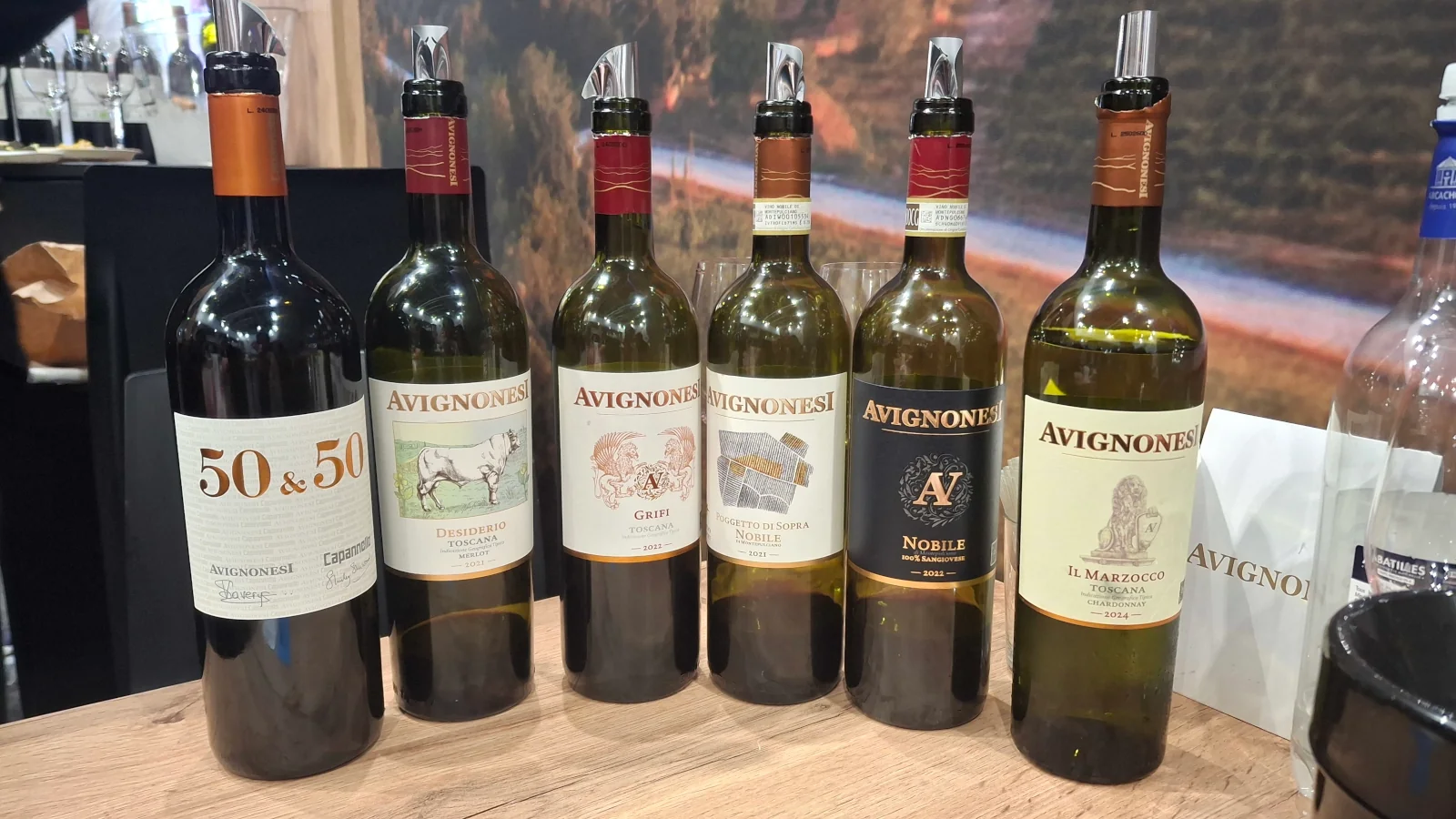
The Vino Nobile di Montepulciano 2022, a 100% Sangiovese from around seventy parcels, shows a deep ruby color with carmine reflections. The nose opens with refined balsamic notes — wild incense, bay leaf and hints of rosemary — before expanding into violet, lavender and crunchy red fruit, with cherry leading the profile. On the palate it is powerful in structure yet not heavy: fruit-driven tannins, acidity already moving toward integration, good dynamism and a finish that combines juiciness, precision and length.
Poggetto di Sopra, from fifteen-year-old vines at 310 meters on marine Pliocene soils and aged for twenty-four months in large Slavonian oak casks, offers a more nuanced and profound interpretation. Medium-dense ruby with carmine reflections, a nose opening with violet and rose before broadening into red fruit, dried blood-orange peel, forest floor, cinchona bark, cigar box and a balsamic bay-leaf finish. The palate convinces through the finesse of its tannic texture and well-integrated acidity that accompanies the fruit without stiffening it.
With Grifi 2022 the winery plays on the dialogue between two Tuscan matrices: Cabernet Sauvignon from Cortona and Sangiovese from Montepulciano. The result is a wine where the polyphenolic richness of Cabernet appears in color density, forest-like balsamic tones and tannic structure, while Sangiovese brings energy, juiciness and fruit precision that avoids excessive muscularity.
Desiderio 2021, a Merlot produced since 1988 and dedicated to the historic bull of the Le Capezzine estate, confirms one of the winery’s most recognizable expressions. Deep ruby with dense movement in the glass, the fruit shifts toward dark tones of blueberry and mulberry, accompanied by bay leaf and fresh juniper. The palate is full and juicy with velvety yet firm tannins: a Tuscan Merlot that does not renounce its terroir.
The tasting concludes with 50&50, born from the friendship between Avignonesi and Capannelle and over time becoming a small legend of Italian wine. The blend of Avignonesi’s Merlot and Capannelle’s Sangiovese — vinified alternately by the two wineries — tells a story of trust and continuity. Amarena cherry, blueberry, violet, rose, herbs and sweet spices unfold with balsamic notes evolving toward mint and thyme. The palate is broad, harmonious and long.
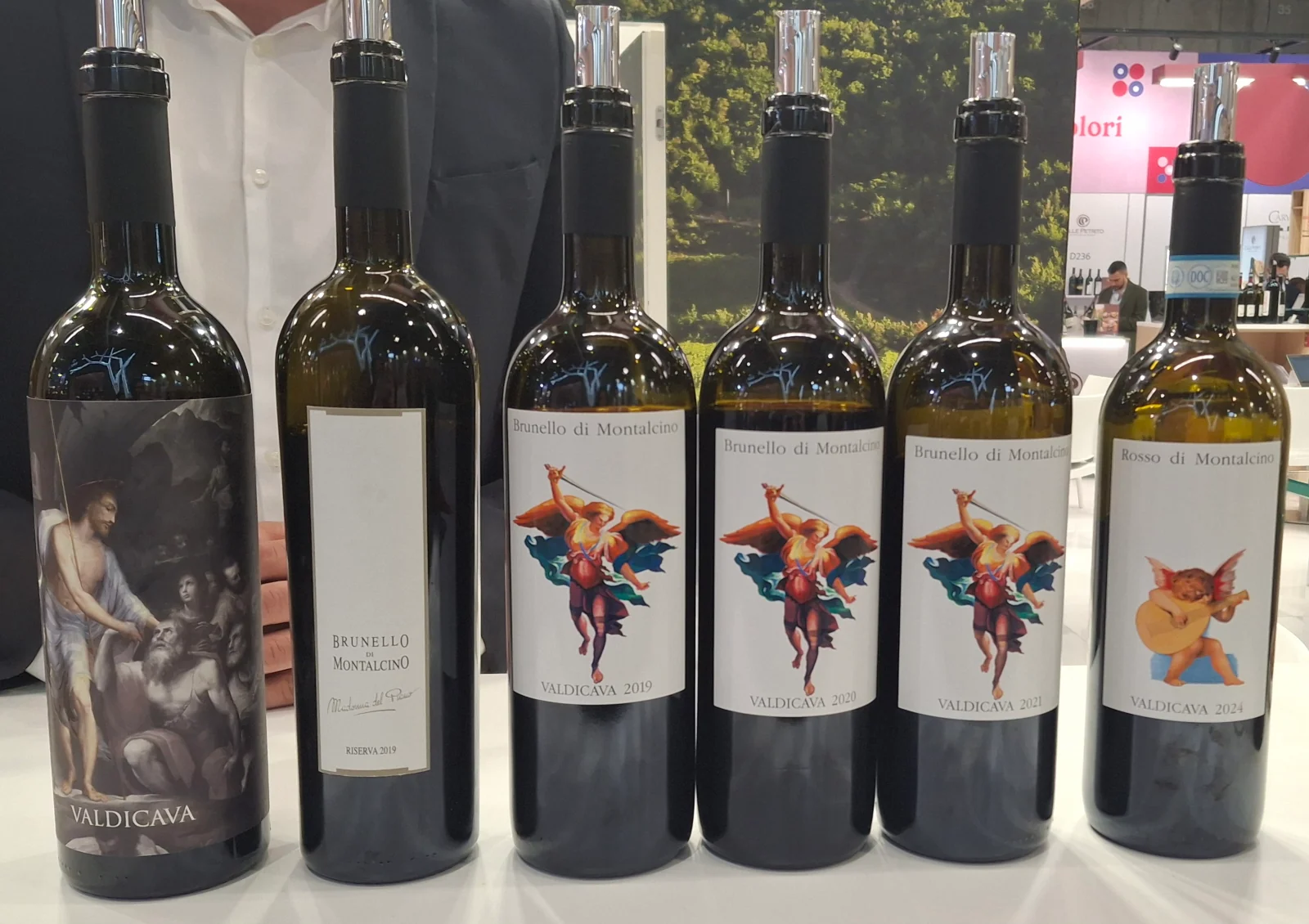
Valdicava: Montalcino between traditional power and contemporary signature
The meeting with Valdicava offered one of the most interesting moments of the entire Italian section. Its wines express a stylistic identity capable of holding together two poles often presented as opposites in the narrative of Brunello di Montalcino: the material power typical of Montalcino and a search for elegance, freshness and precision that makes the palate more contemporary.
The wines reveal substantial material yet never allow it to dominate the scene. Freshness works as a structural axis that lightens the palate, the tannic texture is fine and central, and balsamic notes broaden aromatic depth without weighing down the profile.
What ultimately convinces is the sense that Valdicava’s signature is not simply a search for power but an increasingly precise construction of balance. The wines retain the density expected from Brunello while also delivering clarity of fruit and freshness that make them far more contemporary than stereotypical readings of the territory might suggest.
France: from Provence rosé to the stylistic identities of Champagne
If Italy impressed through territorial plurality and positioning strength, France showed remarkable clarity in defending the segments where stylistic recognizability is already strong.
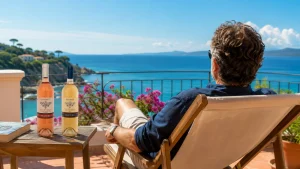
This is particularly true for Provence rosé, which continues to occupy significant space both commercially and culturally. The Provençal rosé is no longer merely a “trendy wine”: it has become an international language, a color, an image and a promise of consumption.
Alongside Grenache and Syrah, the role of Rolle — the local name for Vermentino — is increasingly evident, contributing aromatic tension and structural articulation.
Champagne, however, remains the deepest symbolic signature of the country. At Wine Paris, the presence of historic houses alongside dynamic independent growers showed the vitality of the region.
Among the houses tasted were Champagne Henriot, Abelé 1757, Champagne Philipponnat, and Champagne Gosset, each illustrating a different stylistic approach — from Chardonnay-driven elegance to Pinot Noir depth and tension defined by the absence of malolactic fermentation.
Together they illustrate the remarkable diversity of Champagne and the clarity of its identity within the global wine landscape.
The rise of de-alcoholized wines: market opening, identity still uncertain
One of the most visible novelties of the 2026 edition was the debut of the Be No pavilion dedicated to sparkling, low-alcohol and alcohol-free wines.
Its presence clearly signals where investments, curiosity and attempts to reach new audiences — especially Generation Z — are heading. Yet from my tastings the results remain inconclusive. Evaluating these products independently from wine itself, a technical doubt emerges: at the moment there is no clear production thread or stylistic identity strong enough to define the category.
Markets can grow rapidly due to curiosity or media attention, but consolidation requires coherence, recognizability and a clear language. For now, this identity still appears to be under construction. The comparison with the raw wine phenomenon is instructive. That trend also experienced strong exposure before the market gradually selected and redefined it.
For de-alcoholized wines, that maturation process has not yet fully occurred.
 A fair that measures the present and anticipates the next step
Wine Paris 2026 leaves a clear impression: despite a complex economic and cultural phase, the wine sector still possesses extraordinary power of attraction and relationship.
But this attraction no longer rests only on the historical reputation of territories. It now depends on the ability to remain clear, coherent and recognizable.
Wine Paris grows because it interprets this transition well. It combines international scale with urban functionality, technical depth with commercial readability, tradition with openness to new segments.
What remains after leaving the pavilions is not the number of wines tasted but the precision of certain directions: territories with their own voice, wineries showing coherence and wines that do not seek to impress but to be understood.
In a time when wine risks being reduced to slogans, Wine Paris reminds us that real positioning still comes from something far more demanding: having an identity, knowing how to communicate it, and proving it in the glass.