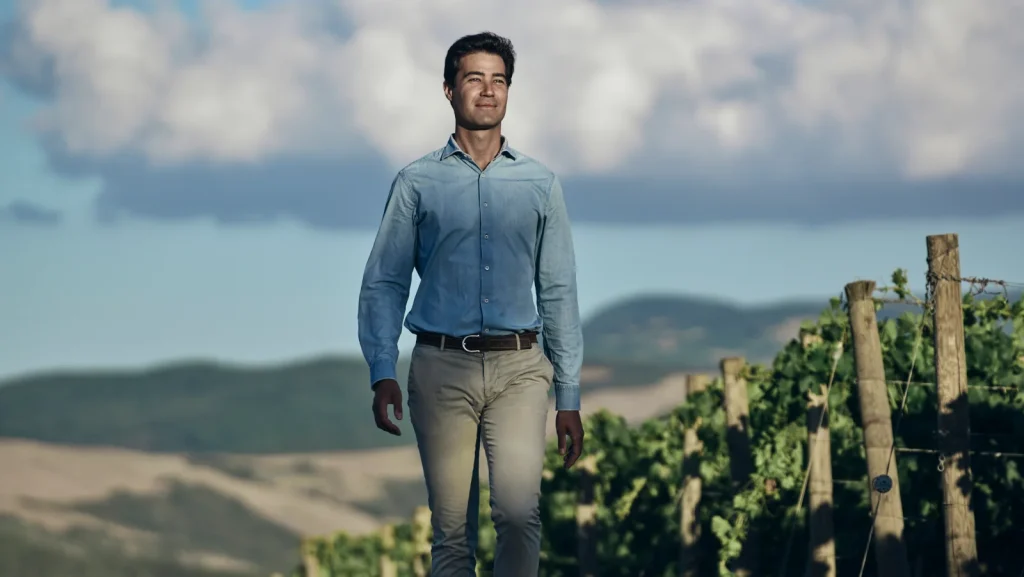
Interview with Gabriele Gorelli MW on the Evolution of the Appellation
The reflections on the 2021 vintage, on the growing attention to drinkability, and on the stylistic evolution of Brunello provided the ideal ground for a conversation with Gabriele Gorelli MW, a native of Montalcino and global observer of the denomination. The result is an interview that maintains the intimacy of a back-and-forth exchange, but carries the weight of someone who has lived and analyzed Montalcino for years.
Gabriele, from your point of view, how is the identity of Montalcino’s slopes changing in response to climate change?
“It’s a question that needs to be looked at over a longer period of time. It’s an analysis we carry out every year with Brunello Formula—though in truth we were doing it even before—and it always leads us to look back at least ten vintages prior to the one entering the market.
The result is that there are no winners or losers: that old idea—valid maybe thirty years ago—that you needed southern exposures to support the production of higher-altitude or northern vineyards no longer holds. Today, when looking at the slopes over a significant timeframe, the differences are no longer so marked.
Of course, differences do emerge in specific vintages. For instance, the western side of the appellation is often the warmest in recent years and, at the same time, the one with the lowest minimum temperatures: one of the more extreme areas, let’s say.
Ultimately, what I can tell you is that yes, a change has occurred, but the real shift is in the producers’ awareness of climate change—in the way they work. Generally speaking, we’re seeing wines that undergo less extraction, from grapes left to ripen for a shorter period, and that see different and less intrusive wood. It’s a phenomenon that has been happening for several years, and I believe that with 2021 it has truly become universal.”
Exactly, and this ties into my second question: recent Brunello vintages seem immediately approachable. Are we also witnessing a stylistic evolution, and how will these changes affect long-term aging potential compared to the past?
“Yes, and this concerns all great red wines, not just Brunello. You can definitely notice greater accessibility right from the start; perhaps the biggest leap has been made by the Bordeaux Châteaux with 2022, where the level of drinkability—already evident even during En primeur—is astonishing, something unthinkable until a few years ago.
But what happens there, as elsewhere, must be contextualized, because very often if a wine is good early on, it’s good always. That old idea of ‘wait, wait, the wines will come around’—it might have been true for certain vintages or producers, but not universally.
If that added a certain charm in the past, today this expanded drinking window increases accessibility and aligns more clearly with the market.”
As a Master of Wine, you have a pulse on international markets. How is this new, more balanced, more carefully oaked expression of Brunello perceived globally? And what do you see as the key strategic challenges and opportunities for strengthening Brunello’s position among the world’s fine wines?
“What strikes me immediately is that international markets have realized Brunello is changing—and so far, this change is seen as an improvement.
For too long—regardless of how powerful or ripe the wines were—there was that oxidative note, that hint that masked the fruit and made certain wines appealing only to a particular audience.
Today the market is responding well because, along with the gradual disappearance of that candied fruit note that dulled Brunello’s brightness, we’re seeing juicier, more approachable tannins.”
I’ve also noticed, in recent releases, a clearly finer and fruit-driven tannic texture that doesn’t interrupt the flow of the wine.
“Yes, exactly! That dryness, that hardness in the wine is finally fading. Regardless of ripeness, extraction, or power, there was always this constant element—a reaction to oxygen.
Producers are now more mindful—coming back to your point on oak—of when to apply wood and how that wood interacts with tannins. You can even shorten the time in oak, staying at the disciplinary minimum, but perhaps use more new wood that doesn’t dry the wine but builds structure.
These interventions don’t push the wine sideways, as the oxidative character once did. I find this new approach very aligned with qualitative evolution but also with a deeper awareness of place, because all this work makes wines more convex, more nuanced, more readable—and therefore more interesting. It enhances differences in altitude, soils, and exposures for a mature market eager to explore the nuances of Montalcino.
In my view, this is a strategic point: by reducing oxidative influence, you necessarily highlight the terroir.”
Benvenuto Brunello, in its preview format, is becoming an increasingly technical and transparent moment of exchange. Do you think this analytical approach can improve the quality of dialogue between producers and the specialized press? And how might it help knowledgeable consumers better understand Brunello’s complexity?
“I’m certain that starting from conversations grounded in facts and objective data greatly elevates the level and makes exchanges far more productive, allowing us to build proper reasoning and interpretation on a solid base.
You mentioned ‘transparency’: this is something I strongly believe in! Last year I was truly pleased to see the Consorzio’s board confirm, without reservation, a panel including Masters of Wine. Nothing was mediated or curated—it was pure, direct exposure to international palates with specific expertise.
And it was wonderful, because very few denominations have this willingness.”
 I would even call it courage…
“Yes, exactly—courage! The courage to stand bare and be judged. Of course, it won’t always be smooth sailing, but it will be a journey that brings enormous value.
Bruce Sanderson of Wine Spectator publicly stated that Brunello Formula is a unique system that offers tremendous support, and similarly Eric Guido of Vinous said it is essential today because it gives critics a set of tools to refine their deductions.”
And do you think consumers will also soon perceive this new openness? In my view this shift is already happening across wine: attentive consumers are increasingly interested in terroir, vintage expression, and varietal identity. They’re already somewhat ‘trained’ in this direction.
“Yes, and this requires reflection, because there are two levels at which we can intervene. The first is simply observing climate and stylistic changes; the second is explaining how specific reactions in the wines correspond to those changes.
What we’ve done with Brunello Formula is to bring everything onto a Cartesian diagram, where the vertical axis runs from density (below) to tension (above), and the horizontal axis from crunchiness (left) to maturity (right).
We’ve shown that even at the same declared quality level (including the star ratings), and going back as far as 2005, the personality of these wines can be completely antithetical.
We can also add another layer regarding tannin typology:
– tenacious in vintages with strong heat waves and marked drought;
– harmonious in regular vintages, with longer, more even seasons (like 2016);
– linear in vintages that started strong but then moderated in rainfall and extreme temperatures (like 2021).
With these tools, a curious consumer must be willing to explore rather than say: ‘Well, if it’s not 4 or 5 stars, I don’t want it; it must not be good!’
Communication must move in this direction: explaining to everyone—starting with buyers, importers, the trade and restaurants—how these wines behave. And through them, we often reach the final customer.
This is a great act of transparency and shows how committed the appellation is to defining and narrating itself, vintage after vintage.”
At the end of this conversation, it becomes clear that the denomination is entering a new season—one in which climate change is no longer an obstacle to chase, but a language to interpret; where stylistic research abandons rigidity and oxidation to deliver livelier tannins, more authentic fruit, and a more conscious winemaking touch.
Montalcino today is not just a place that produces a great wine, but a place that thinks, listens, and evolves. An open-air laboratory where Brunello—more readable, more accessible, more sincere—becomes not just a symbol, but a shared narrative.
From Montalcino comes a simple, powerful message: quality is an act of clarity.