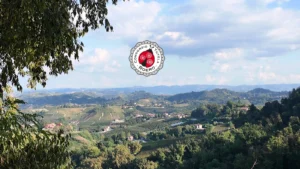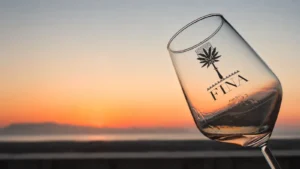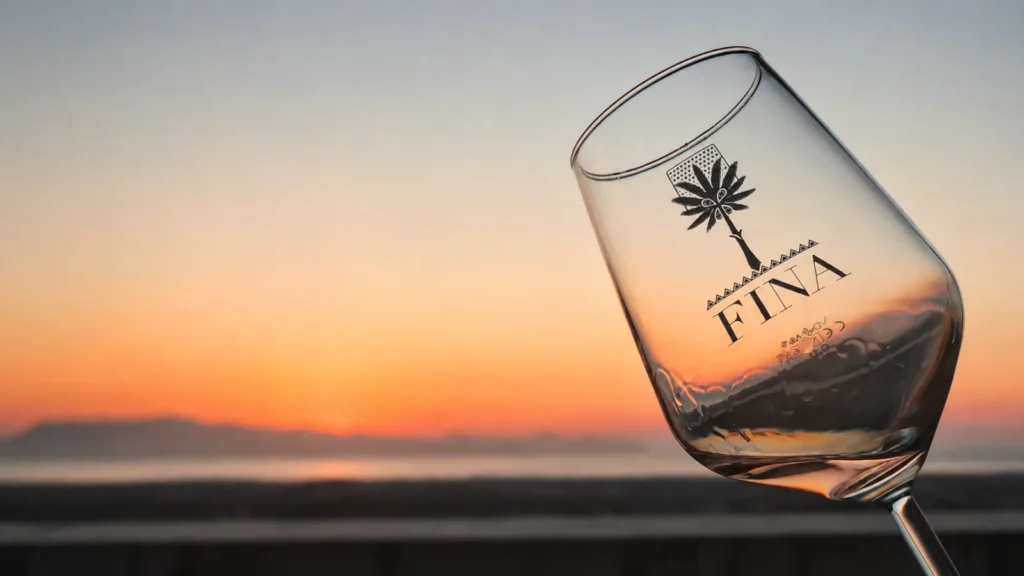
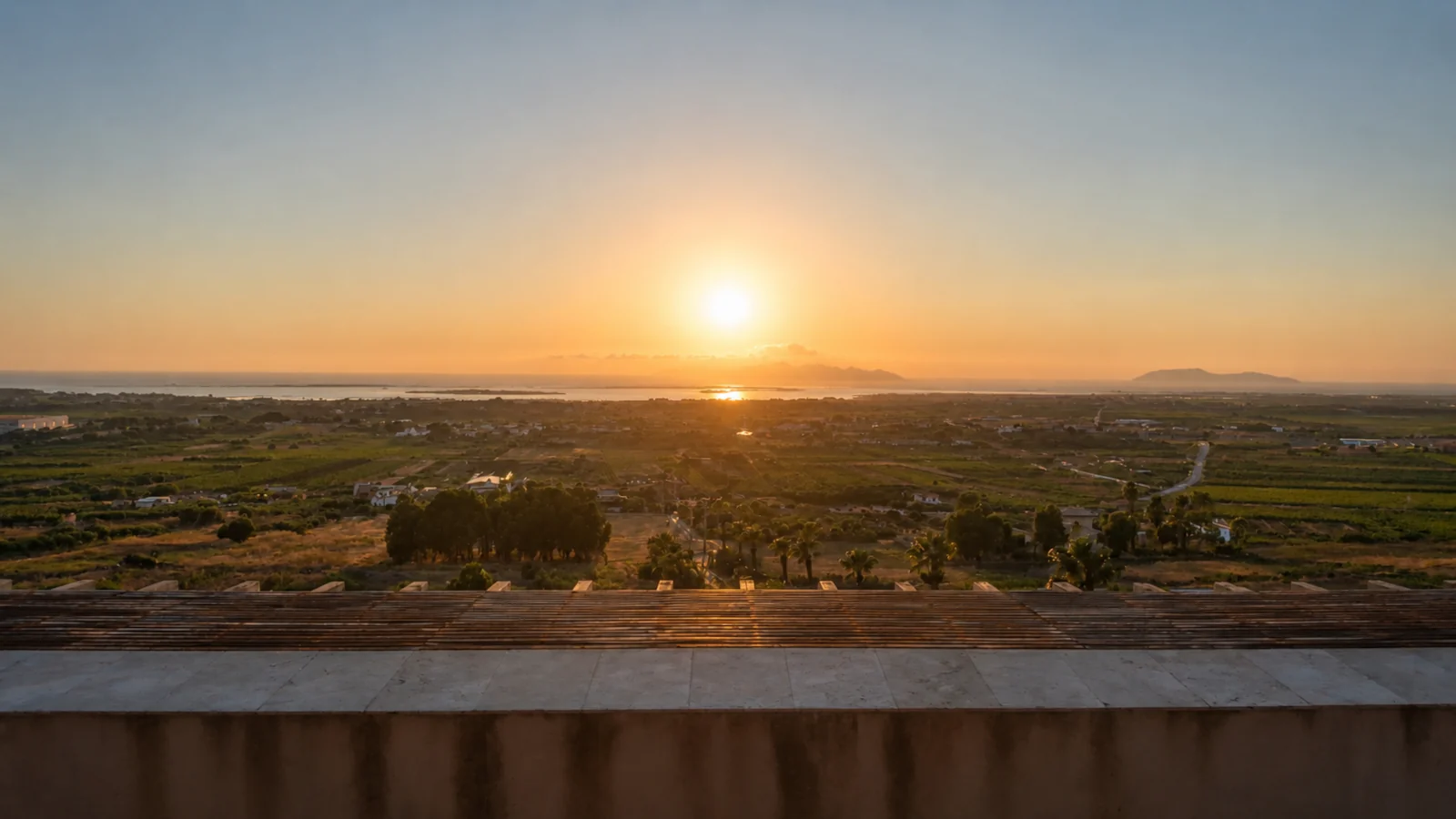
It is around seven in the evening on August 10 when the road begins to climb towards Cantine Fina. The light has already lost the harshness of the day, and western Sicily is settling into that warm glow that comes just before sunset, when the sun seems deliberately to slow down before surrendering to the sea. From the hillside, the eye travels far across the landscape, towards the Stagnone lagoon, the salt pans and the Egadi Islands breaking the horizon, suspended in a luminous haze.
It is difficult to arrive here without feeling, at least for a moment, that time has somehow stopped.
What captivates you is not the grandeur of the place, but something subtler, more intimate, almost whispered. Cantine Fina has an elegance that never needs to assert itself, born instead from the immediate feeling of having entered a lived-in space before entering a winery. There is the warmth of a home and, even before tasting the wines, you sense that behind these walls lies a story of deep bonds, of people connected by something that goes far beyond simply sharing a business venture.
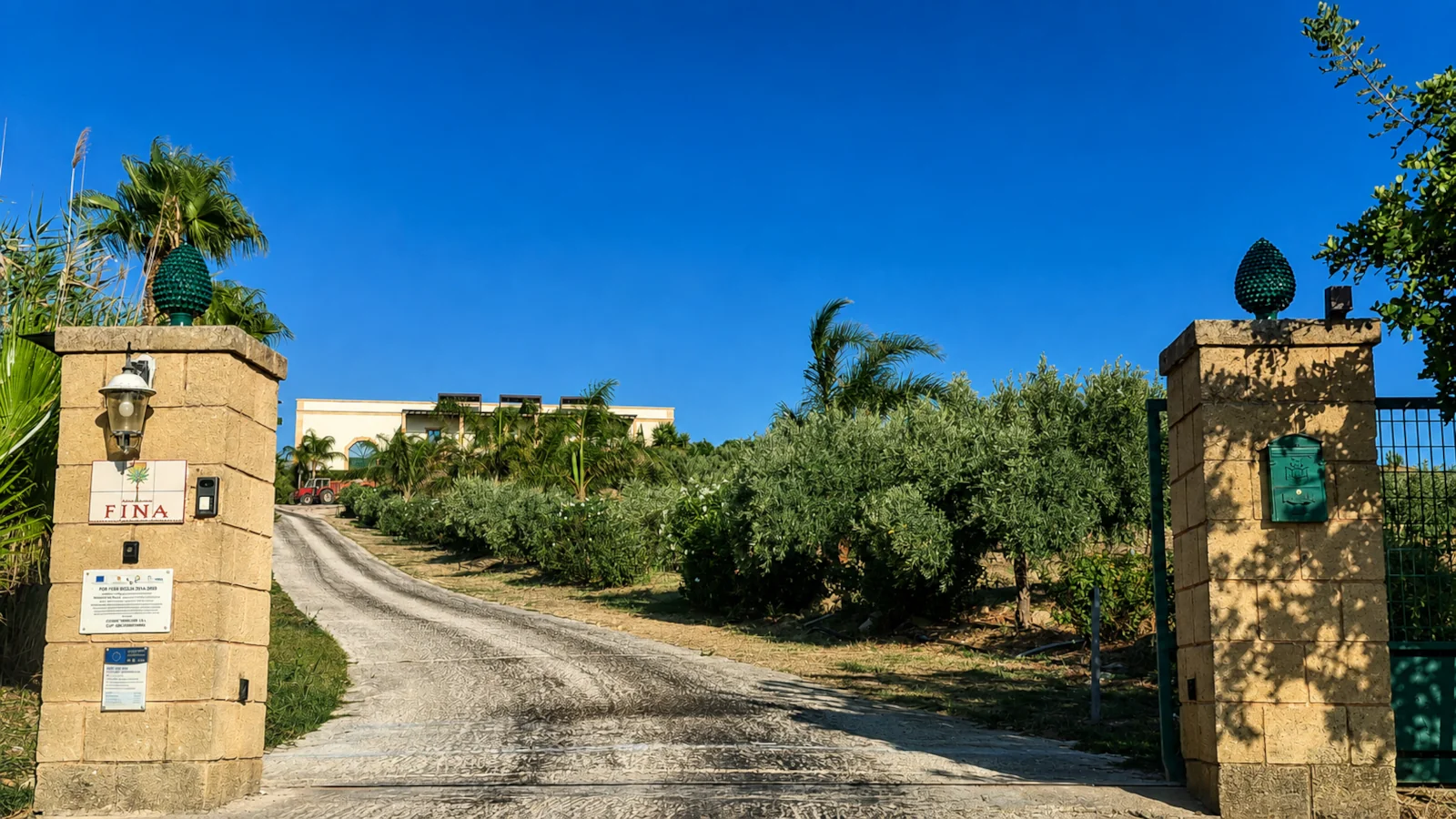
Perhaps Cantine Fina begins with a wish: the one shared by Bruno Fina and his wife Mariella, who would come to this hillside to watch the sea and the sunsets, imagining that one day they might build something here that would belong to their family. Bruno already knew wine intimately. A Sicilian oenologist, he had built up solid professional experience over the years and, along the way, met Giacomo Tachis, a figure who would leave a profound mark on the way he understood Sicily and its endless winemaking possibilities. His knowledge had been built in the field, through study, experience and intuition. Yet at a certain point, that was no longer enough. Because knowing wine, making it and studying it is one thing; entrusting a dream to it, imagining it at the heart of a family and a life project, is quite another.
In 2005, that dream finally took shape in Contrada Bausa, Marsala. Bruno and Mariella built their winery and, almost naturally, the project soon became that of their children too: Marco, Sergio and Federica. The family began calling the winery their “fourth child”. It might sound simply like an affectionate expression, one of those phrases that often accompany family stories in the world of wine. But then you come here, listen to their voices and walk through these spaces, and you realise there is very little metaphor about it: Cantine Fina truly grew up alongside them, nourished by the same time, the same sacrifices and the same love.
Today, Marco oversees the administrative and commercial side of the business, Sergio works in production as an oenologist alongside his father, while Federica is responsible for communication, marketing and wine tourism. Different roles, different personalities, but the same sense of belonging.
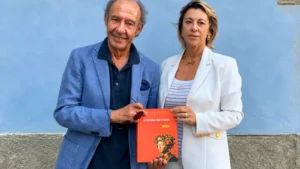
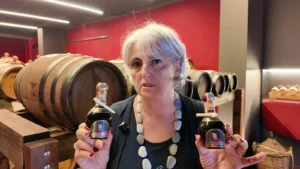
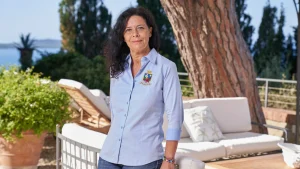
And it is Federica who opens the door to us. She does so much as she would probably welcome friends into her home: without creating any distance. She speaks quickly, smiles often, her expression changing as she recalls one episode only for another to immediately surface. There is a particular brightness in her eyes, the kind you see in people when they stop talking about their work and, almost without realising it, begin talking about something they love.
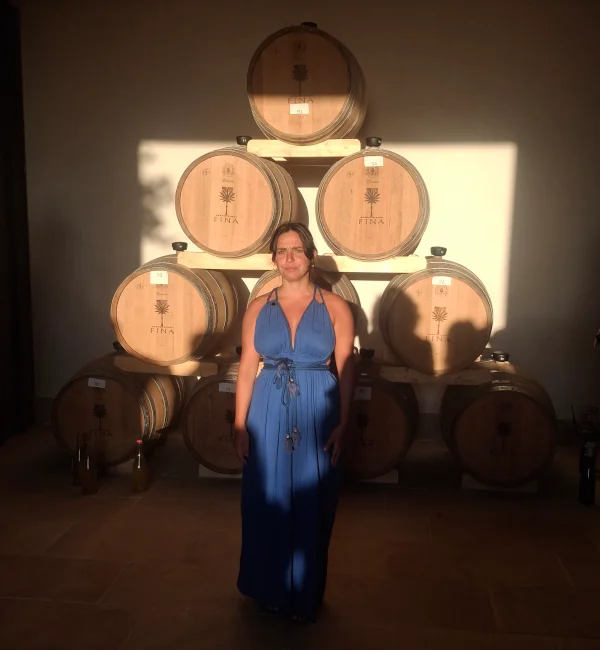 With her, the visit soon becomes something else. It is no longer simply a tour through the winery, but a gradual journey into her family’s story. Her words take us back to childhood harvests, the early years of the brand, evenings spent presenting the wines, and the need to carve out a place in a territory dominated by historic names. Then she talks about her brothers, her father and her mother. Above all, her mother. Mariella is no longer here, but at Cantine Fina her memory never takes on the contours of melancholy. Instead, it becomes continuity, preserved in stories, choices and even in a wine. Federica speaks of her with a daughter’s pride and with the serenity of someone who knows that carrying a dream forward also means continuing to speak the name of the person who first imagined it.
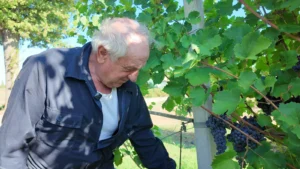
In the winery, we also meet Sergio at perhaps the least convenient time to stop an oenologist: it is harvest season. Yet he pauses and accompanies us for a few minutes through the winemaking areas, explaining his work simply, without turning it into a technical demonstration. More than his words, it is that same light in his eyes that gives him away. There is pride when he speaks about grapes and fermentations, of course, but above all an awareness that he has inherited something that must both be protected and carried forward.
This is where the story of Cantine Fina ceases to be solely a family story and meets Bruno’s vision: to understand Sicily beyond the stereotypes, not as a uniform wine region but as a true continent, encompassing sea and mountains, different altitudes, exposures and profoundly diverse microclimates. From this idea comes the coexistence of native varieties such as Grillo, Zibibbo, Nero d’Avola and Perricone with international grapes including Chardonnay, Sauvignon Blanc, Traminer, Syrah and Cabernet Sauvignon, each planted in the areas best suited to its particular needs.
The vineyards are therefore not concentrated in a single area. Instead, the right place is sought for each variety: close to the sea, where wind and salinity make their presence felt, or at higher elevations, where temperature variations preserve acidity and aromatic precision.
Traminer Aromatico is perhaps the gamble that best encapsulates this philosophy: taking a variety apparently far removed from Sicily and searching here for the place capable of allowing it to express itself.
Before we get there, however, our tasting on the panoramic terrace begins with a grape that needs no passport to tell the story of this part of the island.
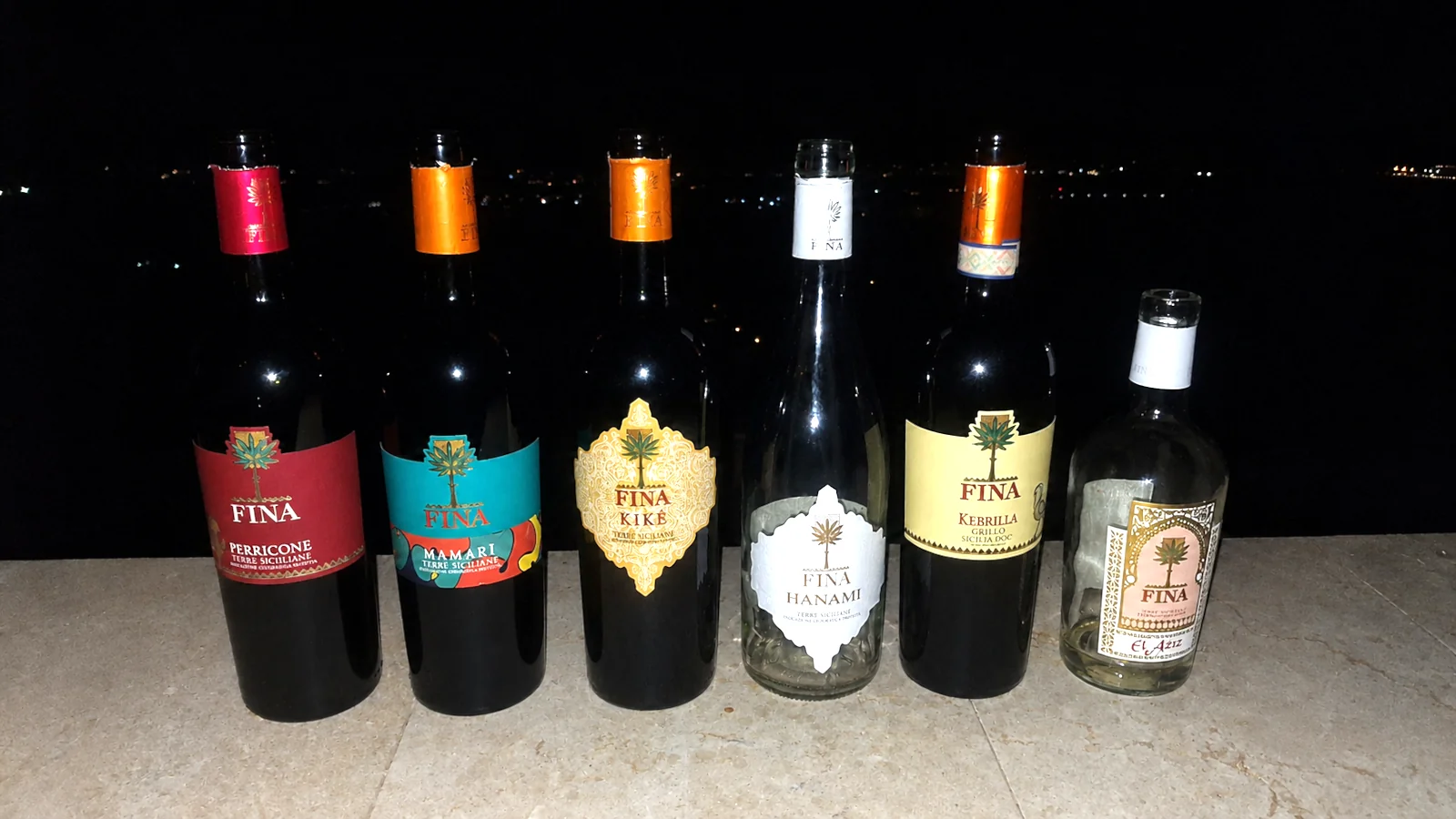
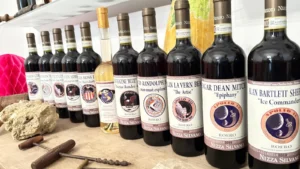
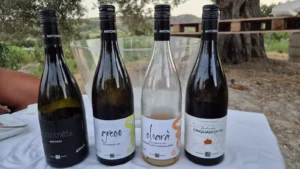
In the glass, Kebrilla Sicilia DOC 2025, made entirely from Grillo, shows a bright straw-yellow colour. The nose immediately speaks with a Mediterranean accent: orange blossom and jasmine open onto fresh pineapple, passion fruit and kumquat, followed by lemon thyme, a delicate hint of anise and candied ginger. On the palate, the wine changes register, becoming taut and vertical. Citrus freshness recalls lime, while a distinct savoury character drives the wine forward and leads into a finish with hints of dried fruit.
This is a Grillo built around the meeting of two Sicilies: the vineyards close to the Stagnone and those at higher, cooler elevations, with vinification divided between stainless steel and a small proportion of oak. Its name was inspired by Jovanotti’s song “Kebrillah”, which in turn gave rise to “Quel che brillerà”, the summer event that brings the Cantine Fina hillside to life every year and which, on August 7 this year, welcomed Alex Britti.
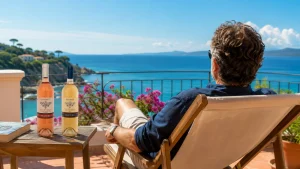
The second wine is Hanami Terre Siciliane IGT 2025, a rosé originally created from Merlot and now complemented by a proportion of Syrah, grown at altitude and aged on the lees in stainless steel.
In the glass, it is a delicate, luminous peach-blossom pink. The Merlot opens with a subtle balsamic note of bay leaf, followed by wild strawberry, raspberry and pink grapefruit zest. Gradually, the spicy signature of Syrah emerges, finishing on pink peppercorn. The palate finds a fine balance between body and agility: citrus notes provide momentum, savouriness drives the progression and the finish returns to grapefruit, crossed by a subtle spicy sensation.
Hanami, in Japanese, means “contemplating the cherry blossoms”, a reference to the winery’s openness towards Asian markets.
Then comes Kiké Terre Siciliane IGT 2025. And when Federica says the name, the wine immediately ceases to be just a wine: Kiké is her. Or rather, it is the name her family has always called her. The youngest, once “Kiketta”, eventually became simply Kiké.
The blend combines 90% Traminer Aromatico and 10% Sauvignon Blanc. In the glass, the colour becomes richer, straw yellow with golden highlights. The Traminer makes its presence known immediately: rose, lychee, white peach and jasmine, while Sauvignon Blanc balances its aromatic exuberance with vegetal and citrus hints of lemon thyme and grapefruit, followed by a balsamic touch of lesser calamint and wild incense. Beneath it all, a subtle mineral note recalls face powder.
On the palate, the contrast is the most fascinating aspect: the richness of Traminer meets the citrus freshness of Sauvignon Blanc, a blade cutting through the wine, lightening it and restoring its energy, while the savoury character extends the finish and leads once again towards grapefruit.
After listening to Federica, it is difficult not to think that Kiké resembles her, at least a little: expansive from the first encounter, bright and impossible to ignore, yet defined by a precision that prevents its aromatic character from ever becoming excessive.
Mamarì Terre Siciliane IGT 2025 is 100% Sauvignon Blanc. But above all, it is “Mamma Mariella”.
Federica tells us the story without changing her voice in search of emotion. She does not need to. There is something far more powerful in the natural way she explains that this bottle allows them, every day, to continue talking about their mother. And perhaps this is one of the moments when you truly understand what it means for the Fina family to consider their wines part of the family.
Made from Sauvignon Blanc grown at altitude and vinified exclusively in stainless steel, Mamarì is a pale straw yellow. The nose initially moves through distinctly vegetal notes: boxwood, Mediterranean scrub and helichrysum, followed by grapefruit and a saline streak. The palate has greater weight, with savouriness building texture while citrus acidity drives the wine forward and keeps its warmth in check. The finish returns to herbs and vegetal notes.
As the sun sinks further and the light on the terrace begins to turn pink, the red arrives: Perricone Terre Siciliane IGT 2025, bringing the story back to one of the varieties historically most closely associated with western Sicily.
The colour is a medium-intensity ruby with amaranth reflections. Cherry comes first, followed by bay leaf, geranium petal and clove. On the palate, its agility is surprising: the tannins are gentle, finely textured and central to the wine’s development; the fruit returns to cherry, while acidity carries the progression. There is texture too, supported by savouriness, and the finish gradually moves towards the spice of green pepper.
This is a Perricone that does not need muscularity to prove that it belongs to the South. And this, too, ultimately says something about the Fina family’s vision: Sicily can offer intensity without heaviness, ripeness without sacrificing movement, sunshine without losing freshness.
Around us, meanwhile, the terrace begins to change.
The pink light of sunset brushes the Egadi Islands. Marsala stretches towards the sea, the voices around us mingle with the music and the still-warm wind moves between the tables. It is one of those moments when the landscape stops being merely a backdrop and begins to enter the glasses. Perhaps this is precisely the meaning of wine tourism at Cantine Fina: not simply allowing visitors to taste a wine, but giving them back the place that created it.
The tasting ends with El Aziz, and once again there is a family story behind the wine.
In Arabic, the name means “The Magnificent”. It is a late-harvest Grillo, picked by hand after the grapes have naturally dried on the vine.
Its origins, however, have something almost cinematic about them. The story begins with a harvest postponed for a few days because the family had gone out on their boat, which happened to be called El Aziz. When they returned to pick the grapes, the fruit had already begun to follow a different path from the one originally intended: an inconvenience turned into an intuition, and chance transformed into a great wine.
In the glass, El Aziz shines gold. Caramelised citrus, lemongrass, gentian, lime blossom and broom precede a note reminiscent of peach juice. On the palate, its glyceric richness finds a precise counterpoint in fresh fruit. Apricot follows, with the texture of fruit nectar, while savouriness carries the finish towards caramelised citrus. Sweetness and tension move forward together.
Outside, it is almost night now, and it is August 10. Listening to the story of the Fina family, it feels natural to return to the idea of wishes.
The ones we casually entrust to a star because they seem too great to depend on us alone; and those that instead require years, sacrifices, mistakes, harvests, arguments and courage before they can finally take concrete form.
Bruno and Mariella once looked at this hillside imagining a home beside a winery. Then that home and that winery became real, and their children chose to make them part of their own future. Bruno still watches over the vineyards and the winery with the same rigour of someone who never considers his work truly finished. Mariella’s name continues to be spoken within the family and poured into a glass bearing her name.
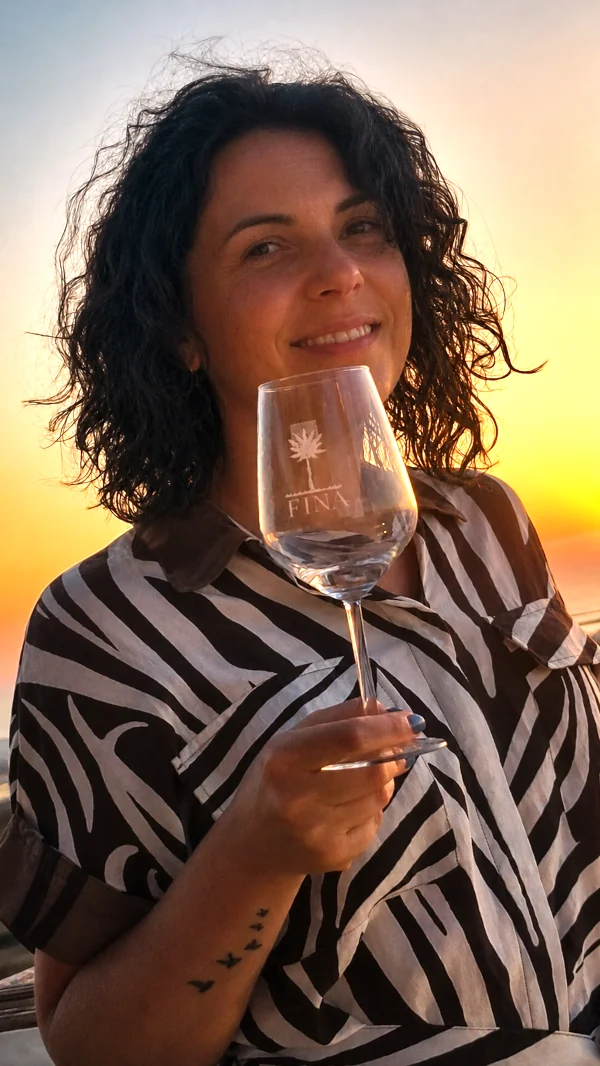 And perhaps this is the most precious thing I take away from Marsala.
On the terrace, the last light of sunset has almost disappeared. The Egadi Islands have become dark silhouettes on the horizon and above us the stars of San Lorenzo are beginning to appear. Something of this land still lingers in our glasses: the salt of the sea, citrus fruit, Mediterranean herbs, ripe fruit and the warm evening wind. But alongside the wine, what remains above all is the story of a family that managed to transform a place into a project, and that project into something to be passed on to the future.
Perhaps this is exactly what wishes do when they cease to belong only to the sky: they find someone willing to believe in them enough to bring them down to earth. And at Cantine Fina, this dream has taken root.