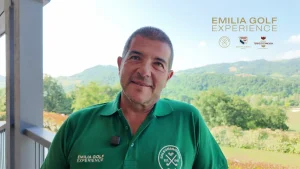
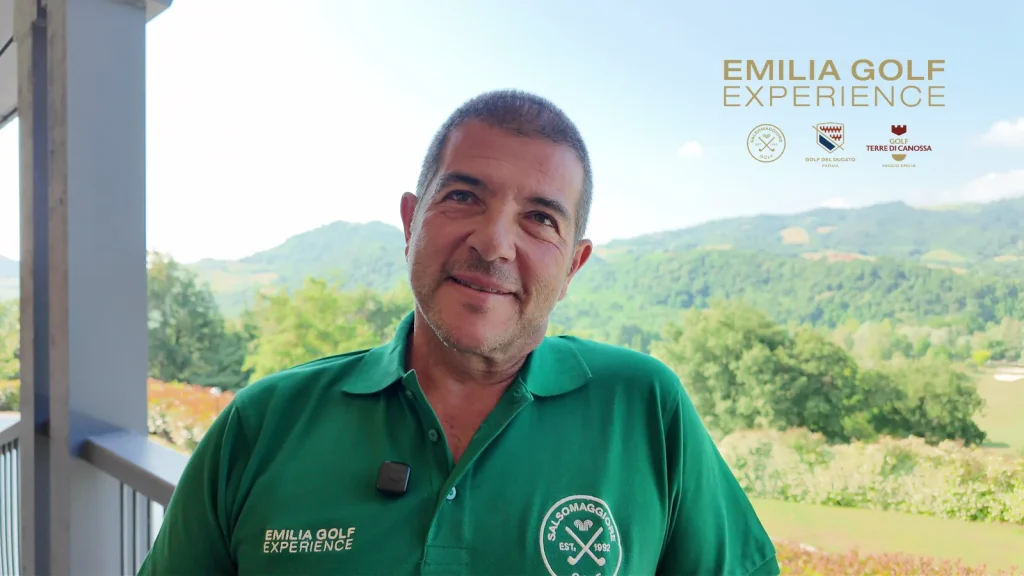
With Emilia Golf Experience, Alessandro Carrara has built something that goes far beyond sport. A project that demonstrates how wine, gastronomy, hospitality and local identity can become part of the same experience, transforming into a tourism resource capable of creating value for everyone involved.
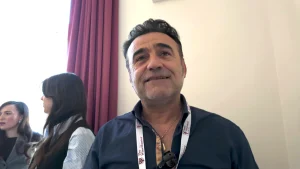
Sitting by the fairway at the Golf Club of Salsomaggiore, with the rolling green landscape stretching across the Emilian hills, it is almost natural to wonder what a wine journalist is doing talking about golf. Yet the question itself already contains the answer.
For years, we have tended to think about tourism in separate categories. Wine on one side, gastronomy on another, hospitality somewhere else, and sport confined to its own world. Each sector focused on promoting itself, often without realizing that the greatest value lies precisely where these worlds meet. Alessandro Carrara is one of those people who understood before many others that the future does not necessarily depend on creating new attractions, but on connecting the ones that already exist.
This is the principle behind Emilia Golf Experience, a project that uses golf not as an end in itself, but as a tool. Golfers may arrive to play, but once their round is over, they look for something more. A good restaurant, a winery to visit, a village to explore, a producer to meet, a story to take home along with memories of the day. In other words, they seek a complete experience—something that goes beyond sport and turns a simple stay into a meaningful journey.
Alessandro’s insight was precisely this: understanding that golfers are curious travelers, often willing to stay for several days, eager to discover a destination and constantly looking for authentic experiences. In a region such as Emilia-Romagna, where world-class food, wine, motors, culture and landscapes coexist, the potential is enormous. The challenge has never been a lack of attractions. The challenge has been connecting them.
That is how a network gradually emerged, bringing together golf courses, accommodation providers, restaurants, hospitality services and local producers. It is a network that exists not only in brochures or on websites, but in everyday operations. When visitors arrive, someone guides them through the experience, simplifies reservations, coordinates hospitality and ensures that moving from one activity to another feels natural and seamless. It may sound like a small detail, but it is exactly what separates a collection of services from a true tourism destination.
Listening to Alessandro, it is impossible not to think about how relevant this model could be for the wine world as well. For too long, wine tourism has treated the winery as the center of everything. Today, however, visitors are looking for something broader. They certainly want to taste wine, but they also want to understand where it comes from, meet the people who produce it, explore the landscape that surrounds it, enjoy local cuisine and perhaps combine all of this with cultural or sporting experiences. The bottle becomes part of a larger story and, for that very reason, gains even greater value.
In this sense, golf is simply one possible gateway. It could just as easily be cycling, hiking, sailing or any other activity capable of attracting people and bringing them into contact with a territory. The principle remains the same. What matters is the ability to transform individual points of excellence into an ecosystem that communicates, collaborates and generates opportunities for everyone involved.
Perhaps this is why Alessandro pays close attention to what is happening in countries such as Spain, Greece and Turkey, where golf has long been understood as a powerful tool for destination marketing. Not because golf is more important than wine or gastronomy, but because it attracts visitors who stay longer, spend more locally and actively seek diverse experiences. Exactly the kind of tourism many Italian destinations say they want to attract.
Yet the word that returns most often during the conversation is not golf.
It is network.
Building connections.
A concept that sounds simple but remains surprisingly rare. Because building a network means giving up a little individual protagonism in order to create something larger. It means understanding that a winery on its own is simply a winery, a restaurant on its own is simply a restaurant, and a golf course on its own is simply a golf course. Together, however, they can become a destination.
Perhaps that is the most valuable lesson emerging from Alessandro Carrara’s experience. At a time when everyone is searching for new formulas to attract visitors, true innovation may not lie in inventing something new, but in finally learning how to connect what already exists. And from this perspective, Italy probably possesses more resources than almost any other country in Europe.
What is needed are people capable of building the bridges.