Of my Canarian stories, I saved the one about La Geria for last. And to think I expected it to be the most touristy of all, partly because it’s highlighted in every guidebook, and partly because the roads are filled with every type of tourist vehicle, from cars to quads.
But then I knocked on their door and found myself sharing a wonderful experience with Alejandro Besay, the winery’s oenologist. It was an experience marked by the luxury of taking the time to see everything properly and enjoy it fully.
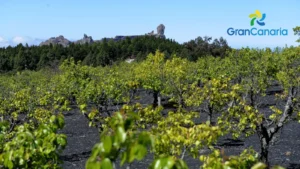
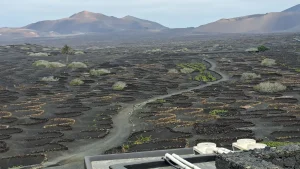
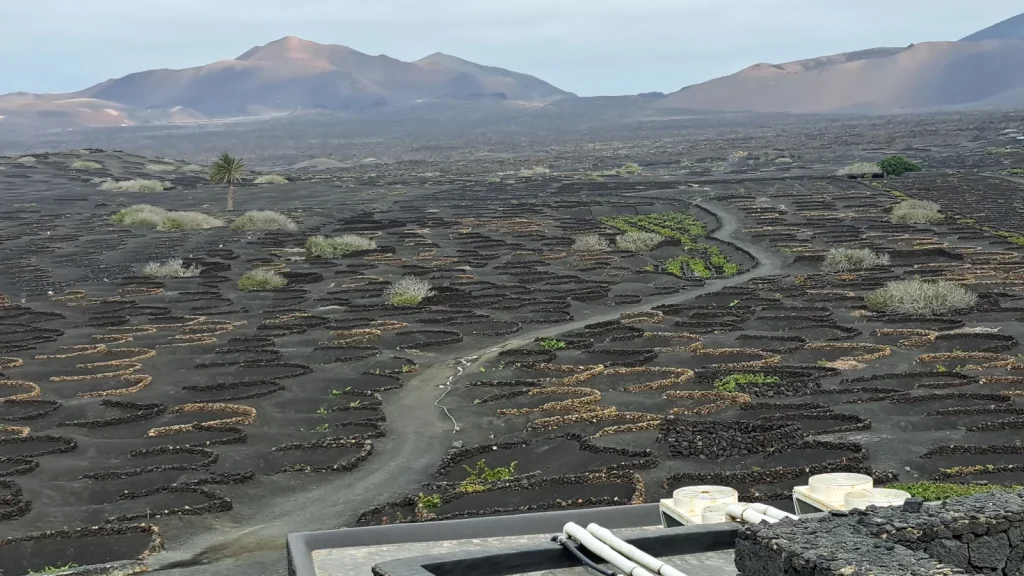
Let’s start at the beginning. One of the strangest and most fascinating aspects of Lanzarote is the transition from brown to black. From soil to rock, from smooth to jagged. You drive along a road, and suddenly everything turns black. But not just that. Step out of the car, and you’re met by a wind that sweeps you away. A landscape that captivates you, astonishing in its difference from anything you’ve seen before—made even more remarkable when you stop to think that you’re standing before vineyards.
It’s all black. A black composed of fine granules of volcanic residue, which somehow makes everything appear incredibly orderly and smooth. From the garden of the house hosting us to the vineyards we’re visiting. Something about the texture and color makes the geometry of these places truly dominant.
The landscape consists of small craters, each shielded by a semicircle of dry-stone walls, always oriented in the same direction, as if the wind blows perpetually from one side.
It’s a stunning sight, but then, with Alejandro, we delve into the details. Beneath the “black” lies clay, and the crater is dug to allow the roots to reach this clay. The black “sand,” inevitable given the location, plays a key role in maintaining the right balance of humidity on an island where water seems to be a precious commodity.
Here, Malvasia becomes Malvasia Volcánica, thanks to the adaptation of this grape variety. We also find Vijariego, planted alongside Malvasia to protect it from rabbits (who dislike its scent).
Then we let our imaginations take flight (and not just our imaginations), moving from the vineyard to the cellar and finally to the shop, where Alejandro guides us through tasting some of the wines from the MANTO line. A dry white aged three months in barrels, the Malvasia Volcánica, and a Tinto Joven blend of Syrah, Merlot, Tintilla, and Listán Negro, one of the most prevalent varieties in the Canary Islands. The Malvasia stands out for its minerality and freshness, the Listán Blanco equally mineral and fresh, although I would have preferred it unoaked (Alejandro, don’t hold it against me!), and the red is intriguing, with good character for a Joven wine.
In short, I tried to describe this place, but it’s pointless.
You simply must visit and let yourself be mesmerized by the landscape, the vineyards, and their exceptional hospitality.
Ale, once again, thank you for your time and for the way you welcomed us to this incredible place.