Lambrusco, Balsamic Vinegar of Modena, culture, identity and the ability to tell a compelling story. A journey to Modena confirms an impression I have had on previous visits to Emilia: this is a place where a region truly thrives when its finest products and traditions stop operating in isolation and learn to speak with one voice.
Some regions are blessed with outstanding products. Others have gone a step further, learning how to build a shared narrative around them. Modena firmly belongs to the latter category.
Perhaps this is the most interesting takeaway from my experience with Piacere Modena: that distinctly Emilian ability to build networks, connect different players and transform a collection of individual excellences into a recognisable regional identity.
It is not simply a matter of promotion. Above all, it is a method. Lambrusco and Balsamic Vinegar of Modena are two clear examples. Products with very different histories, characteristics and ways of being enjoyed, yet united by a profound connection to their place of origin and by the need to move beyond certain oversimplifications that have accompanied their success over the years.
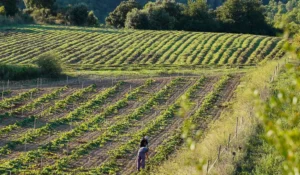
For Lambrusco, this means explaining that behind a single name lies not just one wine, but a complex world of grape varieties, appellations, colours and interpretations. From the lighter, more vibrant and linear Sorbara to the more intense and tannic Grasparossa di Castelvetro, the character of the wine changes considerably. And so does the way it needs to be presented. Across the provinces of Modena and Reggio Emilia, approximately 10,000 hectares are planted with Lambrusco, within a production system that yielded around 32 million bottles of DOC wine in 2025.
With Balsamic Vinegar, the story takes a different direction. Time, wood, traditional vinegar cellars and family memories come into play. Different production traditions coexist: from Aceto Balsamico Tradizionale di Modena DOP, whose identity is rooted in exceptionally long ageing processes, to Aceto Balsamico di Modena IGP, which has become one of Italy’s most internationally successful food products, with more than 91 million litres produced in 2025 and over 93% of production exported.
Yet a visit to Modena quickly reveals that the real point is not simply the figures or the quality of individual products. It is the ability to connect them. Piacere Modena offers a picture of a region where consortia, producers, institutions, cultural organisations and the hospitality sector manage, at least when the system works at its best, to speak a common language.
And there is something about this language that particularly struck me: it is simple, without being simplistic. That distinction matters.
Explaining a set of traditional balsamic vinegar barrels, describing the different styles of Lambrusco, helping people understand what an appellation means or why protecting a geographical designation carries both economic and cultural value: all of this can be made accessible without being trivialised. Greater technical complexity is not necessarily what gives content its value. Sometimes the opposite is true: value becomes apparent precisely when those communicating it succeed in making it understandable.
This is probably one of the areas in which many Italian regions still have a great deal to learn.
Too often, wine, gastronomy, culture, tourism and local identity are presented as separate worlds, each with its own language, events and audiences. In Modena, once again, I had the impression of a greater willingness to cross boundaries, collaborate and build a cohesive system.
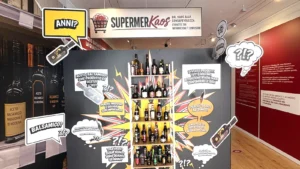
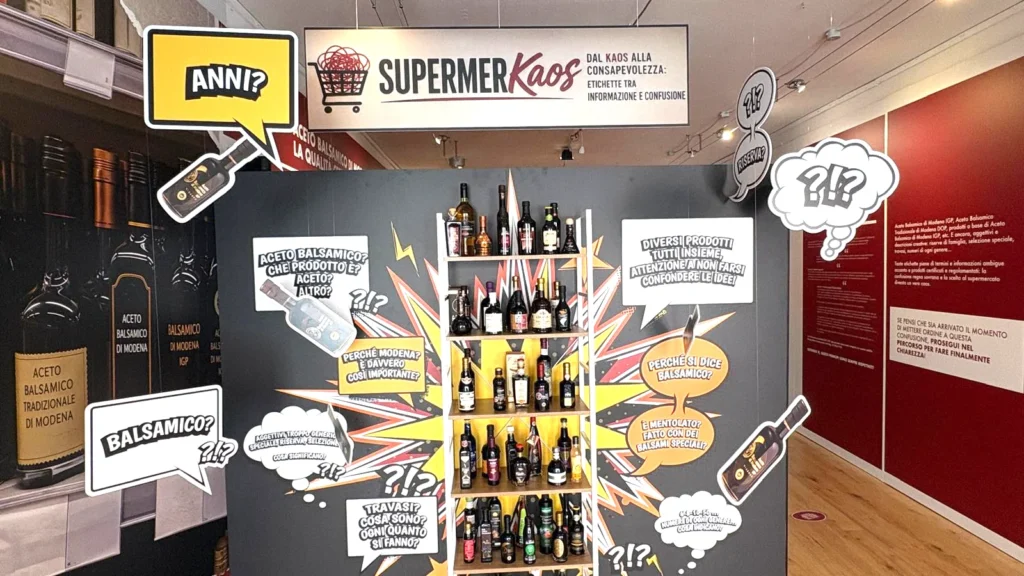
In this respect, I found one experience particularly significant, even though it might initially seem somewhat removed from the world of food and wine: SupermerKaos.
Created for Festivalfilosofia, this temporary exhibition and interactive workshop recreated the setting of a supermarket, placing visitors in front of shelves, labels and commercial messages and inviting them to distinguish accurate information from misleading claims and products that might appear deceptively similar. Its stated aim was to guide consumers “from chaos to awareness”, teaching them to read and understand more carefully what they buy.
I thought it was an especially effective idea because it addressed the issues of counterfeiting and imitation without turning the experience into a conventional lecture on product fraud. Instead, visitors were placed directly in a situation we all encounter every day: standing in front of a supermarket shelf.
This is precisely where the protection of geographical indications stops being an abstract concept. In the case of Aceto Balsamico di Modena, the issue is far from marginal. The PGI product is marketed in more than 130 countries, and the sector has established an enormous international presence. At the same time, the Consorzio carries out monitoring and protection activities to defend the designation against imitations and misleading references.
What made SupermerKaos particularly successful was its ability to communicate all of this without starting from regulations, production specifications or legal disputes. Instead, it started with the consumer and a very simple question: do you really know what you are buying?
It was probably the clearest example of the communication style I encountered throughout my experience in Modena: accessible, engaging, sometimes even playful, yet firmly grounded in substantial content.
And perhaps that is precisely the point. To promote a region successfully, having outstanding products is not enough. You need to make them part of a wider conversation, building connections between those who produce, those who protect, those who communicate, those who contribute to cultural life and those who come from elsewhere to discover the place.
Above all, you must not be afraid of simplicity, because clear, straightforward language does not diminish the value of what it describes. When supported by expertise, identity and a genuine ability to work together, simplicity can become the very tool that allows that value to reach a much wider audience.