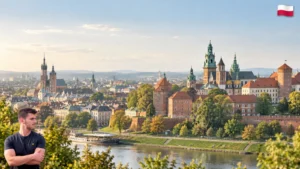
For many travellers, Poland means Kraków, Warsaw, castles, forests and vodka. And yet, while almost nobody was looking in that direction, a new generation of winemakers has been emerging.
Today, vineyards cover more than a thousand hectares and can be found across all 16 of the country’s administrative regions. Perhaps it is time to redraw the map.
If someone asked me to quickly name five European countries worth visiting for wine, Poland would probably not be among my first answers. And that is exactly why it interests me today.
In the wine world, we are used to travelling along well-established routes. Bordeaux, Burgundy, Tuscany, Rioja, the Douro, the Mosel. Extraordinary places, of course, but also regions we already know a great deal about before we even set off. We know what we are likely to drink, what landscapes we will find, which grape varieties we will encounter.
Poland starts from the opposite position: we know almost nothing about it.
And when a destination can still surprise us before we have even visited it, perhaps it deserves a closer look.
The first surprise is in the numbers. At the end of the first quarter of 2025, Poland’s official register counted 673 winegrowers and just over one thousand hectares of vineyards. By September of the same year, the vineyard area had already exceeded 1,098 hectares.
These are tiny figures compared with Europe’s major wine-producing countries. And that is exactly what makes them interesting: Poland matters not because of how much wine it produces, but because of how quickly it is building a wine identity that, until only a few years ago, would have seemed almost unlikely.
In a feature published in September 2026, Decanter traced an impressive rise: from just three registered producers in 2009 to more than 700 today, with vineyards now present in all sixteen of the country’s voivodeships.
But it would be wrong to think that Polish wine suddenly appeared simply because of climate change.
Vines have a much older history here. Viticulture was already present in the Middle Ages, before colder climatic conditions, wars, political upheaval and, later, the communist period progressively reduced its importance. The modern revival began mainly in the 1980s and accelerated after wine legislation was liberalised in 2008.
In other words, Polish viticulture is not so much a story without a past as a story that was interrupted and has now begun to be written again.
And perhaps this is one of the most interesting aspects for travellers.
You do not come here to see a tradition frozen over centuries. You arrive while something is happening.
Climate, of course, remains one of the key issues. Growing vines this far north means working with shorter growing seasons, difficult winters and considerable fungal disease pressure. This is why Poland has also become an interesting testing ground for resistant grape varieties.
Solaris is currently the most widely planted variety, alongside grapes such as Regent and Rondo, while better-known international varieties including Riesling, Chardonnay and Pinot Noir are also gaining ground. Particularly important is the role of so-called PIWI varieties, grapes bred for greater resistance to fungal diseases and therefore potentially capable of reducing the number of vineyard treatments required.
For an oenologist, this is one of the most fascinating aspects of all.
When visiting a historic wine region, we often observe the outcome of choices made generations ago. In Poland, many of those decisions are still being made today. Which grapes should be planted? Which sites work best? What should Polish wine taste like? How much should producers rely on international varieties, and how much should they embrace experimentation?
These questions are still open.
And it is probably much more interesting to visit a region while it is searching for answers than to arrive once everything has already been decided.
The geography, too, makes the story less predictable. There is no single Polish wine region. Vineyards are spread across many parts of the country, with particularly significant concentrations in Lubuskie, around Zielona Góra, in Lower Silesia, Lesser Poland and the south-east.
By September 2025, Lubuskie had the largest registered vineyard area, with around 165 hectares, followed by Małopolskie, Dolnośląskie and Lubelskie.
Zielona Góra is probably the first name to place on the map.
Its relationship with wine predates Poland’s recent viticultural revival. The area has a historical tradition linked to sparkling wine production, and today wine has once again become part of its cultural and tourism identity, with wineries, tastings and dedicated events.
And then there is the landscape.
When we think about wine tourism, we tend to imagine a very specific visual language: Tuscan hills, French châteaux, the terraces of the Douro. Poland offers something different. Vineyards coexist with forests, fields, small historic towns, lakes and the broader landscapes of Central Europe.
It is not the kind of spectacular beauty that immediately demands a photograph.
It is probably a beauty that reveals itself slowly.
And that could become one of its strengths.
Contemporary wine tourism, after all, is no longer just a race towards the most prestigious appellations. More and more travellers are looking for places where they can meet producers directly, understand a territory and perhaps drink something they would struggle to find once they return home.
From this perspective, the still highly artisanal scale of Polish wine becomes an advantage.
With just over a thousand hectares of vineyards in total, many estates remain small. There is not yet the kind of distance that can sometimes develop in major wine tourism destinations between the visitor and the person actually making the wine. Here, it is easier to imagine experiences in which a winery is not simply another stop, but a genuine encounter.
And then there is the inevitable question: what are the wines actually like?
It is probably still too early to give a single answer. And perhaps it would not even be fair to try.
A young wine industry inevitably goes through a phase of experimentation. There are wines made from resistant varieties that many Italian consumers may never even have heard of, interpretations of Riesling and Chardonnay, Pinot Noir, sparkling wines and wines from regions that, only a few years ago, would have seemed geographically improbable.
One of the most interesting recurring features seems to be the character shared by many cool-climate regions: acidity, tension and a strong sense of freshness.
But for travellers, the point should not be to go to Poland expecting a new Burgundy, a new Champagne or a new Mosel.
That would be the easiest way to misunderstand everything.
The fascination lies precisely in the opposite: travelling to a place that has not yet fully decided what it wants to become.
Climate change is, naturally, part of the story. Higher average temperatures and more favourable ripening seasons have contributed to the growth of viticulture in northern European regions, Poland included. But reducing everything to “it is warmer now, so wine can be made there” would be far too simplistic.
Behind this growth there are also new skills, investment, experimentation with grape varieties, legislation that has progressively become more supportive of small producers and a generation of people who have decided to take a chance on the vine.
And it is exactly this human side that I would want to find in Poland.
I would like to meet the people who planted vineyards knowing they could not rely on centuries of reputation. Those who still have to explain every day that yes, Polish wine exists. Those who may still have to convince many Polish people themselves.
Because the most interesting wine destinations are not necessarily those producing the best wines.
Sometimes they are the places where you can feel movement most clearly.
Today, Poland has just over a thousand hectares of vineyards. Tuscany has tens of thousands. The gap is enormous, and the comparison would make little sense.
But let us change the question.
Instead of asking whether Poland can compete with Tuscany, Burgundy or Rioja, let us ask something else.
How interesting might it be to arrive there before travelling to Poland for wine becomes completely normal?
That, at least, is where I would start.
Next Wine Stop. Wine is the reason. The destination is the story.