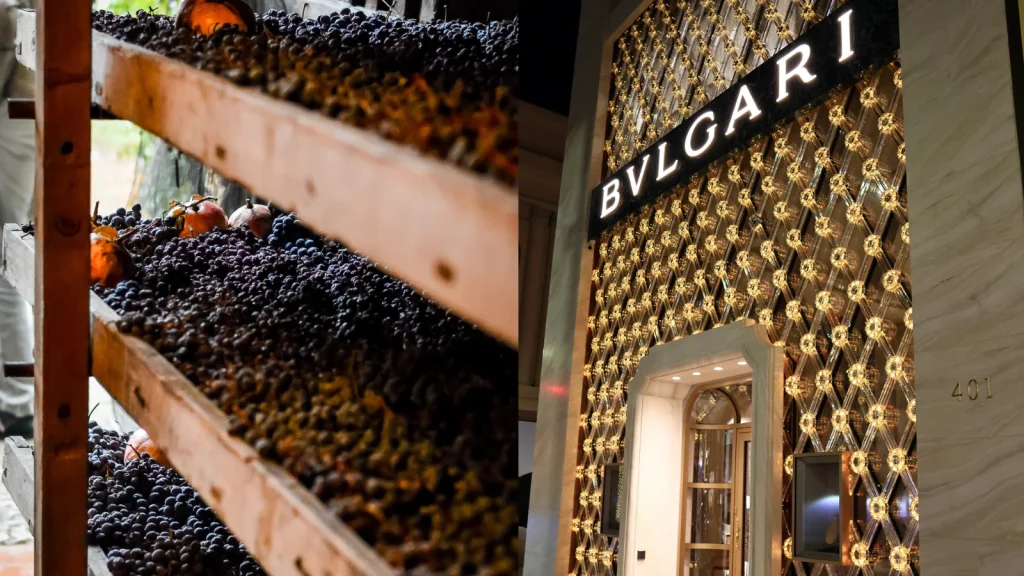
The instant that endures.
There is a moment in every serious blind tasting when the glass tells you something before you have found the words for it. The colour is too deep for Nebbiolo, too alive for Syrah. The nose arrives in layers — dried fig, dark cherry, a whisper of chocolate that dissolves into something almost medicinal, like a herb pressed between the pages of an old book. Then the palate, and the recognition: that particular balance of confited fruit and fresh lift, the alcohol that warms without burning, the sucrosità that never tips into sweetness. Amarone. There is nothing quite like it, and once you know it, you cannot unknow it.
My first was a Masi Campofiori. I was new to international wine then, still learning that the world of the vine was far larger and stranger than I had imagined, and that bottle was one of those early revelations that reorders your understanding of what fermentation can be. The technique behind it — appassimento, the controlled drying of harvested grapes for months before vinification even begins — is not a shortcut. It is a decision to remove water, to concentrate everything that remains, to make the wine wait for itself. The fruit loses up to thirty percent of its weight. What is left is essence.
I have thought about that process many times since completing my formal training in the wines of Valpolicella through the Wine Scholar Guild, where Andrea Eby walks you through the entire family — Valpolicella DOC, Ripasso, Amarone, Recioto — with the precision of someone who understands that these are not merely different wines but different philosophies about what a vine owes the people who tend it. The Recioto is the original, the sweet wine that came first. The Amarone — whose name derives from amaro, bitter, and whose existence was, according to legend, an accident of a Recioto left to ferment too long — is the one that stayed dry when it was meant to be sweet, and became something greater than what was planned.
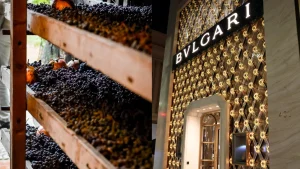
I am standing in Via Monte Napoleone, before a vitrine that contains things I will not pretend I can afford and several that I cannot stop looking at. The Bulgari boutique in Milan occupies a particular kind of space — not the hushed reverence of a museum, nor the aggressive brightness of a luxury department store, but something between the two, a room that has decided to take beauty seriously without making you feel unworthy of being in it. I have been in the London boutique and the one in Paris. Each has its own register. Milan feels most like a conversation.
The Serpenti bracelet, when you hold it, surprises you. Not with its weight — though the weight is real, and deliberate, the gold present in a way that reminds you that this is not a decorative object but a made thing — but with its movement. The scales shift against one another. The snake’s head turns. There is a logic to the articulation that you feel before you understand it, the way a well-made shoe tells the foot what to do before the mind has caught up. I have studied it on my wrist, the way it conforms to the curve, the way it claims the space without demanding attention. That is a very specific kind of confidence.
The Secret Garden necklace belongs to the Eclettica collection, Bulgari’s most recent high jewellery statement, and it is anchored — anchored is the right word, though it also somehow floats — by a padparadscha sapphire of 26.65 carats from Sri Lanka. Lucia Silvestri, Bulgari’s creative director of jewellery for more than three decades, pursued this stone for years before it was hers. “It was love at first sight,” she has said of it. “Its balance of pink and orange is simply extraordinary.”
Padparadscha is one of the rarest of sapphire varieties, and its name comes from the Sanskrit for lotus blossom — that precise, unrepeatable colour that sits at the border of pink and orange without being definitively either. The stone at the heart of the Secret Garden necklace is surrounded by onyx, diamonds, emeralds and purple sapphires, the whole composition evoking the coral-tinged warmth of an Italian courtyard garden at sunset.
I looked at photographs of it for a long time before I understood what I was seeing. The green in the composition is the green of a line of cypress trees along the boundary of a Tuscan estate — that particular dark, architectural green that exists nowhere else in quite the same way. The pink-orange of the padparadscha is the colour of a Tuscan sky at seven in the evening in late September, when the light has gone gold and the hills have gone soft and everything seems to be in the last moment before it changes. It is a garden at the precise instant when a garden is most itself.
The appassimento begins after harvest. The grapes — Corvina, Corvinone, Rondinella — are laid on bamboo racks or in wooden crates in lofts called fruttai, where the mountain air of the Valpolicella dries them slowly over three to four months. During this time they lose water and concentrate sugars, acids, and aromatic compounds. They are watched. They are managed. A fungus — Botrytis cinerea, the same noble rot that produces Sauternes — is sometimes permitted and sometimes discouraged, depending on the vintage and the intention. Nothing about this process is passive. The waiting is the work.
By January or February, the dried grapes are pressed. The fermentation that follows is slow and difficult — the yeasts struggle against the high sugar concentration — and can last for thirty to fifty days. The wine then ages for a minimum of two years in oak, four for the Riserva. It arrives in the glass carrying everything that was decided, year by year, hour by hour, in those drying lofts and those barrels.
Lucia Silvestri found her padparadscha and waited. She knew what she wanted to make from it, and she waited until the stone existed that could carry the weight of that intention. The necklace that resulted is not a design imposed upon a gemstone. It is a conversation between what the stone already was and what the jeweller knew it could become.
This is, I would argue, the same conversation that happens in a fruttaio in Valpolicella every autumn. The fruit arrives from the vine carrying what the vintage gave it. The producer decides how long, at what temperature, with what airflow, the drying will proceed. The wine that results is not extracted from the grape. It is drawn out of it, slowly, by someone who knows what they are waiting for.
In true luxury, what appears to be waiting is the work. The Amarone does not apologise for the time it requires. The Secret Garden does not explain the years it took to find its centre. Both arrive already knowing what they are, because someone, somewhere, was patient enough to let them become it.