Every crisis needs a culprit. The wine world seems to have found its own: young people.
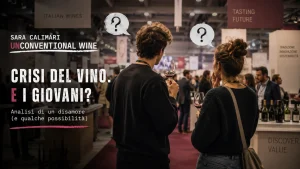
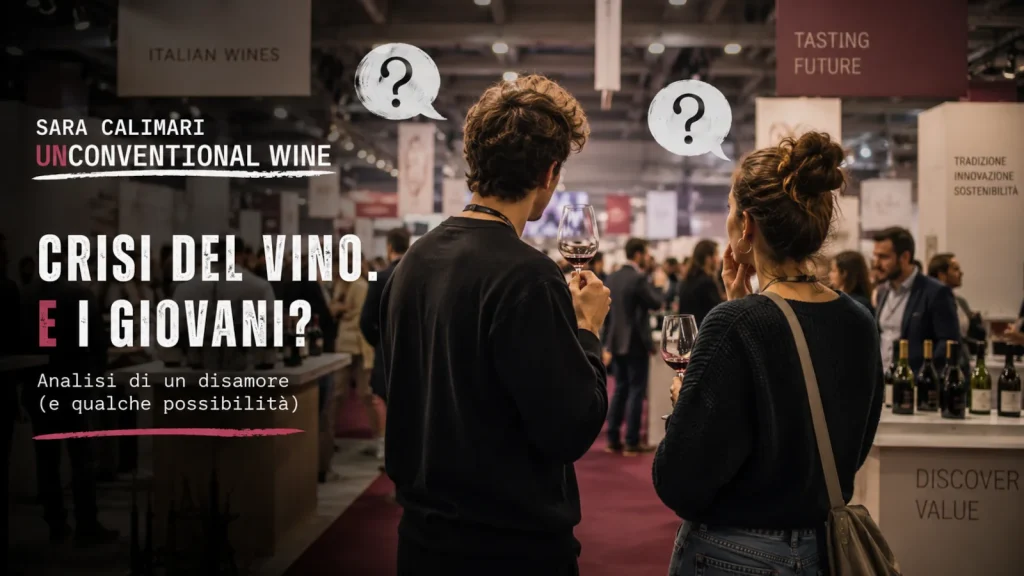
“Generation Z doesn’t drink.”
“People in their twenties prefer cocktails.”
“They have no wine culture.”
It is a simple explanation—perhaps too simple—but it has one major advantage: it shifts the focus away from the industry itself. If young people are the problem, then wine doesn’t need to change; they simply need to learn how to appreciate it.
Yet every market undergoing transformation should also question itself, not just its consumers.
Because the numbers tell a different story.
According to the latest UIV–Vinitaly Observatory, the number of Italian wine consumers has remained broadly stable in recent years, standing at around 30 million people.
The real change is not how many people drink wine, but how they drink it. It is primarily older generations that have reduced both the frequency and the quantity of their consumption, while younger consumers show curiosity, a willingness to pay for quality experiences, and a preference for drinking wine outside the home. In fact, the report effectively clears younger generations of being responsible for the decline in wine consumption.
And perhaps this is where we should stop and reflect.
Did we really drink wine when we were twenty?
It is worth making a small effort to remember. Those who are now in their fifties or sixties—did they really order a bottle of Barolo, Brunello or Chianti Classico when they went out with friends at the age of twenty? Probably not. Most of us spent our evenings in pubs, clubs and bars where industrial beers, vodka lemon, Cuba Libre, gin and tonic and cocktails of what we would now consider questionable quality flowed freely.
Expecting today’s twenty-year-olds to possess a wine culture that previous generations did not have at the same age is a fundamentally unfair comparison. The mistake lies in comparing two different stages of life rather than two different generations.
A twenty-year-old in 1985, 1995 or 2025 has far more in common than we might imagine: they go out with friends, have limited financial resources, like to experiment and seek carefree experiences. Wine almost always comes later, alongside work, greater financial stability and a desire to deepen one’s knowledge. That is exactly what happened with previous generations. Why should today be any different?
Expecting wine to be the first choice at the age of twenty means forgetting that, in all likelihood, it never really was.
In fact, part of the younger generation is showing genuine interest in forms of wine consumption that differ from the traditional ones. Just look at the success of urban wine bars, natural wines, orange wines, artisanal sparkling wines and experience-driven tastings. This does not prove that young people are drinking more wine, but rather that their relationship with wine is expressed through different languages and different experiences.
They may not drink wine in the same way their parents did, but that does not mean they are not interested.
Perhaps, then, the real question should be a different one: what if it is actually the generations that built today’s wine market that are now drinking less, as recent studies suggest?
I am referring to the generations with the greatest purchasing power—the ones who developed a wine culture, filled restaurant wine lists for decades and contributed to the success of Italy’s great appellations. They are also the same generations that are now facing high inflation, a rising cost of living and growing economic uncertainty affecting both households and businesses.
Over the past few years, energy costs, mortgages, fuel, raw materials, transport, services and restaurant prices have all increased. Wine does not exist outside the economy.
Even beyond Italy’s borders, the picture remains much the same. For more than twenty years, exports have been one of the main engines of growth for Italian wine, absorbing an ever-increasing level of production. Today, however, even this driver is showing signs of slowing down. According to the Italian Wine Union Wine Observatory, Italian wine exports closed 2025 at €7.78 billion, down 3.7% in value and 1.9% in volume compared with the previous year. The slowdown affected several of Italy’s key export markets and, during the first four months of 2026, the trend continued, with exports declining by a further 6.8% in value and 3.7% in volume. Among the reasons identified by UIV are the slowdown of the global economy, growing trade tensions, tariffs affecting the US market, the depreciation of the US dollar and a more cautious international demand.
Of course, it would be simplistic to believe that economics alone explains everything that is happening. For some time now, the debate surrounding the wine crisis has also focused on another issue: increasing attention to health and the reduction of alcohol consumption. But are we really sure this is the main explanation?
If health concerns were truly the driving force, we would expect to see a slowdown across the entire beverage sector. Instead, the opposite is happening. Mixology is thriving, premium cocktails continue to grow, artisanal spirits are gaining popularity and increasingly specialised bars are opening. This may well be the greatest paradox of the current market.
The issue is not that people no longer want to drink. They are simply choosing experiences that they perceive as more contemporary. And that is, without doubt, an uncomfortable question for the wine industry—not for consumers.
Wine is not losing quality. It is losing relevance.
Not on retail shelves, but in people’s everyday lives. Perhaps because, in the way we communicate wine, we have gradually allowed technical details to take precedence over conviviality, turning wine into something to be explained rather than something to be shared.
The industry must recognise that wine no longer competes only with other wines. It competes with people’s leisure time—with cocktails, craft beer, gourmet pizza, concerts, weekend escapes and travel. All of these experiences compete for the same disposable income while promising memorable emotions.
This is where the industry should ask itself a difficult question: Does wine still occupy a central place in people’s lives, or are we still trying to tell its story using the language of twenty years ago?
There is, however, another issue that receives far less attention: the perception of value.
In recent years, many wineries have progressively repositioned themselves towards higher price segments. A strategy often justified by the genuine increase in production costs: glass, energy, cardboard packaging, transport, corks and labour.
All of this is true. Ultimately, however, it is the consumer who decides whether the asking price matches the value they perceive. Price can enhance the prestige of a wine, but it cannot replace it. When perceived value fails to grow alongside price, the market eventually delivers its verdict. The problem arises when consumers begin to perceive too wide a gap between price and value—and this gap becomes particularly evident in the restaurant sector.
Today, anyone can check the retail price of a bottle online within seconds. When that very same bottle appears on a restaurant wine list with a markup four or five times higher, customers do not simply think that wine has become expensive—they begin to wonder whether the price is truly justified.
This is not about wanting to spend less; it is about trust. Continuing to behave as if customers will not notice means underestimating them.
Interestingly, the new FIPE–UIV Observatory offers valuable insights precisely on this issue.
Wine sales in the Italian restaurant industry are worth approximately €12 billion per year, yet both volumes and overall spending have declined in recent years. More than half of restaurant wine lists are updated less than once a year, while in many establishments wine training remains inadequate, relying largely on informal advice from sales representatives and distributors. Restaurateurs themselves identify declining demand as one of their main challenges and acknowledge the need to invest more in staff training, communication and closer collaboration with producers.
Perhaps what restaurants need is not longer wine lists, but smarter ones—clearer, more dynamic and, above all, more honest. Yet there is an even more important question.
Over the past twenty years, we have invested enormous resources in improving the quality of wine. But have we invested with the same determination in improving the way we tell its story?
We continue to talk about vineyard hectares, vineyard exposure, ageing techniques, scores and medals. All of this information is accurate—but are we certain these are the factors that truly make someone choose a bottle?
For years, we believed that producing better wines would be enough. Today, we must also learn how to make them more desirable.
Meanwhile, another challenge continues to grow: wineries are holding increasingly large inventories while demand slows.
This is the consequence of a system built during years when continuous market growth was almost taken for granted. But no market grows forever. For decades, the industry invested in increasing production. Today, it must invest with the same determination in creating new consumption opportunities, because a bottle remains unsold not only when too much wine has been produced, but also when it fails to find its consumer.
Further complicating the picture is climate change. Producers are investing more and more to cope with drought, extreme weather events, emerging vine diseases and increasingly unpredictable harvests. Sustainability has become a production necessity long before it became a marketing slogan.
But sustainability can no longer be viewed solely from an environmental perspective. It must also be economically sustainable.
Producing great wine is no longer enough. The industry must create the conditions for that wine to be chosen, purchased and enjoyed. A bottle that remains in the cellar is not merely a financial cost—it is also evidence that sustainability has broken down somewhere along the value chain.
For years we have asked ourselves how to convince young people to drink wine. Perhaps it is time to start asking different questions.
How can we make wine desirable again?
How can we tell its story without speaking only to insiders?
How can we rebuild trust between producers, distributors, restaurateurs and consumers?
Continuing to blame people in their twenties risks becoming the perfect excuse. Far more difficult is looking within the industry itself and asking whether, over the past few years, we have stopped listening to the market.
Are we still capable of making people fall in love with wine?
No one falls in love with a production regulation, a score or a medal.
People fall in love with a story, a producer, a place and a shared table.
Italian wine became great when it was part of people’s everyday lives, long before it became a symbol of prestige.
Perhaps the wine crisis is not twenty years old.
Perhaps it is as old as an industry that, while searching for new consumers, forgot to ask itself whether it was still capable of inspiring the ones it already had.
Key Sources and References:
- UIV – Vinitaly Observatory 2026 Wine Consumers in Italy: A Stable Audience and Generational Preferences An analysis of wine consumption habits across different generations. The report highlights that the decline in wine consumption cannot be attributed solely to younger consumers, but is also linked to the reduced drinking frequency among older generations. Italian Wine Union – Consumer Report 2026
- FIPE – UIV Observatory “Wine & Hospitality”The first Italian observatory dedicated to the relationship between wine and the restaurant industry. It includes data on:
- the value of wine sales in the Italian restaurant sector (€12 billion annually);
- declining spending and consumption volumes;
- staff training;
- wine list updates;
- the evolution of out-of-home wine consumption. FIPE – Wine & Hospitality Observatory 2026
- Italian Wine Union – Vinitaly 2026 Consumption, Markets and Emerging Trends A comprehensive analysis of the Italian wine industry’s economic outlook presented during Vinitaly 2026, including insights into exports, domestic consumption and new market trends. UIV – Consumption, Markets and Emerging Trends 2026
- Italian Wine Union2025 Harvest Stable, but Inventories Continue to Rise
A key document for understanding the issues of overproduction and increasing wine stocks in Italian wineries. It provides data on inventories, yields and the need to rebalance the production system.
UIV – 2025 Harvest and Rising Wine Stocks - International Organisation of Vine and Wine (OIV)State of the World Wine Sector 2025
A global report on the wine industry analysing the combined impact of:
- climate change;
- declining wine consumption;
- economic pressure on consumers;
- international trade;
- changing consumption patterns. OIV – State of the World Wine Sector 2025
- ANSA Economy UIV Warns: Wine Stocks Reaching Critical Levels An article reporting the figures released by the UIV Observatory on record wine inventories and the market challenges recorded in 2026. ANSA – Record Wine Stocks in Italian Wineries
- MASAF – Ministry of Agriculture, Food Sovereignty and ForestryOfficial archive containing national data on:
- wine production;
- wine and must inventories;
- Italy’s vineyard surface area. MASAF – Official Data on the Italian Wine Sector
- Wine Observatory – Italian Wine Union Italian Wine ExportsUIV – Italian Wine Exports Decline in 2025UIV – Italian Wine Exports: First Four Months of 2026 Down 6.8%