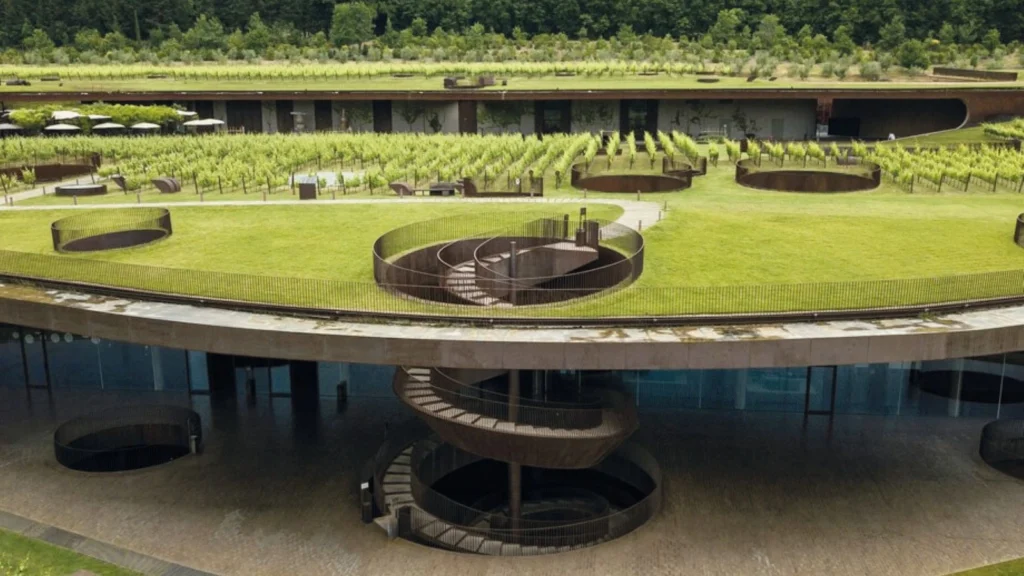
To call it a winery is a useful simplification, one that identifies its primary purpose, yet in reality its role extends into other realms, both in terms of winemaking and in the symbolic expression of a genius loci shaped over more than six centuries of family and Florentine history. Antinori’s winery in Chianti Classico is a dream brought to life and inaugurated in 2012, after seven years of construction, by Marchese Piero Antinori — a key figure in the so-called Renaissance of Italian wine, the man behind Super Tuscans such as Tignanello and Solaia, and recently named a Maestro dell’Arte della Cucina Italiana — together with his family. They brought to completion this monumental architectural project, which “symbolically represents the synthesis of six centuries of family tradition and a constant drive towards innovation, embodying a ‘bridge’ reaching out to future generations.”
A return to the countryside
Until the inauguration of this masterpiece of contemporary architecture, the nerve centre and driving force of the wine business was the family’s Florentine palazzo, a paradigm of Renaissance architecture built between 1461 and 1469 by Giuliano da Maiano and purchased by the Antinori family in 1506. Located in Piazza Antinori, at the very beginning of Via Tornabuoni, this historic building was also the company’s headquarters for more than 500 years. Today Marchese Piero, together with his daughters Albiera, Allegra and Alessia and their children, some of whom are already involved in the business, has restored the ancient palazzo to its primary role as the family’s historic residence.
A bold, forward-looking architecture
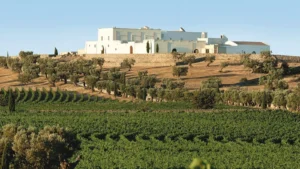
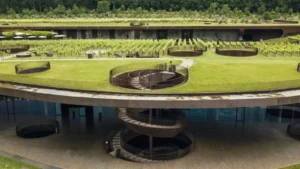
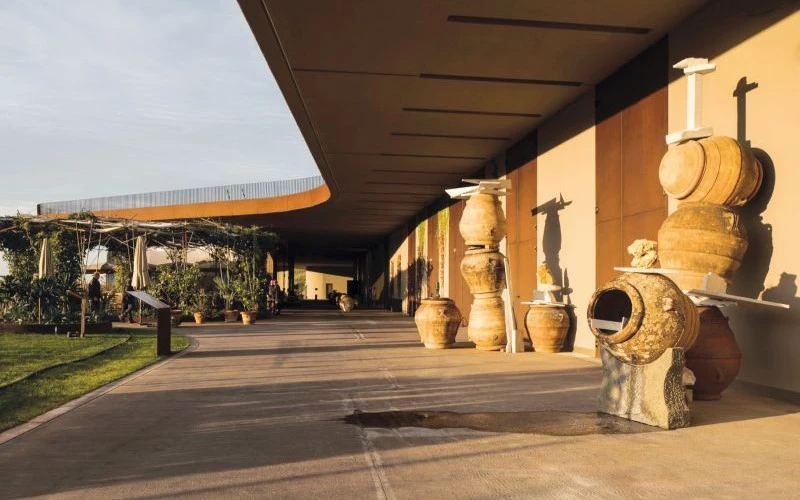
Covering approximately 49,000 square metres within a 12-hectare site, the winery was designed by Archea Associati to blend into the hillside. It extends some 22 metres underground, while its visible façade stretches for 170 metres and rises just 7.5 metres. It is located in Bargino, a hamlet in the municipality of San Casciano in Val di Pesa, in the province of Florence, and from the outside its structure appears remarkably unobtrusive, entirely in harmony with the hill that accommodates it. Only two long horizontal openings in the landscape are visible, together with a roof planted with vines and a car park that becomes a panoramic viewpoint over Chianti Classico, offering a serene glimpse of this remarkable wine-growing territory. The only truly prominent feature is a helical connecting staircase that seems to embrace the visible exterior of the winery, although most of the complex lies underground.
At first sight, the interior evokes the aesthetic language of contemporary architectural design. A broad, dramatic spiral staircase links the different levels of the winery, connecting the rooftop terrace with the subterranean depths of the building.
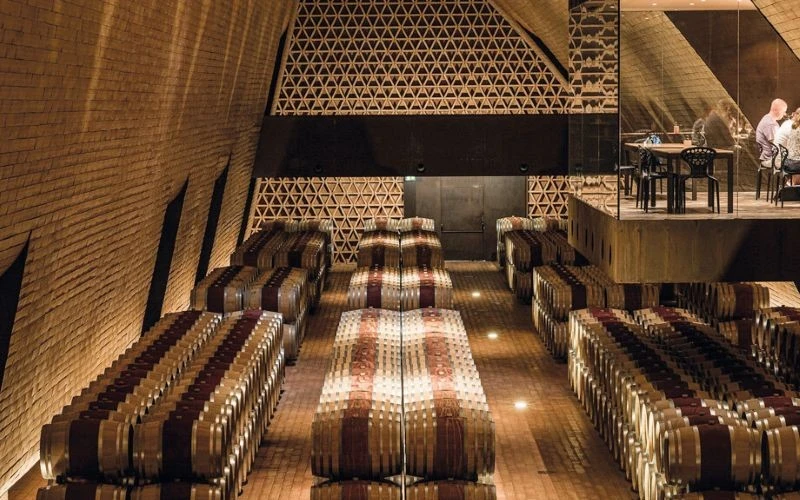
The barrel cellar, where the wines are aged and which forms the beating heart of the winery, instead evokes the architectural language of a Renaissance cathedral, with its vast spaces and soaring barrel vaults. The space was designed to allow winemaking by gravity while ensuring optimal conditions for preserving the wine, combining aesthetic ambition with production requirements. The choice of construction materials reflects the identity of the territory, beginning with the generous use of terracotta and wood, which interact with Corten steel and its striking burnished finish.
Yet while the “cathedral” conveys an atmosphere of quiet, almost sacred fascination, the mood throughout the rest of the building is quite different, enlivened by abundant natural light filtering through the large glazed surfaces that illuminate both the office areas and those devoted to hospitality.
Antinori Art Project
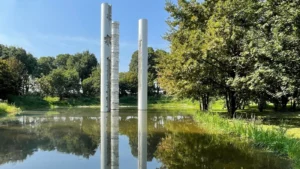
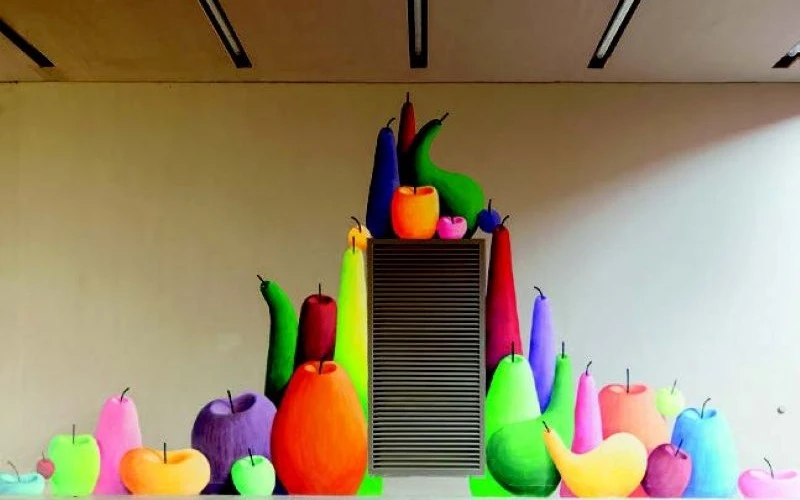
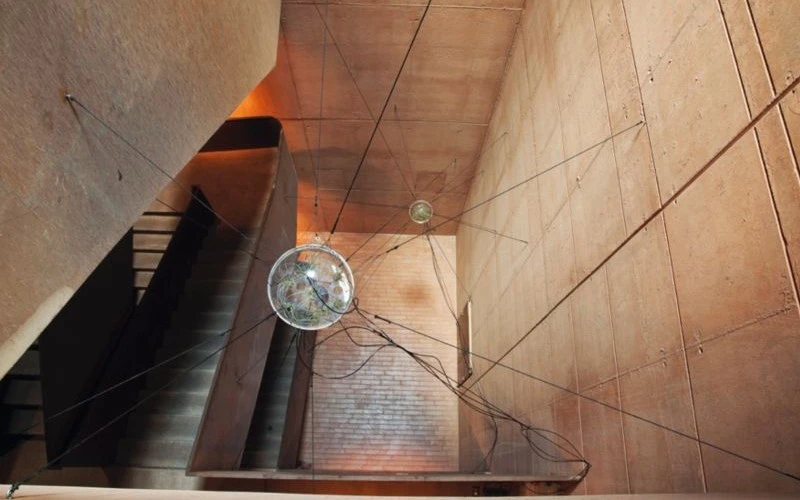
Further testimony to the family’s close relationship with art came in 2012, when the opening of the winery coincided with the creation of the “Antinori Art Project”, a contemporary art platform overseen by young, talented curators. Internationally renowned artists have been invited to create works that are subsequently installed both inside and outside the winery, forming an ever-expanding permanent exhibition.
These site-specific works include pieces by artists deeply engaged with contemporary themes, such as Sam Falls and Yona Friedman, as well as artists with a more distinctly painterly background, including Stefano Arienti, whose high-relief work can be admired in a symbolic connection — a kind of uninterrupted dialogue — with Giovanni della Robbia’s celebrated Resurrection of Christ.
There is also a space that seems intended to emphasise the identity, continuity and tradition of the Antinori family: a museum area that traces and recounts its history through antique paintings and other works, including Della Robbia ceramics.
An immersive visit
A visit to the Antinori winery in Chianti Classico offers a journey through its subterranean architecture and an exploration of its winemaking activities, concluding with a tasting of wines representing the Antinori estates. Visitors can also access the Auditorium, a space designed for events, conferences and meetings, as well as the museum area and production facilities.
Dining and hospitality
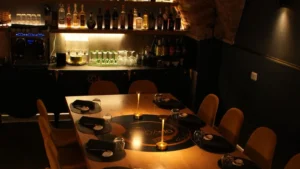
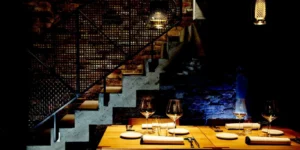
The restaurant fully lives up to the stature of such an exceptional setting. Rinuccio 1180 welcomes guests in a covered section of the terrace. Its name refers to the ancestor of the family, Rinuccio degli Antinori, who lived in the 12th century and was already involved in viticulture at Castello di Cambiate before moving to Florence.
The kitchen team offers dishes rooted in the local territory, reinterpreted in a contemporary style and following the path of a renewed tradition. Large windows allow guests to dine while overlooking the landscape of Chianti Classico. Wines from the Antinori estates accompany an experience deeply imbued with the flavours and identity of Tuscany.
Via Cassia per Siena, 133 – località Bargino, San Casciano Val di Pesa (FI)
tel. 055 2359700 – visite@antinorichianticlassico.it – www.antinorichianticlassico.it